Why a 3ct Emerald Cut Diamond Looks Bigger Than Other Shapes
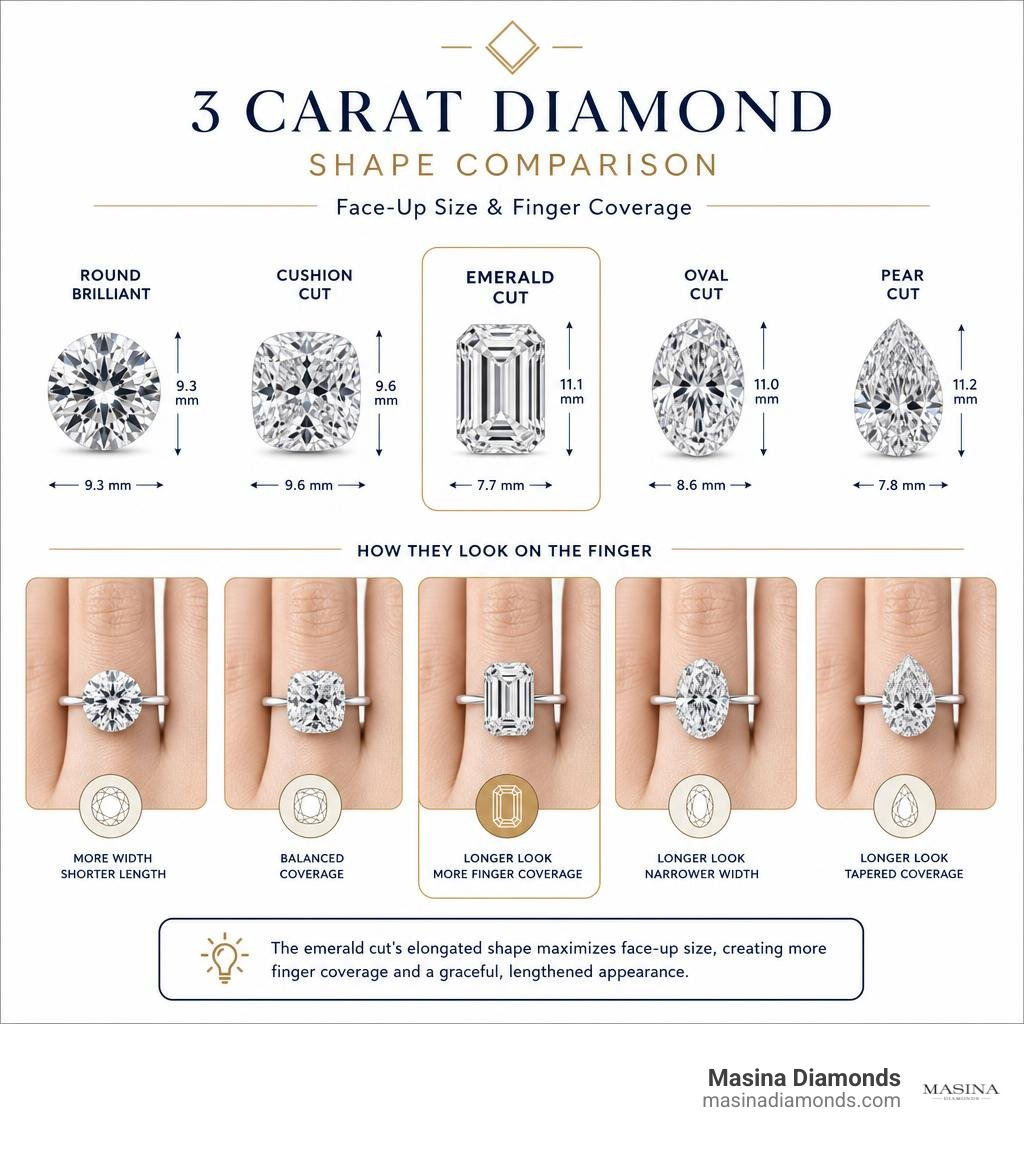
Why a 3ct Emerald Cut Diamond Can Look Larger
A 3ct emerald cut can look larger than many other 3-carat shapes because its long, rectangular face spreads more of its weight across the top of the stone. Its clean outline also lengthens the look of the finger. For the best visual size, choose an appealing length-to-width ratio, strong symmetry, and a stone without dark areas or a see-through center.
Unlike a round diamond, an emerald cut uses broad, parallel step facets rather than many small brilliant facets. This creates crisp flashes of light and a refined "hall of mirrors" look instead of intense sparkle. Its large open table also makes color, clarity, and cut precision especially important.
A well-chosen 3-carat emerald cut offers bold finger coverage with a quiet, architectural elegance. It is a popular choice for buyers who want a substantial center stone that feels timeless rather than flashy.
Masina Diamonds has served Atlanta engagement-ring clients for more than 40 years, with expertise in custom jewelry and diamond selection. We help clients compare every important detail of a 3ct emerald cut, from its face-up size and clarity to the setting that best protects and showcases it.
How the Emerald Cut Maximizes Size and Elegance
When evaluating diamond shapes, carat weight only tells part of the story. Carat is a measure of weight, not physical dimensions. Two diamonds of identical weight can have drastically different visual footprints based entirely on how their mass is distributed.
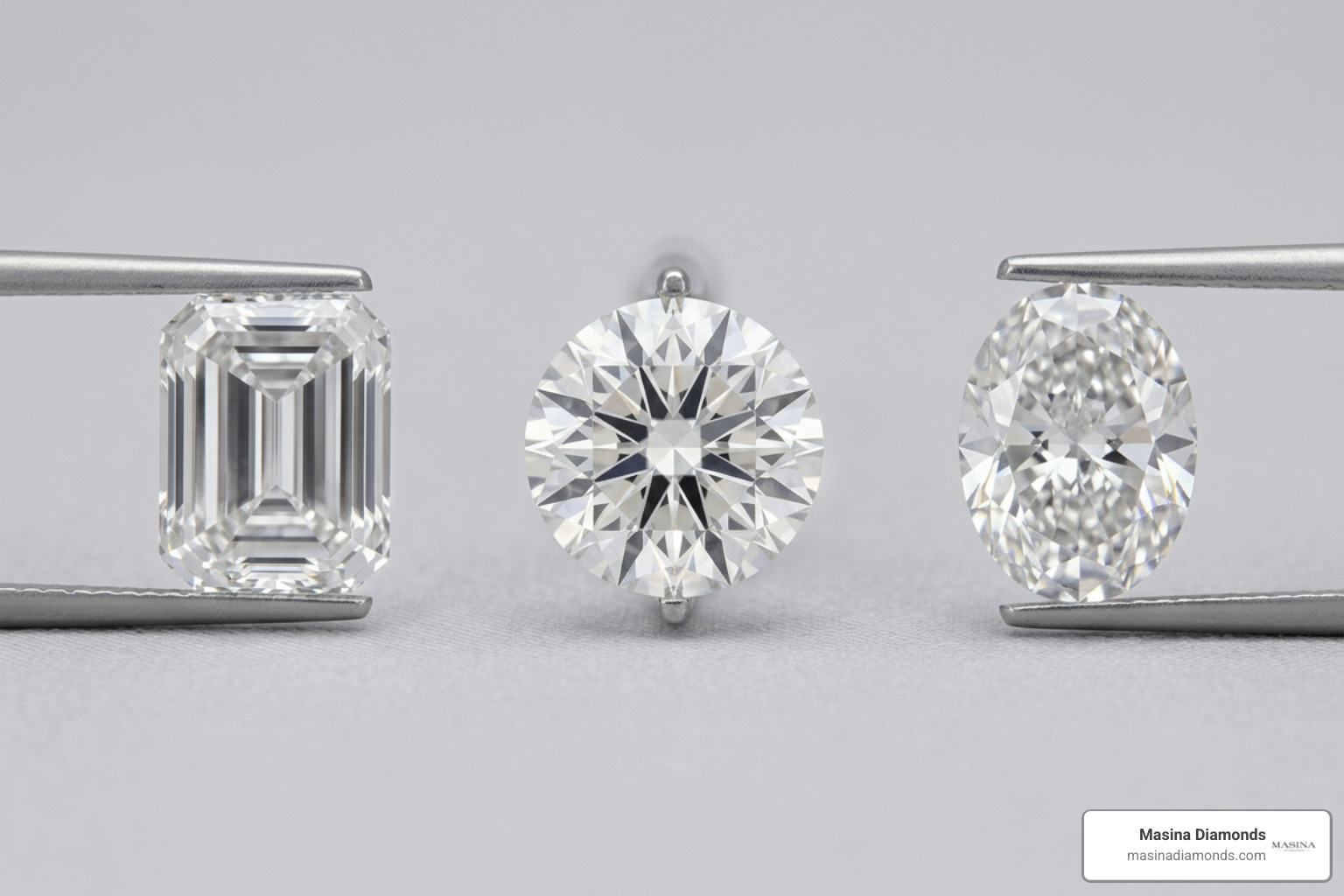
The emerald cut is celebrated for its ability to look larger than its carat weight suggests. Its geometric outline creates an expansive top surface, giving you outstanding visual impact on the hand. While round brilliant cuts hide a significant portion of their weight beneath the girdle in a deep, cone-shaped pavilion, an emerald cut features a shallower pavilion and a broad, open table.
Originating during the Art Deco era of the 1920s, the emerald cut's clean, straight lines and clipped corners evoke architectural balance and sophisticated restraint. Rather than dispersing light into hundreds of tiny sparkles, its broad facets present clean planes of reflection that draw the eye along its entire length.
| Diamond Shape (3.00 Carat) | Typical Dimensions (mm) | Approximate Surface Area (mm²) | Visual Spread Index |
|---|---|---|---|
| Emerald Cut | 9.80 x 7.00 mm | ~68.6 mm² | High (Elongated) |
| Round Brilliant | 9.35 x 9.35 mm | ~68.6 mm² | Moderate (Equilateral) |
| Oval Cut | 11.50 x 7.75 mm | ~69.8 mm² | Very High |
| Cushion Cut | 8.60 x 8.60 mm | ~64.5 mm² | Low to Moderate |
| Princess Cut | 8.10 x 8.10 mm | ~65.6 mm² | Moderate |
| Asscher Cut | 8.20 x 8.20 mm | ~67.2 mm² | Moderate |
Finger Coverage and Surface Area of a 3ct Emerald Cut
Finger coverage refers to the percentage of the finger's width occupied by the center stone. Because of its elongated rectangle silhouette, a 3-carat emerald cut spans a larger vertical plane along the finger than equilateral cuts like rounds, princesses, or Asschers.
A natural stone like our 3.01 Carat Emerald Diamond often measures around 9.8 mm to nearly 10 mm in length. This long profile creates an optical illusion that slims and lengthens the wearer's hand. When paired with an optimal length-to-width ratio, the stone achieves an expansive face-up presence that makes it appear far larger than deeper-cut diamonds of identical weight.
The Step-Cut Hall of Mirrors Effect
Unlike brilliant cuts designed with triangular and kite-shaped facets to scatter light into tiny pinpricks of sparkle, an emerald cut is a step cut. It features rectilinear, parallel facets arranged down the crown and pavilion like steps on a staircase.

This geometry produces the famous "hall of mirrors" effect. As the stone moves, its long facets catch ambient light and return dramatic flashes of white light (scintillation) paired with bold spectral colors (fire). The result is a clean, glass-like transparency that emphasizes purity, clarity, and structural balance rather than dizzying shimmer.
Proportions and Quality Specifications for a 3ct Emerald Cut
Unlike round diamonds, laboratory grading agencies like the GIA do not assign an overall "Cut Grade" to fancy shapes like the emerald cut. This makes understanding key proportions essential to selecting a stone with great life and light performance.
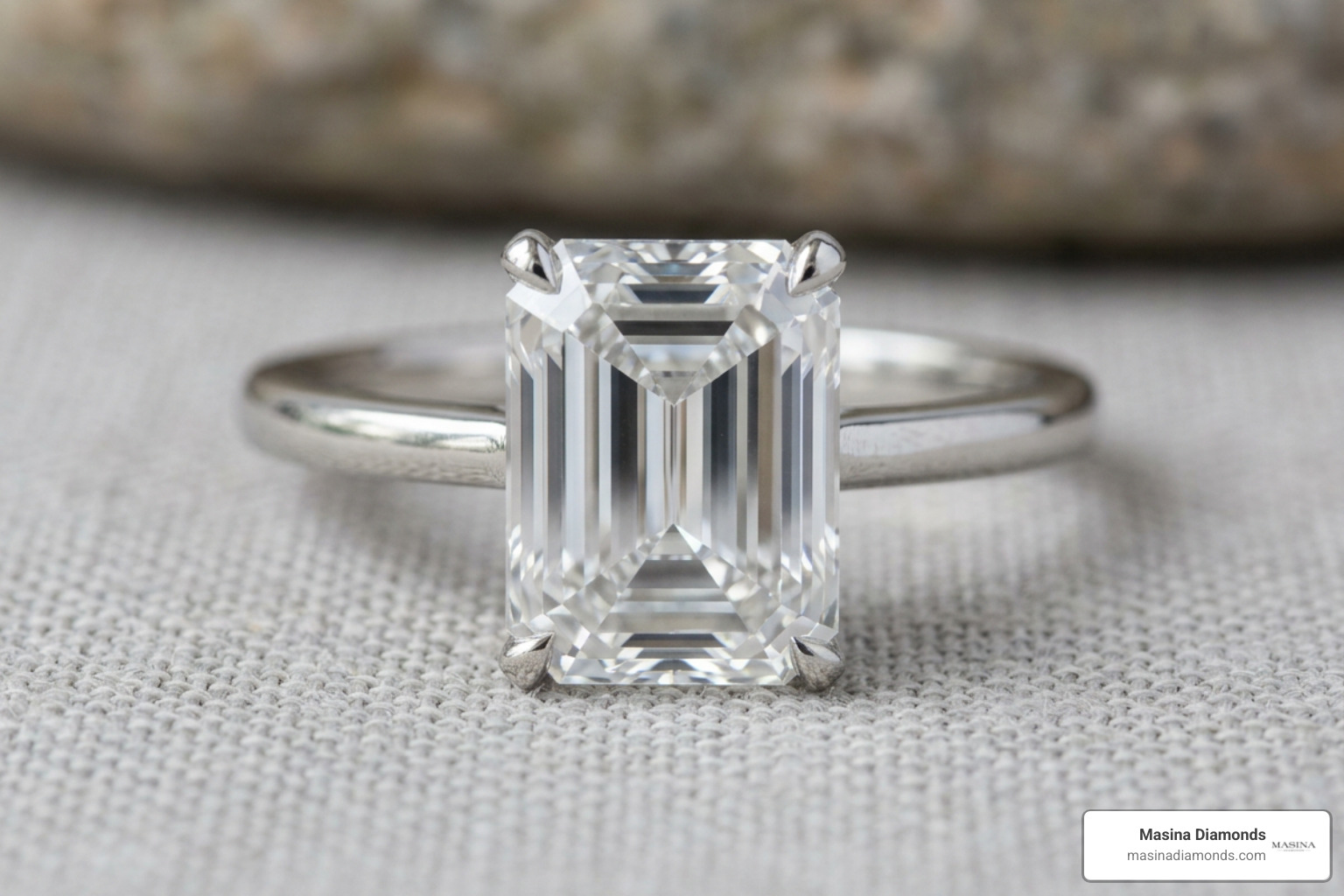
To maximize face-up spread while preventing dull, dark zones, look for these ideal cut parameters:
- Total Depth Percentage: 60% to 68% (Ideal: 62%–66%). A depth above 70% hides weight in the base, making the stone look small, while a depth below 58% leads to washed-out transparency.
- Table Percentage: 60% to 69% (Ideal: 61%–67%). A balanced table allows optimal light entry without exaggerating the open window.
- Length-to-Width Ratio (L/W): 1.35 to 1.55 (Classic benchmark: 1.40 to 1.45).
- Polish & Symmetry: Excellent or Very Good. Precise alignment of parallel facets ensures uniform light return from corner to corner.
- Girdle Thickness: Very Thin to Slightly Thick. Avoid extremely thick girdles that trap dead weight.
Clarity and Color Standards
Because of its expansive, transparent table facet, an emerald cut has no brilliant facet pattern to camouflage internal inclusions. Blemishes, clouds, or crystals near the center of the stone are visible to the naked eye at lower clarity grades.
For a 3-carat emerald diamond, a minimum clarity grade of VS2 is the recommended threshold, while VS1 provides complete peace of mind for guaranteed eye-clean beauty. If you choose an SI1 stone, inspect the diamond under magnification to ensure the inclusion is faint, white, and positioned near the step edges or corners where the setting prongs can obscure it.
When it comes to color, step cuts show body color more readily than brilliant shapes. In a 3-carat stone, we generally recommend choosing an H color or higher (D through G for pure icy white) if set in platinum or white gold. If you prefer yellow gold or rose gold, an I or J color stone will still appear bright white because the warm metal complements the diamond's natural tone. Our team regularly assists clients in finding the perfect balance of color and clarity when selecting Emerald Cut Engagement Rings in Atlanta.
Natural vs Lab-Grown 3ct Emerald Cut Diamonds
Lab-grown diamonds share the identical chemical, optical, and physical properties of natural mined diamonds. Both are composed of pure crystallized carbon graded under the exact same 4Cs criteria.
The primary difference lies in rarity and cost. A lab-grown diamond allows you to maximize your budget, enabling you to step up in carat weight, choose a completely colorless D-F stone, or secure a flawless VVS clarity grade. For example, a premier lab stone like our 3.27 Carat Emerald Lab Grown Diamond delivers exceptional size and pristine step-cut purity at a fraction of the investment required for an equivalent earth-mined gem.
To explore options across both categories, our specialists can guide you through certified mined and Lab Grown Diamonds in Atlanta, GA to suit your personal style and budget goals.
Best Engagement Ring Settings for a 3 Carat Emerald Diamond
A 3-carat emerald diamond requires a setting that balances aesthetic refinement with structural security. The beveled corners of an emerald cut are designed to eliminate fragile points, but they still need thoughtful mounting to guard against accidental impacts.
When browsing our Emerald Engagement Rings Collection, you will find several popular styles tailored to this shape:
Solitaire and Bezel Settings
A classic four-prong solitaire highlights the clean silhouette of a 3ct emerald cut diamond without visual distraction. Claw prongs or double-claw prongs are especially popular, adding an Art Deco look while securely grasping each beveled corner.
For modern elegance and maximum protection, a full or half bezel setting encases the diamond's entire perimeter in a thin rim of precious metal. Our 5.08ct Emerald Diamond Bezel Set Engagement Ring demonstrates how a bezel frame accentuates the geometric lines of a large emerald cut while keeping the stone snag-free and safe for daily wear.
Side Stones and Matching Bands
Three-stone engagement ring designs are a timeless pairing for emerald cuts. Flanking a 3-carat center stone with tapered baguettes, trapezoids, or Cadillac side diamonds creates a graceful stair-step transition down to the band.
To elevate the overall brilliance, pairing your ring with distinctive bands creates a balanced contrast. You can combine step and brilliant cuts using our Emerald Cut Engagement Ring with Radiant Diamond Band or build a cohesive look with pieces from our curated Emerald Cut Wedding Bands.
Common Buying Pitfalls to Avoid
When shopping for a 3-carat emerald diamond, look closely at the diamond in motion rather than relying solely on the grading report. Watch out for these common issues:
- Windowing: If the pavilion is cut too shallow, light passes straight through the diamond rather than bouncing back to your eyes. This creates a "see-through" window where you can read text through the center of the stone.
- Extinction Zones: Overly deep cuts cause large portions of the stone to turn dark or completely black when viewed from above, diminishing its brightness.
- Disproportionate Length-to-Width Ratios: Stones cut below 1.30 can appear squat or chunky, while stones above 1.60 may look narrow and fragile. Aim for the classic 1.35 to 1.50 range for balanced finger coverage.
- Corner Asymmetry: Uneven corner facet cuts disrupt the stone's clean rectangular profile and make secure prong setting difficult.
Our master jewelers design Custom Engagement Rings built around the exact millimeter specifications of your chosen gem. If you are searching for exceptional Diamond Engagement Rings in Atlanta, working with an experienced jeweler ensures you avoid these cut flaws.
Frequently Asked Questions About 3 Carat Emerald Diamonds
Does a 3 carat emerald diamond look larger than a 3 carat round?
Yes, in terms of length and finger coverage, an emerald cut diamond typically looks larger than a round brilliant of the same weight. A 3-carat round brilliant measures roughly 9.35 mm across, while an average 3-carat emerald cut spans nearly 10 mm in length. Its elongated shape spans more vertical surface on the finger, giving it a commanding visual presence.
What is the ideal length-to-width ratio for an emerald cut?
The classic and widely preferred length-to-width ratio for an emerald cut diamond is between 1.35 and 1.50. A ratio around 1.40 delivers the traditional rectangular proportions. Ratios below 1.30 approach a squarish shape, while ratios above 1.55 produce a distinctly elongated, slender aesthetic.
What clarity grade is recommended for a 3 carat stone?
Because emerald cuts feature large, open tables with step faceting, inclusions are much easier to see. For a 3-carat stone, we recommend selecting VS2 or VS1 clarity to guarantee that the diamond is 100% eye-clean without visible crystals, feathers, or clouds disrupting its mirror reflections.
Conclusion
A 3-carat emerald cut diamond delivers an unmistakable blend of architectural symmetry, bold finger coverage, and vintage sophistication. By prioritizing cut quality, selecting an eye-clean clarity grade, and framing the stone in a complementary setting, you create a timeless engagement ring that stands out in any room.
At Masina Diamonds, our family has spent over four decades helping clients select exceptional diamonds and craft bespoke settings. Whether you want to view loose diamonds in person or design your dream ring from scratch using our interactive 3D Ring Builder, our master artisans are here to guide you through every step.
To learn more about how cut, shape, and gem structure influence your ring design, explore our detailed guide to ring stone types exploring your options.