What You Need to Know About a 0.75 Carat Diamond
A 0.75 carat diamond sits in a sweet spot for engagement rings — large enough to make a statement, without the premium price tag of a full 1 carat stone. Here's a quick snapshot of what you're working with:
| Feature | Detail |
|---|---|
| Carat weight | 0.75 ct (75 points, 0.15 grams) |
| Round diameter | ~5.8 mm across |
| Face-up area | ~26.6 mm² |
| Shapes available | Round, Oval, Pear, Marquise, Princess, and more |
| Best color grade | J+ (white gold/platinum), K+ (yellow gold) |
| Best clarity grade | SI1–SI2 (eye-clean) |
| Recommended cut | Excellent (GIA) or Ideal (AGS) |
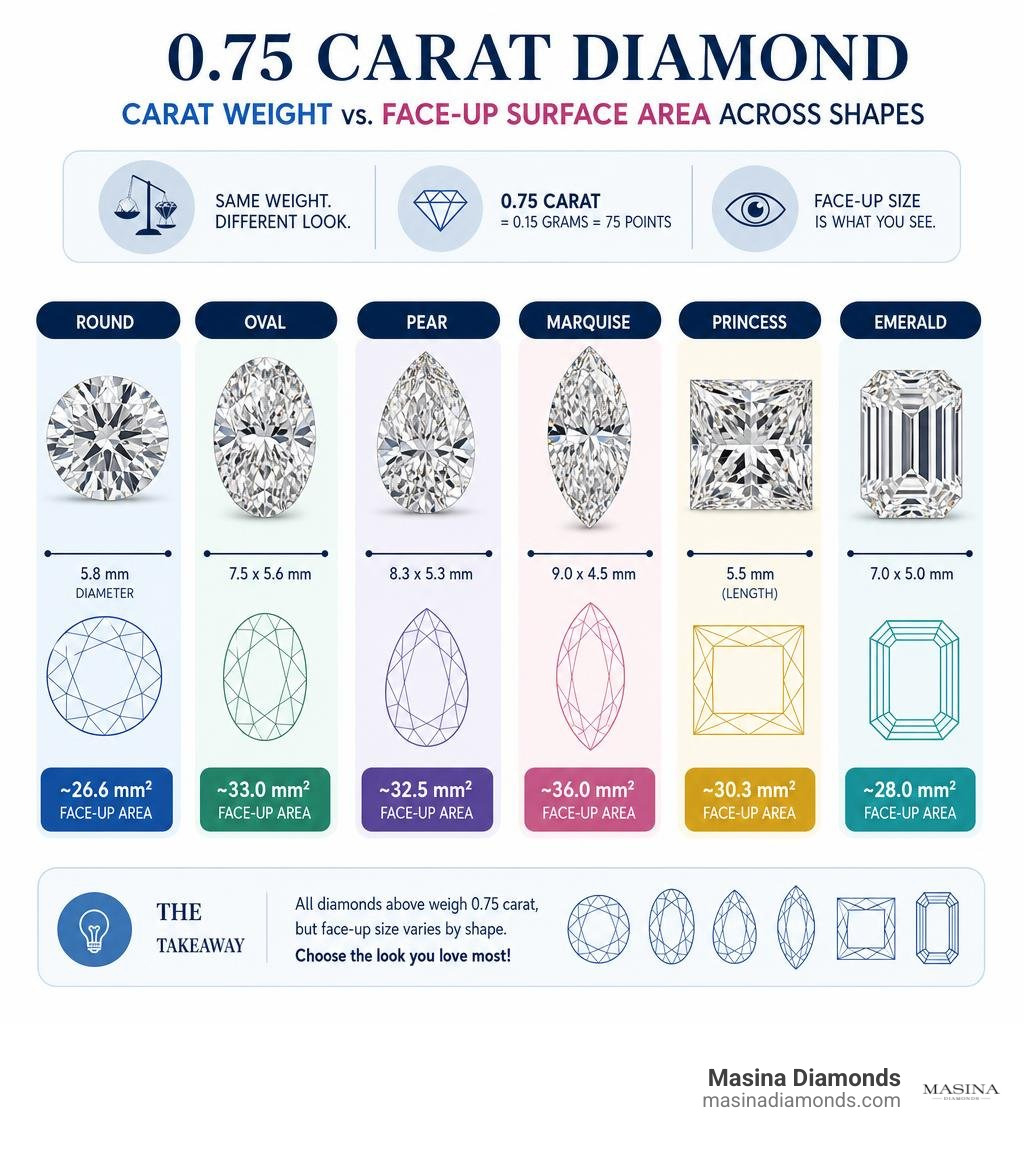
The size you see depends heavily on shape and cut quality — not just carat weight alone. A 0.75 ct marquise, for example, stretches nearly 9 mm long, while a 0.75 ct round measures about 5.8 mm across. Same weight, very different look on the finger.
At Masina Diamonds, we've spent over 40 years helping Atlanta couples find the perfect 0.75 carat diamond and beyond — and we know how overwhelming it can feel to navigate cut grades, certifications, and shapes all at once. This guide will walk you through everything clearly, so you can shop with confidence.
Dimensions and Shape Guide for a 0.75 Carat Diamond
When people shop for diamonds, they often mistake carat weight for physical size. In reality, carat measures weight—specifically, a 0.75 carat diamond weighs 0.15 grams or 75 points. How large that diamond actually looks on a finger depends entirely on its physical dimensions, length-to-width ratio, and face-up surface area.
Because diamond shapes distribute weight differently throughout their depth, two stones with identical weight can have drastically different dimensions. A round cut distributes weight evenly, while elongated shapes push more mass to the surface, creating the illusion of a significantly larger center stone.
To help you explore how different shapes carry weight, you can reference the 0.75 Carat Diamond Size Comparison | All Shapes | Carat Compare. Here is a breakdown of average physical dimensions for a well-proportioned 0.75 carat diamond across ten popular shapes:
| Diamond Shape | Dimensions (Length × Width) | Face-Up Impression |
|---|---|---|
| Round | 5.8 mm × 5.8 mm | Symmetrical, timeless, balanced |
| Princess | 5.0 mm × 5.0 mm | Modern square footprint |
| Cushion | 5.25 mm × 5.25 mm | Softened square with pillow edges |
| Emerald | 6.1 mm × 4.5 mm | Elegant rectangular step-cut |
| Asscher | 5.0 mm × 5.0 mm | Vintage octagonal square |
| Oval | 7.0 mm × 5.0 mm | Finger-lengthening curve |
| Pear | 7.6 mm × 4.8 mm | Tear-drop silhouette |
| Marquise | 9.0 mm × 4.5 mm | Maximum length and coverage |
| Radiant | 6.0 mm × 4.7 mm | Rectangular shape with brilliant facets |
| Heart | 5.8 mm × 5.8 mm | Distinctive romantic silhouette |
To learn more about how carat weight impacts physical dimensions across different styles, explore our detailed guide on Understanding Diamond Carat Weight: A Guide to Size and Sparkle.
Round 0.75 Carat Diamond vs. Fancy Diamond Shapes
The classic round brilliant cut is engineered to reflect maximum light through its 58 facets (or 57 if cut without a culet). Measuring roughly 5.82 mm in average diameter, a 0.75 carat diamond in a round cut provides a classic, symmetrical look with a face-up area around 26.6 mm². Because rounds carry a generous amount of weight in their depth to optimize brilliance, their surface footprint per carat is around 35.47 mm²/ct.
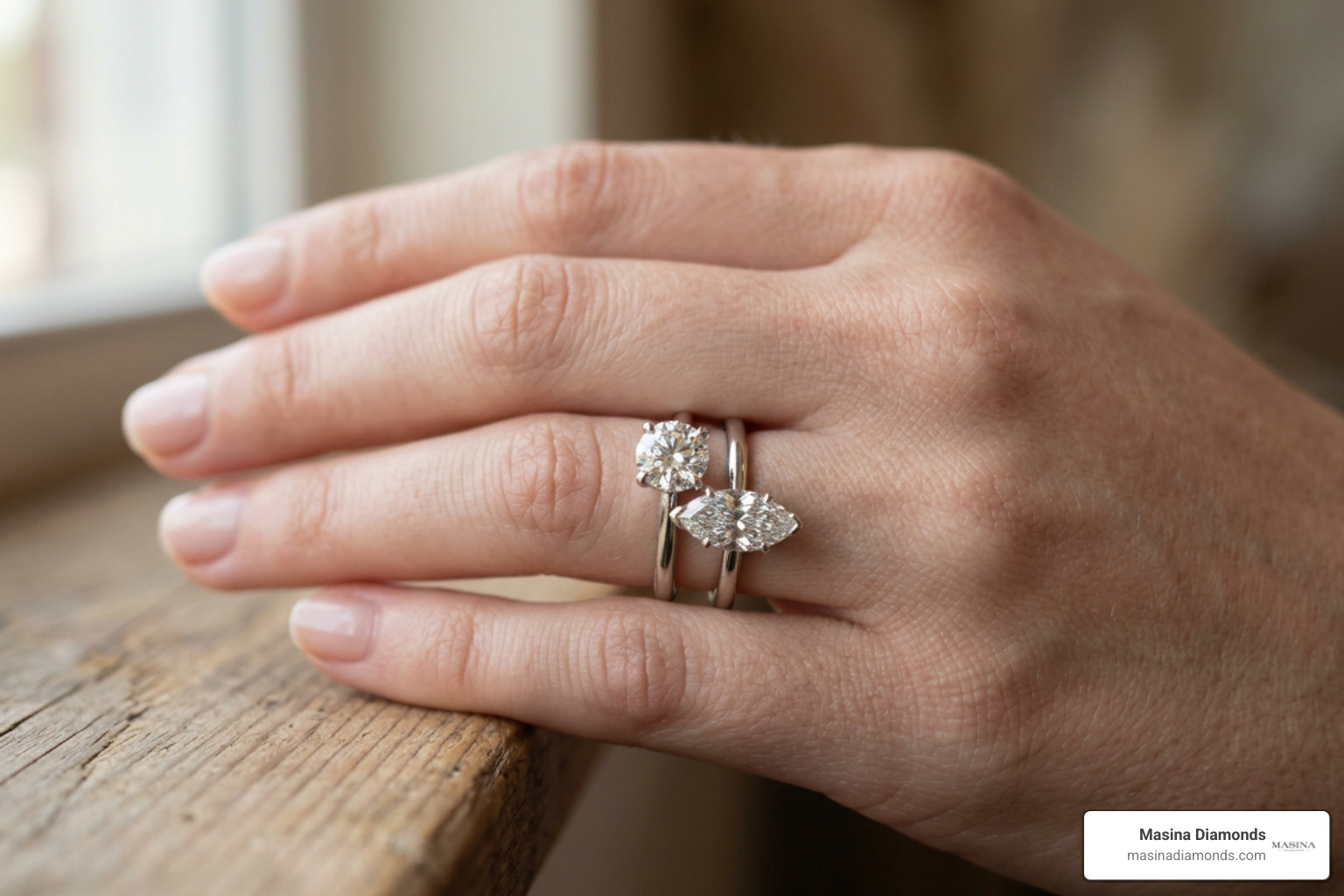
If visual coverage is your primary goal, elongated fancy cuts like the oval, pear, and marquise offer a clever advantage. The marquise cut, for instance, spans an impressive 9.0 mm in length at 0.75 carats. That is over 3 millimeters longer across the finger than a round stone of the exact same weight! Similarly, an oval cut measuring 7.0 mm × 5.0 mm creates an slimming effect on the finger while covering noticeable real estate.
On the other hand, square fancy cuts like the princess cut (5.0 mm × 5.0 mm) and asscher cut (5.0 mm × 5.0 mm) store more weight in their corners and deeper pavilions. While they offer distinct geometric beauty, they appear slightly smaller face-up than a round cut of equivalent weight.
Visual Comparison: 0.5 ct vs. 0.75 Carat Diamond vs. 1 ct
Choosing center stone size is often a balancing act between visual footprint and budget. Seeing how a 0.75 carat diamond stacks up against 0.50 ct and 1.00 ct diamonds helps clarify the value it offers.
- 0.50 Carat (~5.1 mm round): A half-carat diamond offers delicate elegance, but can sometimes feel a bit small on wider bands or larger ring sizes.
- 0.75 Carat (~5.8 mm round): Stepping up from 0.50 ct to 0.75 ct provides a massive visual improvement. You gain roughly 30% more surface area, giving the center stone substantial presence on the hand without pushing into top-tier pricing. You can review the exact scale on the 0.75ct Round Cut Diamond (5.9×5.74×3.33mm) - Actual Size tool.
- 1.00 Carat (~6.5 mm round): While a 1.00 ct stone is the traditional benchmark, diamond prices jump dramatically at full-carat thresholds. A 0.75 ct diamond provides about 80% of the visual size of a 1.00 ct diamond for a fraction of the cost.
If you are curious about regional trends and sizing benchmarks, take a look at our article on Average Engagement Ring Carat Size in 2026 What's Normal. For those exploring significantly larger statement pieces, we also cover How Much Is a 3 Carat Diamond Ring.
Cut Proportions and Depth Percentage for Maximum Brilliance
While carat weight dictates mass, cut quality determines beauty. A poorly cut 0.75 carat diamond will look flat and lifeless no matter its clarity or color grade.
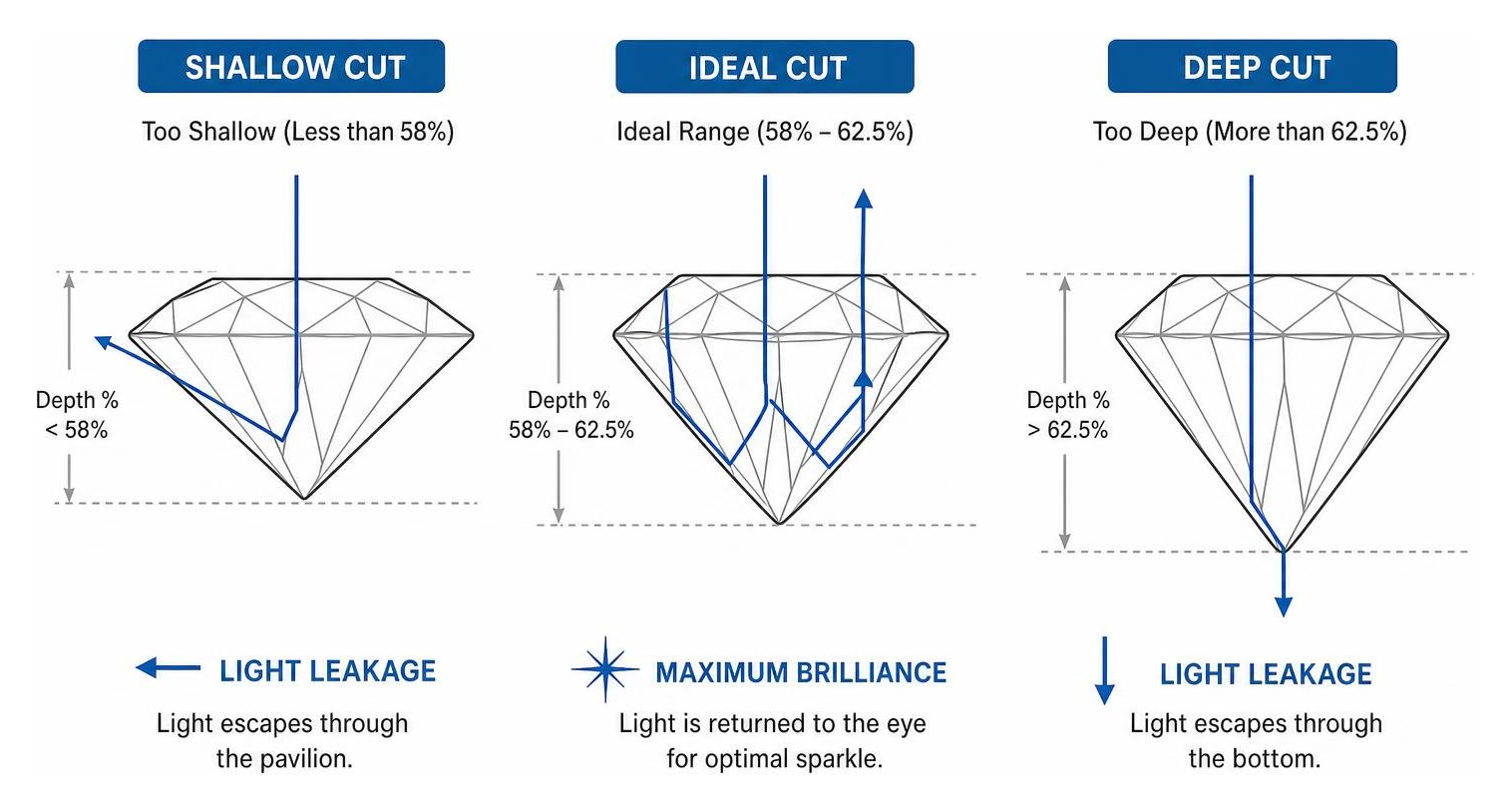
Light performance depends on precise proportions:
- Recommended Depth Percentage: 58% to 62.5%
- Recommended Table Percentage: 53% to 58%
- Length-to-Width Ratio (Round): 1.00 to 1.02 (or up to 1.03 for standard tolerances)
Why is depth percentage so important? Total depth percentage is calculated as:
$$\text{Depth \%} = \left(\frac{\text{Total Depth}}{\text{Average Diameter}}\right) \times 100$$
If a diamond is cut too shallow (for example, a 5.9 mm × 5.74 mm × 3.33 mm stone with a 57.2% depth), light escapes through the bottom of the pavilion rather than bouncing back up to your eye. Although a shallow stone might look slightly larger face-up, it suffers severe light leakage, resulting in a dull, shadowy ring center. Conversely, if a diamond is cut too deep, it hides excess weight in its belly, appearing smaller than a well-cut 0.75 ct stone while leaking light through the sides.
A well-proportioned round diamond features a 58-facet structure engineered to redirect light straight back to the viewer, creating maximum fire and scintillation. To learn more about how proportion influences light behavior, visit our dedicated resource on Diamond Carat.
Maximizing Value: Color, Clarity, and Certification Strategies
When selecting a 0.75 carat diamond, smart parameter choices ensure you don't pay for features undetectable to the naked eye. To get the best overview of grading fundamentals, read our guide on Understanding the 4Cs and our deep-dive 4Cs of Diamonds: A Comprehensive Guide.
Here are our expert recommendations for stretching your budget on a 0.75 ct stone:
-
Color Grade: Diamonds are graded on a scale from D (colorless) to Z (light yellow/brown). At 0.75 carats, diamonds do not concentrate color as heavily as larger 2.0+ carat stones.
- White Metal Settings (Platinum / 14k or 18k White Gold): Target J color or higher. In a round cut, a J color stone appears bright and crisp against white metals.
- Yellow or Rose Gold Settings: Target K color or higher. The warm metal reflections naturally absorb subtle warmth in the stone, saving you considerable money.
- Clarity Grade: Select SI1 or SI2 clarity, provided the stone is "eye-clean" (meaning inclusions are invisible without magnification). At 0.75 carats, small pinpoint inclusions or feather feathers are nearly impossible to see with the naked eye. Avoiding VVS or IF clarity saves thousands without sacrificing appearance.
- Certification: Insist on grading reports from independent, authoritative laboratories—specifically the Gemological Institute of America (GIA) or the American Gem Society (AGS). Uncertified stones or reports from lenient alternative labs carry significant risk; merchants may inflate color or clarity grades by 1 to 2 tiers, causing you to pay premium prices for lower-quality diamonds.
- Blue Fluorescence: Blue fluorescence occurs when a diamond emits a soft blue glow under ultraviolet light. In lower color grades like I, J, or K, medium to strong blue fluorescence can actually complement the stone by offsetting warm yellow tones, making the diamond appear whiter face-up! Furthermore, fluorescent stones often carry a slight discount, offering clever savings. Just exercise caution with higher color grades (D–F), where very strong fluorescence can occasionally make the stone look hazy.
Smart Buying Strategies: Buying Shy and Setting Selection
One of the best industry tricks for getting high value is a practice known as "buying shy."
Diamond price-per-carat scales leap dramatically at round milestone weights like 0.75 ct, 0.90 ct, and 1.00 ct. "Buying shy" means purchasing a stone slightly under these magic thresholds—for instance, choosing a 0.70 ct to 0.73 ct diamond instead of a 0.75 ct diamond, or a 0.93 ct to 0.95 ct diamond instead of a 1.00 ct stone.
Because a 0.72 ct diamond and a 0.75 ct diamond differ by only a tiny fraction of a millimeter in diameter, the human eye cannot tell them apart when mounted in a ring. However, selecting the shy stone bypasses the steep pricing step, unlocking significant savings that can be reinvested into a custom ring setting or setting upgrade. For additional budget planning tips, explore How to Budget for an Engagement Ring and Smart Strategies to Afford an Engagement Ring in 2023.
Setting choice also plays a huge role in how your 0.75 carat diamond presents:
- Solitaire Setting: A thin, delicate band (1.5 mm to 2.0 mm) makes a 0.75 ct center stone pop visually, drawing all attention directly to the diamond. Check out our guidance on How to Choose a Diamond Ring Setting for inspiration.
- Halo Setting: Surrounding a 0.75 ct center stone with a frame of smaller accent diamonds can expand the visual diameter by 1.5 mm to 2.0 mm, giving it the footprint of a 1.50+ carat diamond at a fraction of the cost.
- Three-Stone Setting: Flanking a 0.75 ct center stone with smaller side diamonds creates beautiful hand coverage. Just remember to match the side-stone color grades to your center diamond for seamless harmony.
If you are local to Georgia, follow our step-by-step local shopping resource on Buying the Perfect Engagement Ring in Atlanta Our Step-by-Step Guide.
Frequently Asked Questions About 0.75 Carat Diamonds
How big does a 0.75 carat round diamond look on a finger?
A well-cut 0.75 carat diamond in a round cut measures approximately 5.8 mm in diameter. On an average U.S. female finger size (size 6), a 5.8 mm stone covers about 38% of the width of the finger. When set in a slim band or elevated prong setting, it creates a balanced, noticeable appearance that looks proportional and elegant.
Is a 0.75 carat diamond big enough for an engagement ring?
Absolutely. A 0.75 carat diamond is widely considered an ideal, classic size for an engagement ring. It is large enough to showcase magnificent sparkle and detail without snagging on everyday items or feeling overly heavy. When paired with an Excellent cut grade, its brilliant light performance ensures it commands attention in any setting.
How much money can I save by buying shy near 0.75 carats?
By "buying shy"—such as choosing a 0.70 ct to 0.73 ct stone rather than an exact 0.75 ct diamond—you can save anywhere from 10% to 20% on the center stone cost. Because the physical diameter difference between a 0.72 ct and 0.75 ct stone is roughly 0.1 mm (imperceptible to the naked eye), you enjoy virtually identical visual scale while keeping extra money in your pocket.
Conclusion
Choosing a 0.75 carat diamond offers an ideal balance of visual brilliance, versatile proportions, and exceptional price value. Whether you prefer the classic symmetry of a round brilliant or the elongated elegance of an oval or marquise cut, prioritizing an Excellent cut grade and eye-clean clarity ensures your ring dazzles from every angle.
At Masina Diamonds, our family-owned showroom in Atlanta, GA brings together over 40 years of expert craftsmanship with modern design tools. Using our interactive 3D Ring Builder, you can pair your ideal 0.75 carat diamond with a custom-crafted setting tailored to your personal style and budget.
Ready to explore your options? Explore Diamond Carat Guide or visit our Atlanta showroom today to design the engagement ring of your dreams.
Book a consultation and explore cushion cut engagement ring options in person at Masina Diamonds.