Types of Diamond Cut: Shapes and Styles at a Glance
The main types of diamond cut are brilliant, step, and mixed. Brilliant cuts give you lively sparkle. Step cuts show broad flashes of light and a clean, mirror-like look. Mixed cuts blend features of both. Shape is different: it describes the outline you see from above, such as round, oval, or emerald.
Start with the shape you love, then compare how its facets handle light. That makes it easier to choose between sparkle, a sleek look, and a ring that feels like yours.
We're Masina Diamonds, a family-owned Atlanta jeweler with over 40 years of experience helping clients understand the types of diamond cut for custom engagement rings. Our 3D Ring Builder helps you see those choices in a design before you decide.
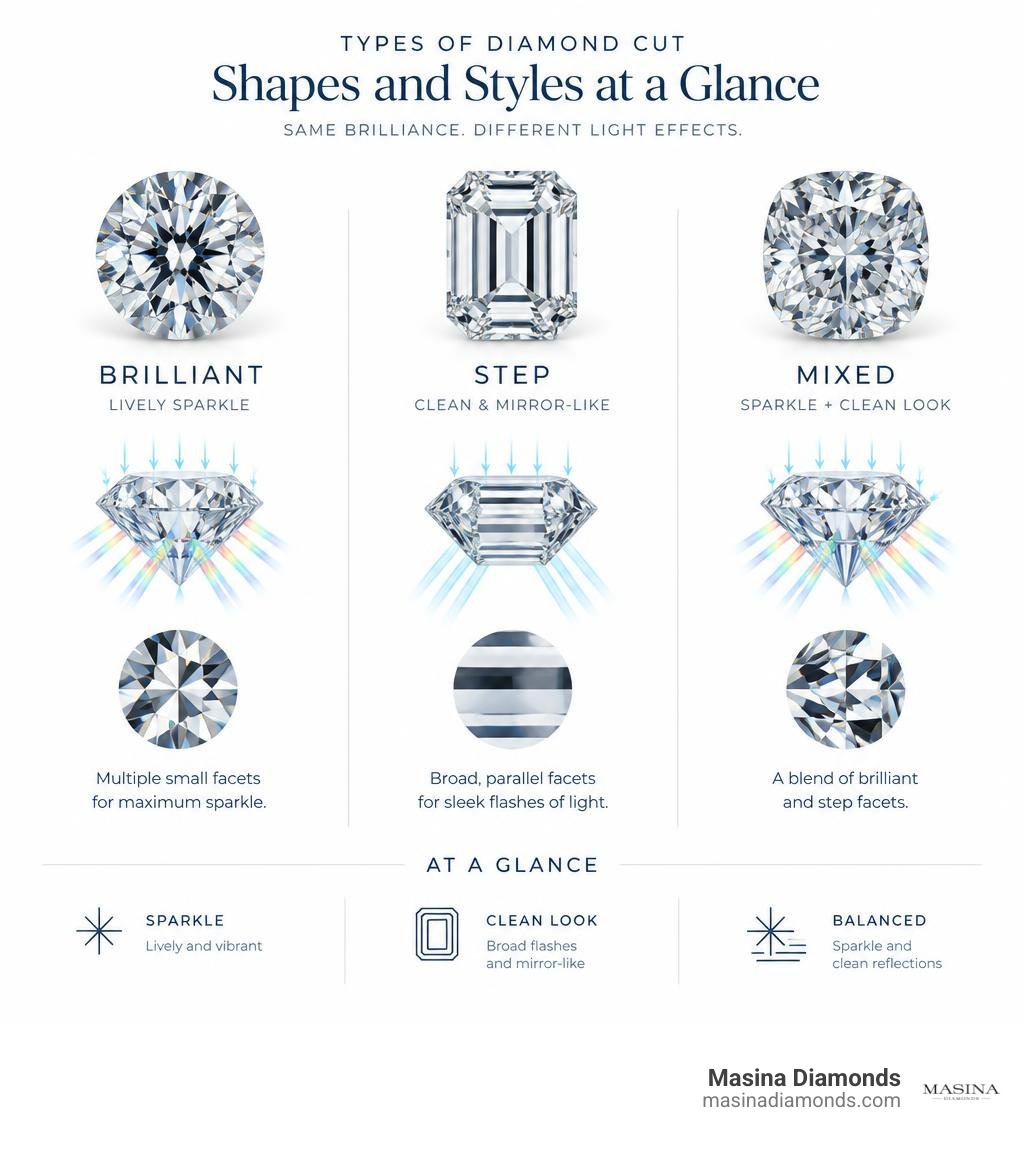
Exploring the Core Types of Diamond Cut: Brilliant, Step, and Mixed Styles
When assessing a diamond's visual personality, gemologists classify stones by how their facets are arranged. Facets act as tiny mirrors, bouncing, bending, and reflecting light back to your eyes. According to global diamond standards established by CIBJO, the exact alignment of these facets harnesses the natural physical properties of carbon crystals. A diamond boasts a refractive index of 2.417 and an optical dispersion rating of 0.044, which explains why perfectly cut stones manipulate light better than any other gemstone on Earth.
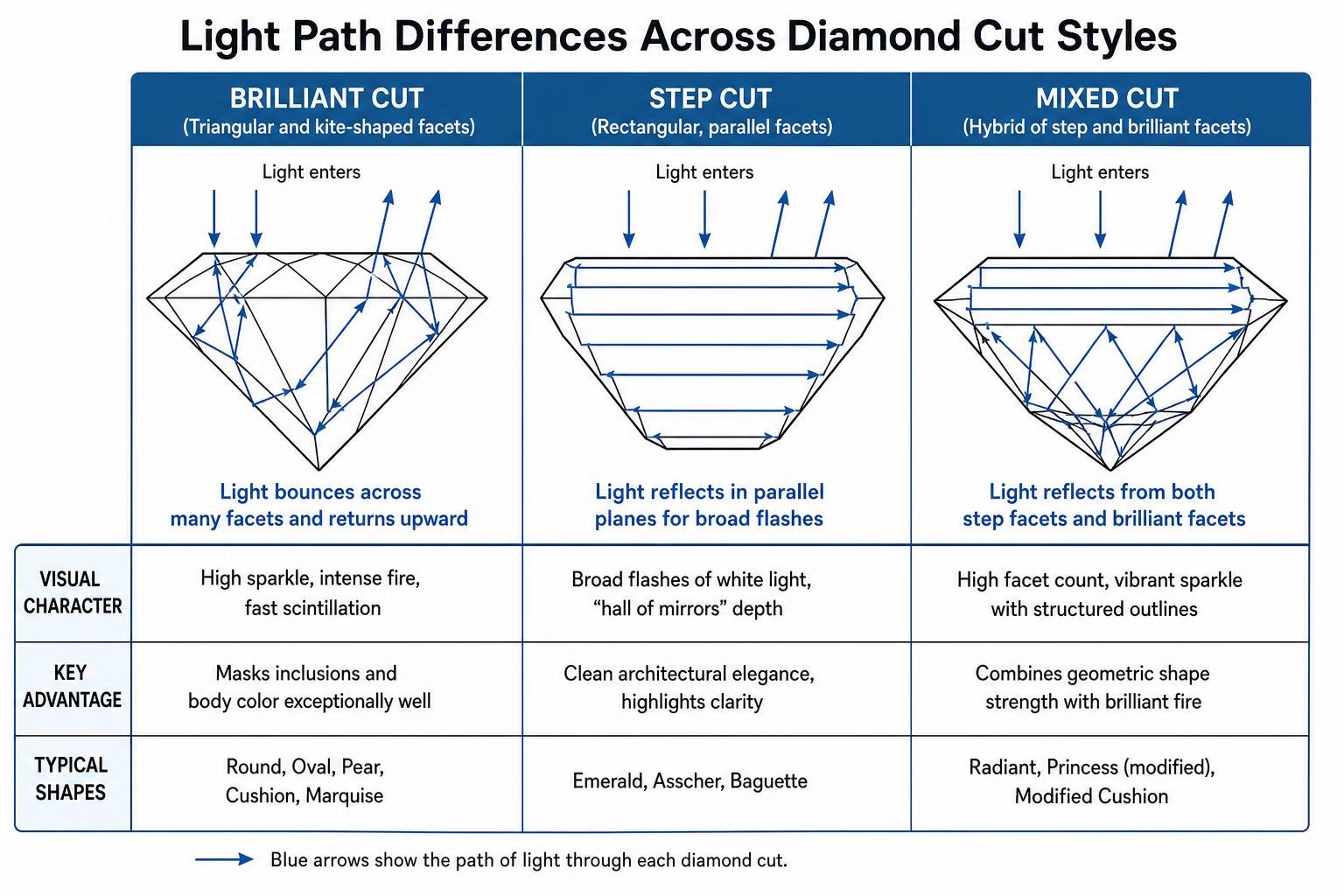
| Cut Style | Primary Facet Geometry | Visual Character | Key Advantage | Typical Shapes |
|---|---|---|---|---|
| Brilliant Cut | Triangular and kite-shaped | High sparkle, intense fire, fast scintillation | Masks inclusions and body color exceptionally well | Round, Oval, Pear, Cushion, Marquise |
| Step Cut | Rectangular, parallel facets | Broad flashes of white light, "hall of mirrors" depth | Clean architectural elegance, highlights clarity | Emerald, Asscher, Baguette |
| Mixed Cut | Hybrid (step crown, brilliant pavilion or vice versa) | High facet count, vibrant sparkle with structured outlines | Combines geometric shape strength with brilliant fire | Radiant, Princess (modified), Modified Cushion |
Brilliant Cuts: Maximizing Brilliance, Fire, and Scintillation
Brilliant cuts are engineered for maximum light performance. By arranging triangular and kite-shaped facets around a cone-shaped pavilion (the bottom portion of the diamond), light entering through the crown bounces across internal walls and returns upward through the table.
This process produces three distinct optical phenomena:
- Brilliance: The brightness created by all internal and external white light reflections.
- Fire: The dispersion of white light into vivid, spectral rainbow colors.
- Scintillation: The flashes of light and dark contrasts produced when the diamond or light source moves.
Because brilliant faceting breaks light into hundreds of tiny beams, it naturally camouflages internal inclusions and subtle body tint.
Step Cuts: The Architectural Hall of Mirrors
Step cuts take a completely different optical approach. Instead of scattering light into tiny bursts, step cuts feature long, narrow facets arranged in parallel rows resembling staircase steps. These facets run parallel to the diamond's girdle edge, framing a wide, open table facet.
Step cuts highlight a diamond's natural luster and clarity rather than sheer sparkle. They produce broad, dramatic reflections often described as a "hall of mirrors" effect. Because the open table provides an unobstructed view straight into the heart of the stone, cutters must preserve exceptional symmetry to prevent "windowing"—an optical flaw where light passes straight through the diamond like a pane of clear glass instead of bouncing back to the viewer.
Mixed and Modified Cuts: Blending Sparkle and Geometry
Mixed cuts combine the best traits of brilliant and step cuts into a single silhouette. A classic mixed cut features a step-cut crown paired with a brilliant-cut pavilion, or an intricate arrangement of modified brilliant facets within a clean, straight-edged geometric outline.
These cuts boast high facet density. When light enters a stone like a radiant cut, the complex facet pattern reflects light from dozens of angles simultaneously, yielding a shimmering "crushed ice" appearance. This approach gives you the sharp, tailored silhouette of an emerald cut alongside the energetic sparkle of a round brilliant.
Modern Diamond Shapes and Their Faceting Profiles
While "cut style" refers to facet arrangement, "diamond shape" defines the stone's physical silhouette when viewed face-up. Every diamond starts as a rough crystal formed deep within the earth up to 3.3 billion years ago. Scoring a perfect 10 on the Mohs scale, diamond is the hardest natural mineral known, yet cutting it requires immense precision to maximize rough yield while creating balanced proportions.
Round Brilliant Cut: The Industry Standard
The round brilliant cut remains the most popular diamond shape in the world, accounting for the vast majority of all engagement stones sold today. Engineered with 57 or 58 facets (depending on whether the culet at the base is pointed or faceted), its proportions follow precise mathematical formulas to optimize light return.
Because of its uniform geometry, the round brilliant is the only diamond silhouette that receives an official cut grade (ranging from Excellent to Poor) on a standardized laboratory report. While round brilliants carry a higher price per carat due to the rough diamond lost during the rounding process, their balance of fire and brilliance makes them a cornerstone of curated diamond ring styling. For a deeper breakdown of diamond grading, review the official GIA guide on diamond shapes.
Elongated Modern Types of Diamond Cut: Oval, Pear, and Marquise
Elongated shapes offer a flattering, finger-lengthening effect and a larger surface area per carat than traditional round cuts.
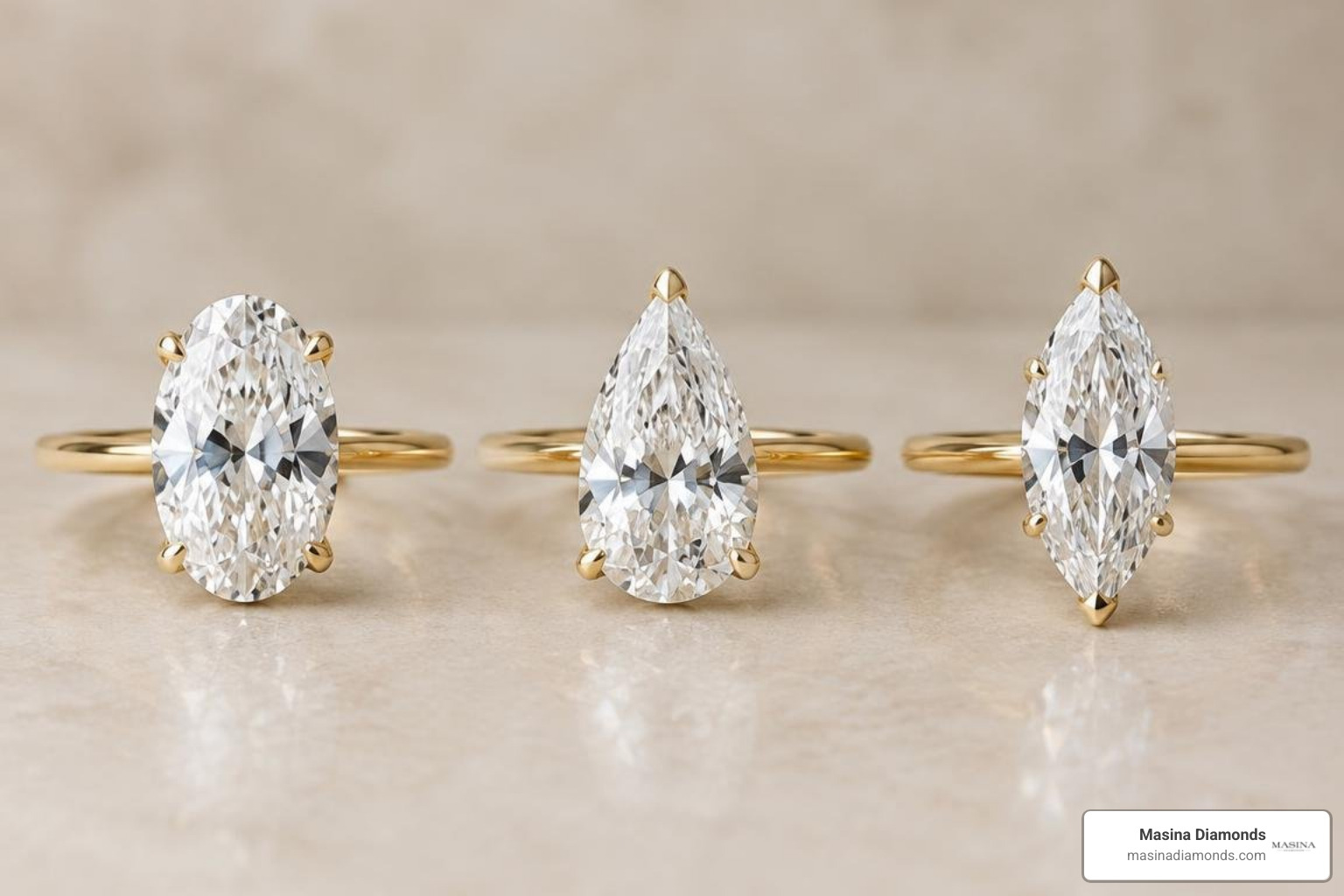
- Oval Cut: Created in the late 1950s, the oval cut captures the fiery brilliance of a round stone within an elongated contour. Most well-proportioned ovals feature a length-to-width ratio between 1.3:1 and 1.4:1.
- Pear Shape: Resembling a shimmering teardrop, the pear cut blends a rounded brilliant base with a tapered point. Like ovals, pear cuts look most balanced with length-to-width ratios of 1.3:1 to 1.4:1.
- Marquise Cut: Featuring an elliptical silhouette with pointed ends, the marquise cut maximizes perceived spread across the finger better than almost any other shape. Legend has it King Louis XV of France commissioned the cut to match the smile of the Marquise de Pompadour.
When shopping for elongated cuts, look out for the "bowtie effect"—a dark, bow-shaped shadow across the stone's center caused by light leaking through the pavilion. While all elongated brilliant stones possess a slight bowtie, expert cutting keeps the shadow subtle and lively. If you are exploring different silhouettes, our engagement ring stones guide offers additional comparisons.
Square and Rectangular Cuts: Princess, Emerald, Radiant, and Asscher
Geometric shapes deliver crisp lines and modern elegance:
- Princess Cut: A contemporary favorite since the 1960s, the princess cut is an inverted pyramid featuring sharp, 90-degree corners and brilliant faceting. It provides high sparkle while preserving up to 80% of the original rough crystal.
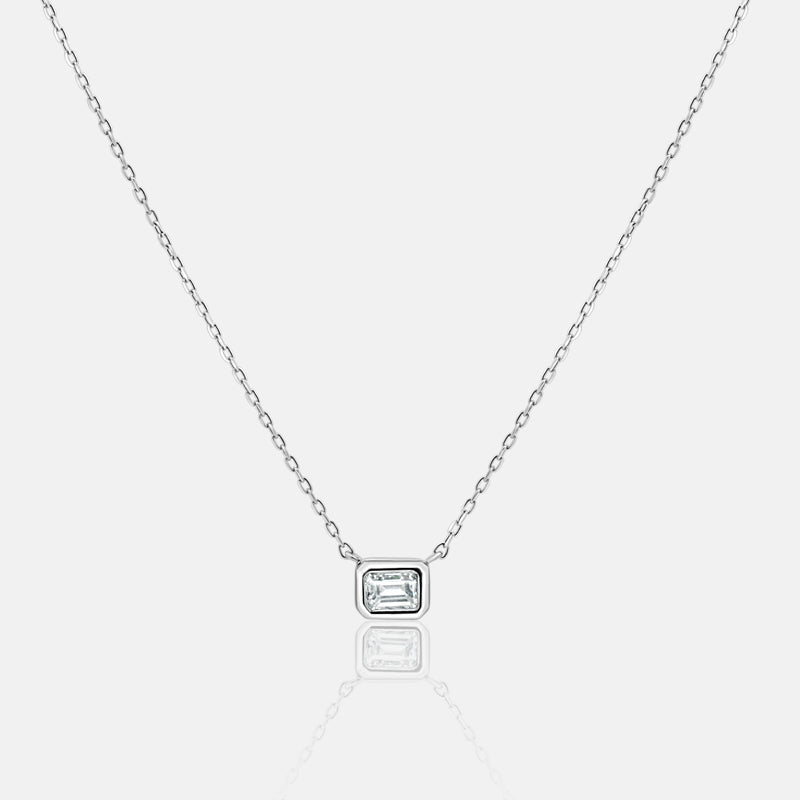
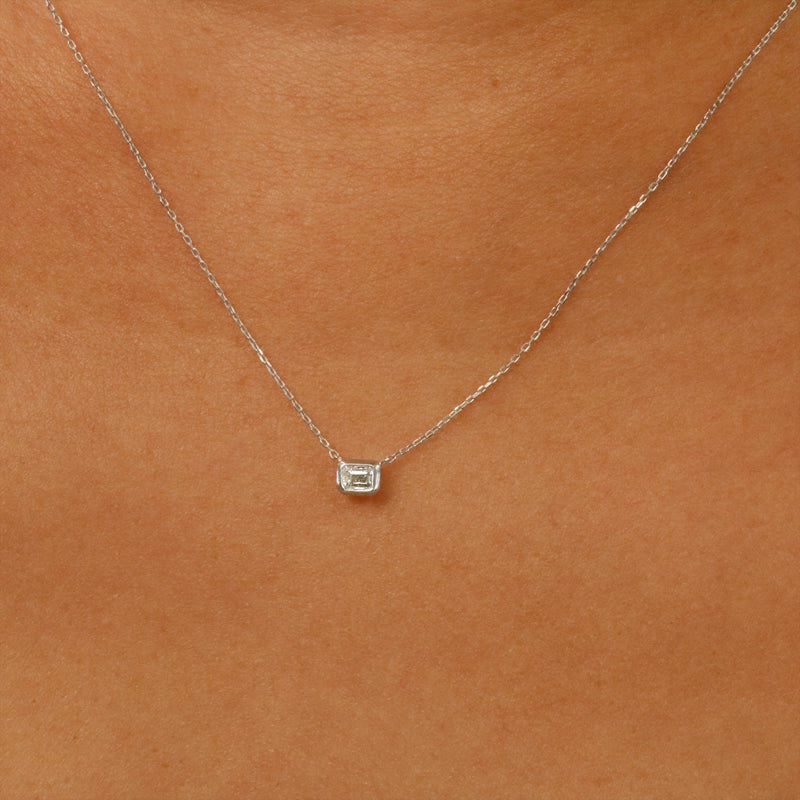
- Emerald Cut: The definitive step cut, characterized by trimmed corners and a wide, open table. Its parallel facets create sweeping flashes of light rather than pinfire sparkle, favoring clarity and understated luxury.
- Radiant Cut: Invented in 1977, the radiant cut features 70 facets within an emerald-cut outline with beveled corners. It delivers intense "crushed ice" brilliance while protecting vulnerable edges.
- Asscher Cut: Developed in 1902 by the Royal Asscher Diamond Company and celebrated during the Art Deco era, this cut is essentially a square emerald cut with high crown angles, a smaller table, and deeply clipped corners forming an octagonal profile.
Romantic Silhouette Cuts: Cushion and Heart Shapes
- Cushion Cut: Often called the "pillow cut," this shape combines a square or rectangular outline with rounded corners and curved sides. Modern cushion cuts can be faceted with traditional chunky patterns or modified brilliant arrangements for a softer shimmer.
- Heart Shape: The ultimate romantic symbol, the heart-shaped diamond requires exact symmetry between its two rounded lobes and a crisp, well-defined cleft. Heart cuts should maintain a balanced 1:1 length-to-width ratio. We generally recommend choosing stones of at least 0.50 carats so the distinctive silhouette remains clearly visible once set in metal prongs.
The Evolution of Diamond Faceting and Antique Cuts
Modern diamond faceting is the result of centuries of craftsmanship. Because diamond only scratches diamond, early artisans relied on diamond dust mixed with olive oil to grind rough crystals. Diamond crystals also exhibit directional hardness, meaning certain crystal planes are harder than others. Cutters learned to align facets slightly off the hardest cleavage planes to grind and polish stones smoothly without flaking.
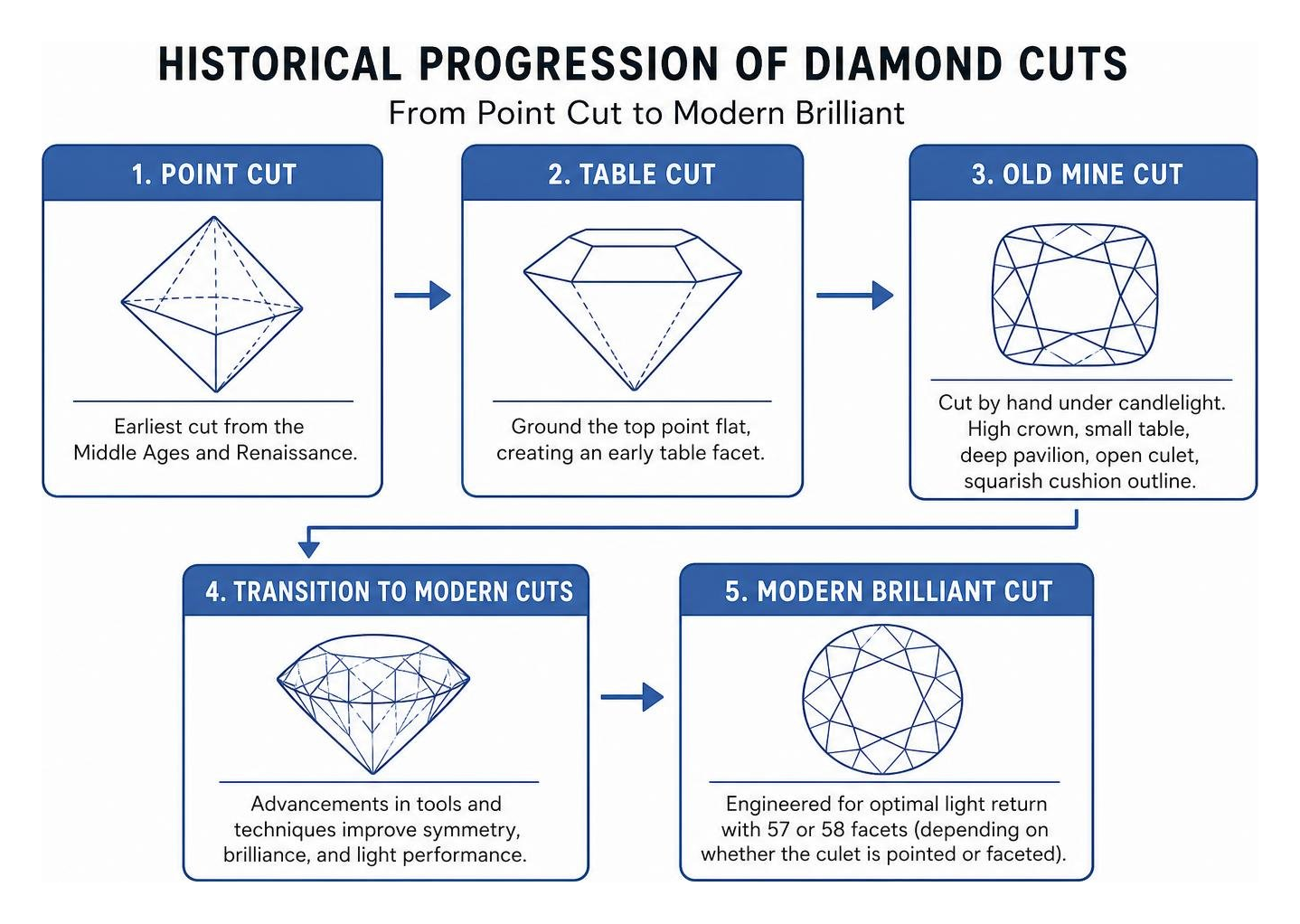
According to the comprehensive History of Diamond Cutting at Antique Jewelry University, early European cutters often lost up to 50% of a rough stone's initial weight while polishing it down. Today, laser sawing and advanced 3D modeling optimize yield and light performance before a physical tool ever touches the rough gem—a technique we frequently honor in our custom jewelry design craftsmanship.
Historical and Vintage Types of Diamond Cut
- Point Cut & Table Cut: The earliest cuts from the Middle Ages and Renaissance. Point cuts simply polished the natural octahedral faces of diamond rough. Table cuts ground the top point flat, creating an early table facet.
- Old Mine Cut: The quintessential cut of the 18th and 19th centuries. Cut by hand under candlelight, Old Mine cuts feature a high crown, small table, deep pavilion, open culet, and a squarish cushion outline.
- Old European Cut: The immediate predecessor to the modern round brilliant, popular from the late 19th to early 20th century. It features a round outline, 58 chunky facets, a high crown, and a distinctive open culet at the base.
- Single Cut: An early 17- or 18-facet cut still used today for tiny accent stones under 0.03 carats.
- Rose Cut: Dating to the 1500s, rose cuts feature a flat base with a domed crown covered in 3 to 24 triangular facets resembling an opening rosebud, producing a gentle, watery glow.
How Cut Style Affects Quality, Perceived Size, and Setting Selection
Choosing among different shapes and cuts directly influences your ring's visual footprint, clarity requirements, and overall durability.

To maximize your budget, it helps to understand how cut interacts with the rest of the 4Cs. While carat measures weight rather than visual dimensions, shallow or elongated cuts distribute that weight across a wider top surface. Review our diamond carat weight guide alongside our ring engagement ultimate guide to see how proportions alter finger coverage.
Color and Clarity Recommendations by Cut Style
Facet design dictates how easily you will spot internal characteristics (inclusions) or natural body tint:
- Brilliant Cuts (Round, Cushion, Radiant, Oval): The intense light scattering masks minor inclusions and yellow tones. You can comfortably choose an Eye-Clean SI1 or SI2 clarity grade and a near-colorless G to I color grade while maintaining a bright, white look.
- Step Cuts (Emerald, Asscher): The open, window-like table acts as a magnifying lens into the stone. Inclusions are easily visible, and body color concentrates along the parallel facets. We advise prioritizing clarity grades of VS2 or higher and selecting color grades of F or G to keep step cuts looking crisp and icy.
Setting Styles for Aesthetic Enhancement and Stone Protection
Different cut profiles require specific setting approaches to guard against chipping. A diamond may score a 10 on the Mohs scale, but it can still cleave if struck hard along a sharp corner or delicate point.
- V-Prongs for Pointed Corners: Marquise, pear, and princess cuts feature vulnerable points. V-shaped prongs wrap securely around these edges to prevent accidental chipping.
- Bezel Settings: A metal rim completely encasing the diamond's perimeter offers unmatched protection for active lifestyles. Explore our protective bezel setting guide and learn how to style a bezel-set engagement ring.
- Hybrid Mountings: If you want the security of a metal frame with the open-air elevation of traditional claws, a hybrid bezel with prongs offers the best of both worlds.
Frequently Asked Questions About Diamond Cuts
What is the difference between diamond shape and diamond cut style?
Diamond shape describes the physical outline of the stone viewed face-up (such as round, pear, emerald, or oval). Cut style refers to the arrangement and geometry of its polished facets (such as brilliant, step, or mixed cuts). The shape establishes the silhouette, while the cut style determines how that silhouette reflects light.
Which diamond cut appears the largest for its carat weight?
Elongated shapes—specifically marquise, oval, and pear cuts—appear largest per carat. Because these shapes distribute more of their total carat weight across the top surface area rather than deep in the pavilion, they cover more surface area on your finger than a round brilliant of identical carat weight.
Why do step cut diamonds require higher clarity grades than brilliant cuts?
Step cuts feature broad, flat, parallel facets and a wide table that offer an unobstructed view straight into the center of the diamond. Unlike brilliant cuts, which break light into hundreds of tiny twinkling beams that mask tiny imperfections, step cuts provide a clear "hall of mirrors" view that makes inclusions and tint much more noticeable to the naked eye.
Finding Your Perfect Diamond Cut
Every diamond cut offers a unique balance of light, geometry, and personal style. Whether you prefer the timeless fire of a round brilliant, the serene geometry of an emerald cut, or the elongated grace of an oval, choosing the right stone comes down to finding the cut that speaks to you.
At Masina Diamonds, our family has spent over four decades guiding clients through every facet of the diamond selection process. You can design your dream ring from anywhere using our interactive 3D Ring Builder, or visit our Atlanta showroom to compare loose stones side by side under natural light. Explore our collection of custom engagement rings in Atlanta and let us help you create a custom piece designed to last a lifetime.