What a 2 Carat Pear Shaped Diamond Costs in 2026
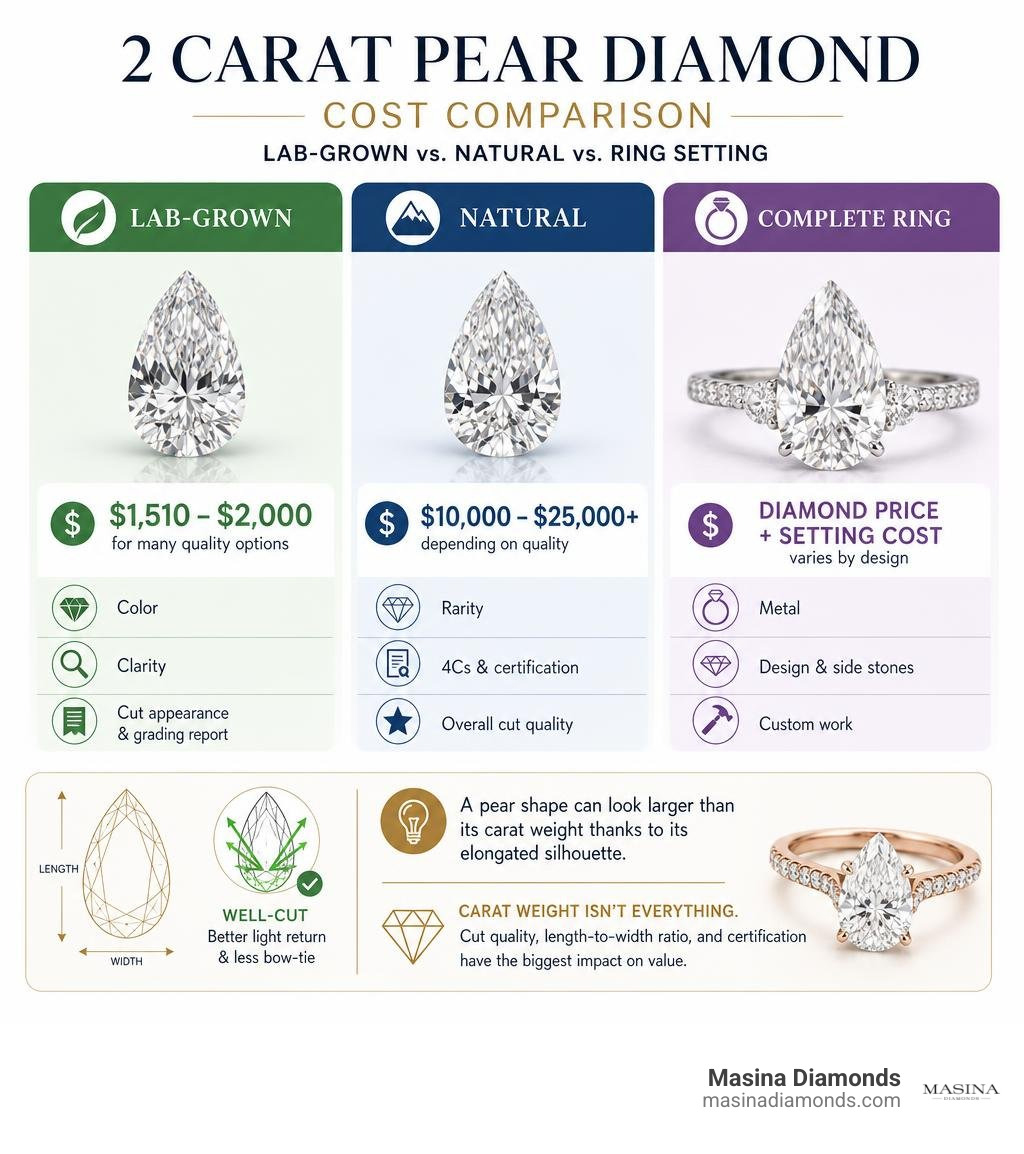
The cost of 2 carat pear shaped diamond can range from about $1,510 for a strong lab-grown deal to $25,000 or more for a high-quality natural diamond. For a comparable 2-carat lab-grown pear, the current fair-market benchmark is about $1,880, with many listings falling between $1,790 and $1,910.
| Diamond type | Typical 2-carat pear diamond cost | What drives the difference |
|---|---|---|
| Lab-grown | $1,510-$2,000 for many quality options | Color, clarity, cut appearance, and grading report |
| Natural | Roughly $10,000-$25,000+ | Rarity, 4Cs, certification, and overall cut quality |
| Complete engagement ring | Diamond price plus setting cost | Metal, design, side stones, and custom work |
A pear diamond offers a distinctive teardrop outline and can look larger than its carat weight because of its longer shape. But carat weight alone does not set the price. A well-cut stone with minimal bow-tie shadow, a pleasing length-to-width ratio, and reliable certification can be worth far more than a similarly sized diamond with weaker visual performance.
At Masina Diamonds, we have helped Atlanta couples choose and create fine diamond engagement rings for more than 40 years. Our experience comparing the cost of 2 carat pear shaped diamond options helps make the next decisions - diamond origin, quality, and setting - clearer.
Understanding the Cost of 2 Carat Pear Shaped Diamond: Lab-Grown vs. Natural
When clients visit our showroom in Atlanta, GA, the very first choice they navigate is diamond origin. Both lab-grown and natural pear diamonds share identical optical, physical, and chemical structures. However, their market prices operate on completely different pricing scales. Understanding how origin shifts the total cost of 2 carat pear shaped diamond selections lets you allocate your overall budget toward the details that matter most to you—whether that is maximizing size, securing rare natural origin, or crafting an elaborate custom mounting.
To explore this debate in depth before selecting your center stone, check out our guide on Lab Grown Diamonds vs Natural and discover what best aligns with your personal taste.
Lab-Grown vs. Natural Pricing Benchmark
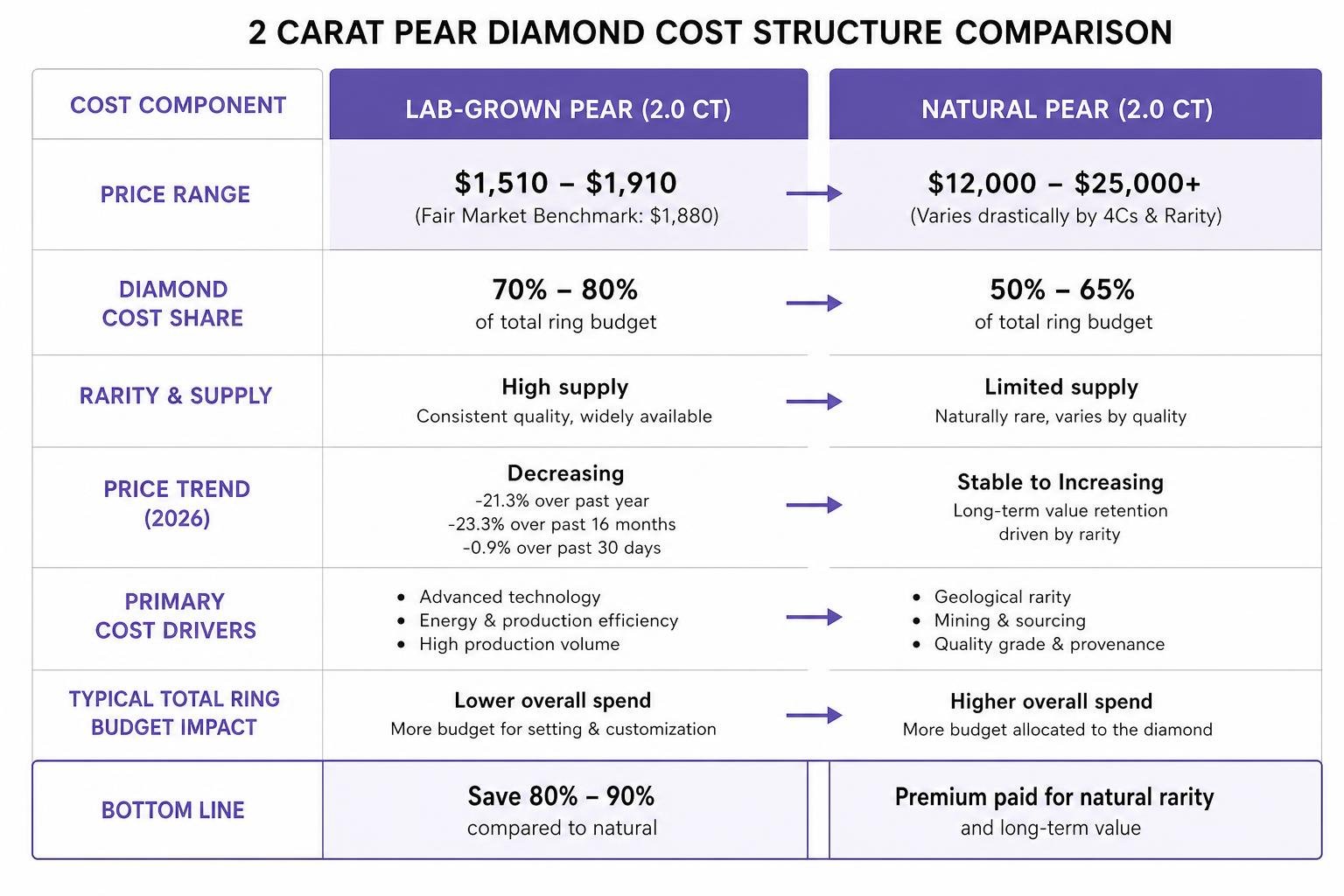
In 2026, the contrast in pricing between lab-grown and natural gems is at an all-time high. A fair market price for a 2 carat lab-grown pear diamond hovering around G color and VS1 clarity sits right at $1,880, with aggressive market deals dipping down to $1,510 (around 20% below fair market benchmark value). A buyer can expect to save between 80% and 90% when choosing a lab-grown pear over its natural counterpart.
For comparison, a natural 2 carat pear diamond with similar visual specs (G color, VS1-VS2 clarity, excellent symmetry) commands anywhere from $14,000 to $24,000+. If you step into higher natural color grades like D or E with VVS clarity, prices easily eclipse $25,000 to $35,000.
If you are exploring different stone sizes to find the ideal footprint on your hand, you might look at options like a 1.51 Carat Pear Diamond or a robust natural 2.04 Carat Pear Diamond. You can learn more about how origin influences your overall investment in our article on Choosing Between a Natural and Lab Grown Diamond.
Historical Price Trends and 2026 Market Analysis
Lab-grown diamond pricing has undergone dramatic shifts over the last 16 months. According to historical indices, lab-grown pear diamond prices have dropped 21.3% over the past year and 23.3% over the past 16 months. Price trends have stabilized somewhat in recent months, with a modest 0.9% decrease recorded over the last 30 days.
Current pricing trackers such as the 2 Carat Lab Grown Pear Diamond Price | Jul 2026 index show that the overall market range for quality 2 ct lab-grown pear diamonds remains tightly bound between $1,790 and $1,910.
What does this mean for shoppers today?
- Strong Negotiating Power: With around 406 live listings available across major diamond networks for 2 carat pear diamonds and robust inventory, buyers have moderate-to-high negotiating power.
- Accessible Upgrades: Decreasing lab costs allow couples to select larger sizes—such as moving up from a 1.5-carat stone to a 2-carat or even 3-carat center diamond without overstretching their engagement ring budget.
- Transparent Pricing: Tools like market trackers and live pricing engines mean shoppers can verify whether a diamond quote represents genuine fair market value. For live updates on natural stone movements, reference resources like 2 Carat Pear Diamond Prices .
Key Factors Influencing 2 Carat Pear Diamond Pricing

While carat weight dictates the overall size tier, the remaining traditional 4Cs—Cut, Color, Clarity, and Carat—along with pear-specific proportions play massive roles in shaping the exact price quote. Understanding how each grade impacts valuation allows you to spend money where it produces visible brilliance and cut back where imperfections remain completely invisible to the naked eye.
The 4Cs Impact on the Cost of 2 Carat Pear Shaped Diamond Value
To make sense of pear pricing, you must recognize how color and clarity tiers stack price premiums onto the base diamond cost:
- Cut Quality: Pear diamonds do not receive a standard GIA cut grade like round brilliants, making Polish and Symmetry grades vital. An Excellent/Excellent polish and symmetry grade commands a 15% to 25% price premium over Good grades because it guarantees maximum light performance.
- Color Grade: Colorless grades (D-F) carry a 30% to 50% premium over Near-Colorless grades (G-J). Because pear-shaped diamonds concentrate color near their pointed tips, color selection requires careful attention.
- Clarity Grade: Flawless to VS1 clarity grades cost 40% to 60% more than eye-clean VS2 to SI1 grades.
| 4Cs Grade Tier | Relative Price Premium | Visual Impact on Pear Diamonds | Recommended Strategy |
|---|---|---|---|
| Color: D - F | +30% to +50% | Icy white appearance, no trace of warmth | Premium pick; required primarily for platinum/white gold |
| Color: G - H | Baseline | Appears completely white to the naked eye | Best Value Sweet Spot |
| Clarity: FL - VS1 | +40% to +60% | Microscopic purity; zero inclusions under 10x | Collector grade; unnecessary for eye-clean look |
| Clarity: VS2 - SI1 | Baseline | Minor inclusions hidden by pear facet pattern | Best Value Sweet Spot |
| Cut: Excellent Polish/Symmetry | +15% to +25% | Vibrant reflection and fire across all facets | Must-Have Priority |
To get a deeper understanding of how these metrics work together, explore our detailed overview on Understanding the 4Cs.
Pear-Specific Cut Qualities: Bow-Tie Effect and Ratios
Beyond standard grading reports, two pear-specific cut metrics directly impact both visual beauty and total diamond valuation:
- The Bow-Tie Effect: Every pear diamond exhibits some degree of a dark shadow running across the center of the stone, shaped like a gentleman's bow-tie. This occurs when light passing through the center fails to reflect back to the eye. Stones with severe, dark bow-ties are valued lower on the market because they lack brilliance in the center. Conversely, pears cut with minimal, subtle bow-ties command higher prices because of their balanced light distribution.
- Length-to-Width (L/W) Ratio: The classic length-to-width ratio for a pear diamond ranges from 1.45 to 1.55. Pears below 1.40 look chubby or rounded, while those above 1.65 look elongated and thin. Pears within the ideal 1.45–1.55 golden ratio are in highest demand, preserving top resale and market value.

Comparing 2 Carat Pear Prices to Other Diamond Shapes
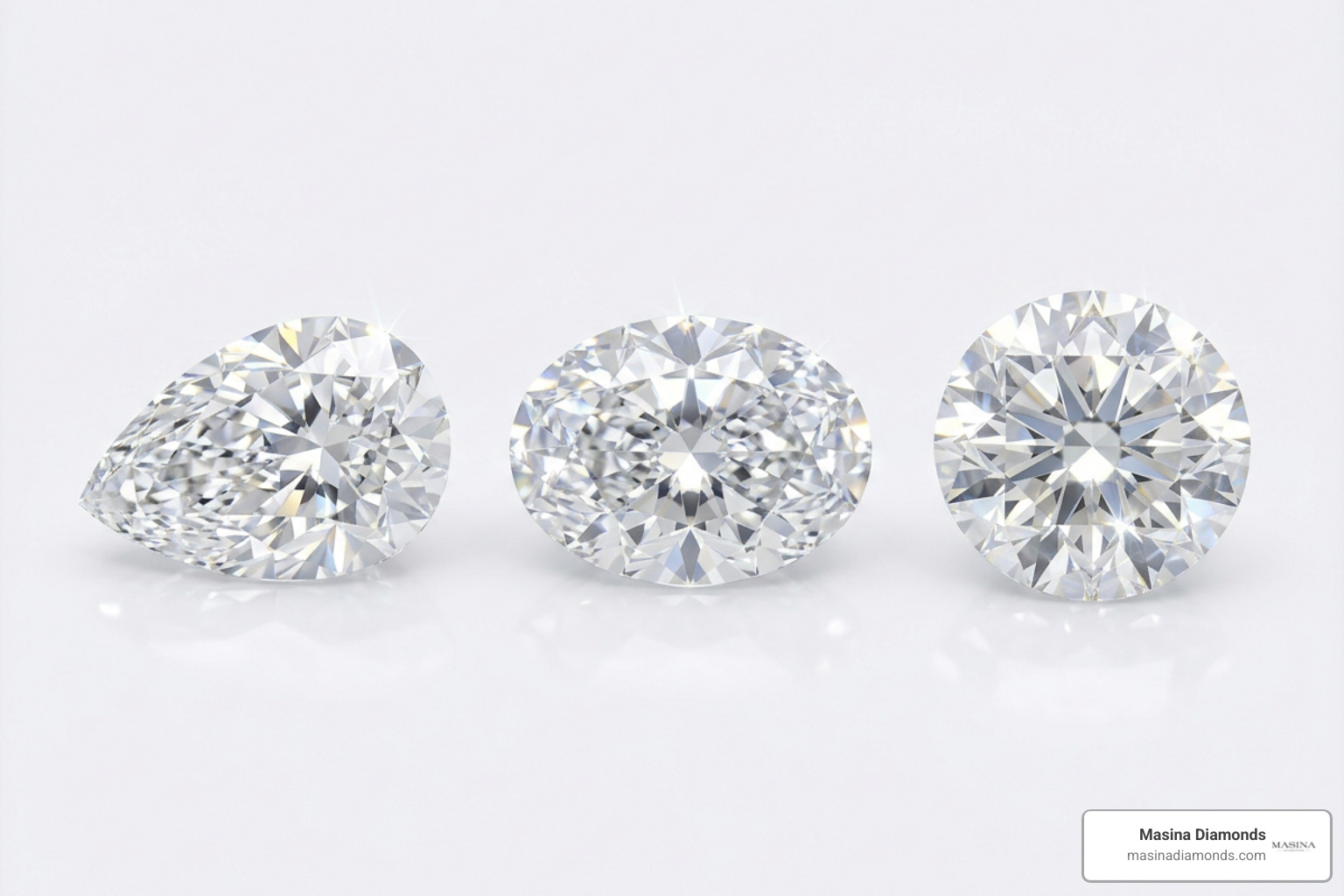
When establishing your engagement ring budget, it helps to see how the cost of 2 carat pear shaped diamond options stacks up against other popular fancy shapes like round, oval, and cushion cuts.
Pear vs. Round, Oval, and Cushion Costs
Historically, round brilliant diamonds carry the highest price per carat due to massive rough diamond wastage during the cutting process (up to 50% lost). Fancy shapes like pear, cushion, and oval utilize more of the original rough diamond crystal, making them inherently more efficient to produce.
However, market listings reveal an interesting nuance when examining median asking prices across live retail inventory without holding cut parameters strictly constant. The typical median live listing price range for a 2 carat pear diamond sits between $2,530 and $2,870, which is approximately 12% higher than comparable reference round diamond listings.
Why does this occur in live inventories? Pears require master cutters to carefully manage point durability and bow-tie suppression, leading vendors to price premium-cut pear stones higher than lower-tier round inventory.
- Round Brilliant: Standard baseline for diamond pricing; highest rough loss.
- Pear Cut: ~12% higher median live listing asking price due to cut selectivity and elongated length dominance.
- Oval Cut: Priced very close to pear diamonds; high demand keeps prices competitive.
- Cushion Cut: Generally 10% to 20% lower in price than round and pear cuts, offering one of the lowest per-carat entry points.
If you are open to larger fancy shape proportions, options like a 3.10 Carat Pear Lab Grown Diamond showcase how fancy cuts provide impressive surface area for your investment.
Finding the Sweet Spot: Best Value Specs to Maximize Budget
To get the absolute best visual value when buying a 2 carat pear diamond, jewelry experts recommend aiming for key sweet spot specifications:
- Color: G or H Grade. In a pear diamond, G or H color looks face-up white, especially when set in white gold or platinum. You avoid paying the 30% to 50% premium attached to D-F colorless stones.
- Clarity: VS2 or SI1 Grade. Pears feature a complex brilliant facet pattern near their center that hides inclusions effectively. Choosing VS2 or eye-clean SI1 delivers a diamond that looks flawless to the naked eye without the 40%+ price jump of VVS or IF grades.
- Cut & Symmetry: Prioritize Very Good to Excellent symmetry and polish. Never sacrifice cut quality for higher clarity or color.
- Price Target: For a lab-grown 2 carat pear with G/VS1 or G/VS2 specs, aim for the benchmark price of $1,510 to $1,880. Experts advise that buyers should avoid paying more than $1,586 for top-value standard spec lab-grown listings in today's soft market.
Here are exceptional inventory examples that represent high-value visual proportions:
- Consider a balanced mid-sized option like a 1.59 Carat Pear Lab Grown Diamond.
- Step up in volume with a 2.63 Carat Pear Lab Grown Diamond.
If you are curious about what goes into designing around this classic shape, dive into our article on Teardrop Chic: The Ins and Outs of Pear Shape Engagement Rings.
Total Ring Costs: Setting Prices and Complete Engagement Ring Budget
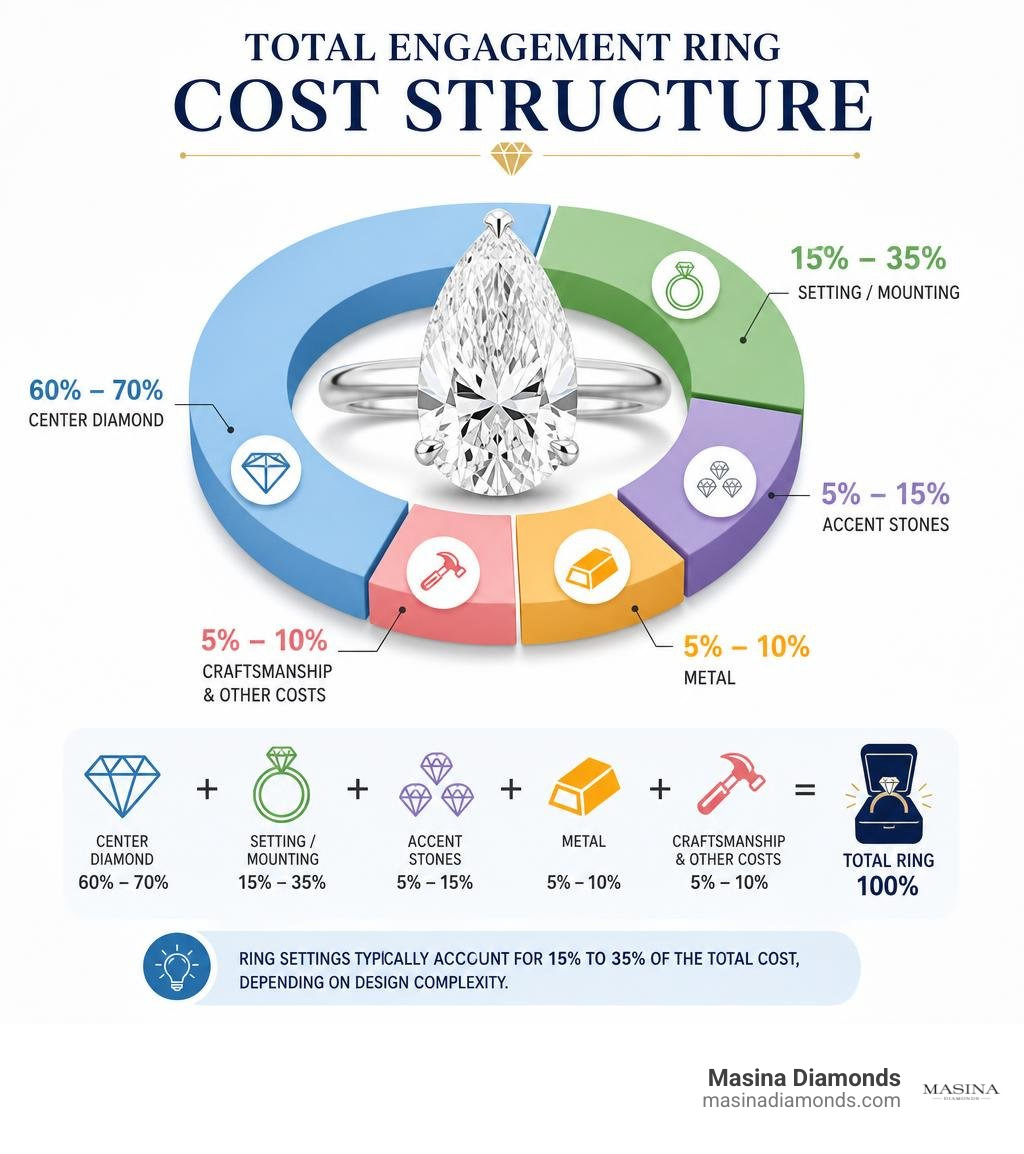
The central diamond is only part of the equation. To determine the total cost of a completed engagement ring, you must factor in the setting, accent stones, metal selection, and craftsmanship.
Breakdown of Complete Engagement Ring Costs
When planning your total ring budget, expect the mounting to account for 15% to 35% of the overall price tag, depending on design complexity:
- Simple Solitaire Setting: $400 – $1,200 (14K/18K gold or platinum band holding the pear with 5 or 6 prongs, including a V-prong to protect the point).
- Pavé or Accent Setting: $1,000 – $2,500 (Features small round brilliant diamonds set along the band).
- Halo or Split-Shank Custom Mounting: $2,000 – $4,500+ (Surrounds the pear center stone with a diamond halo or intricate split-shank diamond paths).
For example, a luxury piece like our Pear Shape Halo Engagement Ring Split Shank with 71 Carat of Diamonds in 18 Karat White Gold demonstrates how side diamonds and detailed metalwork elevate a central pear diamond into a show-stopping design.
Smart Buying Strategies for the Real Cost of 2 Carat Pear Shaped Diamond Options
To ensure you receive maximum value for your diamond purchase, keep these practical strategies in mind:
- Protect the Point: The pointed tip of a pear diamond is its most vulnerable spot. Ensure your setting includes a protective V-prong at the tip to prevent chipping during daily wear.
- Track Price Benchmarks: Compare dealer quotes against current lab-grown benchmarks ($1,880 fair market average for 2ct). If a retailer quotes $3,500 for a loose 2ct G/VS2 lab pear diamond, you know it is significantly overpriced.
- Leverage Color Grading in Yellow/Rose Gold: If setting your diamond in yellow or rose gold, you can safely select an I or J color stone without noticing warmth. The metal reflection hides minor body color, saving you 20% to 30% on stone cost.
- Explore Custom Building: Using tools like our interactive Custom Ring Builder lets you adjust center stone specs and metal choices in real time to suit your personal budget.
- Scale Comparisons: If you are weighing larger diamond budgets across different carat sizes, check out our insights on How Much Is a 3 Carat Diamond Ring.
Frequently Asked Questions About 2 Carat Pear Diamond Costs
How much does a fair market 2 carat lab-grown pear diamond cost?
As of 2026, the fair market price for a 2 carat lab-grown pear diamond with quality specs (G-H color, VS1-VS2 clarity) is approximately $1,880. Standard market listings typically range between $1,790 and $1,910, while discounted listings can drop as low as $1,510.
Is a 2 carat pear diamond more expensive than a round diamond?
Per carat of rough material, round diamonds are generally more expensive to cut than pear diamonds. However, when comparing median asking prices across live retail listings without controlling for cut quality, 2 carat pear diamonds list approximately 12% higher ($2,530 – $2,870 median range) than standard round brilliant listings. This reflects the premium attached to well-cut pears free of visible bow-ties.
What specifications offer the best visual value for a 2 carat pear diamond?
The absolute sweet spot for visual value is G to H color, VS2 to SI1 clarity (verified eye-clean), and Excellent polish and symmetry. This combination yields a bright, eye-clean diamond that faces up crisp and white while avoiding high premiums.
Conclusion
Finding the ideal 2 carat pear diamond comes down to balancing origin, visual cut performance, and setting choices. Whether you opt for a high-value lab-grown gem priced around $1,510 – $1,880 or invest in a rare natural pear diamond, focusing on an optimal length-to-width ratio (1.45–1.55) and minimal bow-tie intensity ensures your diamond shines brilliantly for a lifetime.
At Masina Diamonds, our family-owned team brings over 40 years of expert craftsmanship to help you find or custom build your ideal engagement ring right here in Atlanta, GA.
Ready to discover your perfect teardrop diamond? Design your dream piece today using our Custom Ring Builder or learn more about this elegant shape by reading Teardrop Chic: The Ins and Outs of Pear Shape Engagement Rings. If you are local to Georgia, visit our showroom to explore our selection of Engagement Rings in Atlanta GA.