What Does a 1 Carat Blue Topaz Cost?
A 1 carat blue topaz typically costs about $30–$85 as a loose stone, depending on its color and quality. Sky blue is usually the least expensive at $30–$55. Brighter Swiss blue often costs $45–$80, while deeper London blue runs about $45–$85. These are useful shopping ranges, not fixed prices.
If you're choosing a stone for a ring, start with the shade you love. Then look for even color, a lively cut, and no flaws you can see without magnification. The stone's price does not include the setting.
At Masina Diamonds, we've spent over 40 years crafting custom engagement rings and fine jewelry in Atlanta. We bring that design experience to this guide to 1 carat blue topaz, from comparing shades to choosing a stone for a ring.
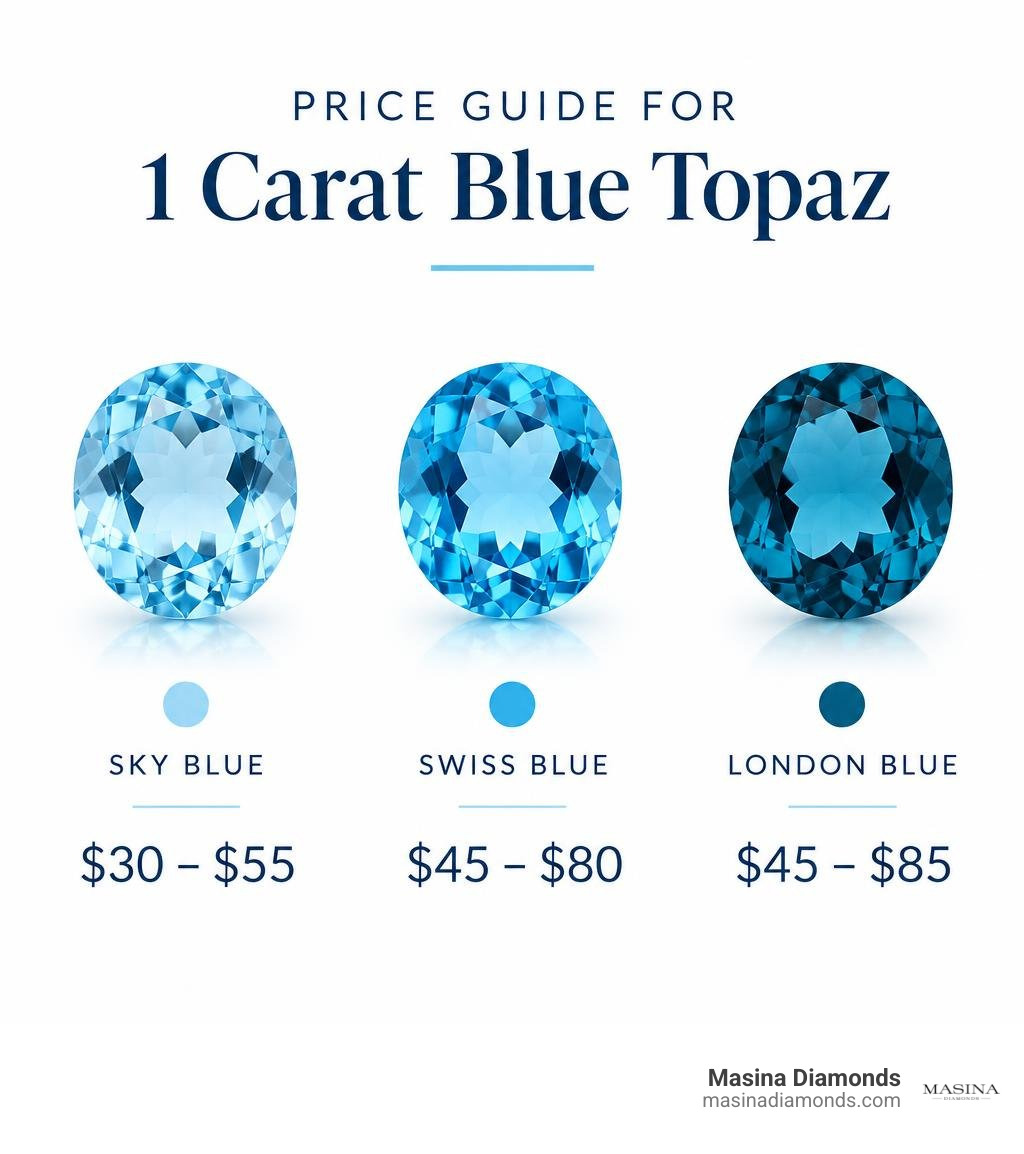
Understanding Blue Topaz Color Varieties: Sky, Swiss, and London
Blue topaz is famous for its crisp brilliance, incredible clarity, and striking spectrum of color. While naturally occurring blue topaz exists in nature, it is exceptionally pale and rare. The vibrant gems you see today owe their vivid shades to stable, standard enhancement techniques developed in the late 20th century.
As a beloved choice for fine jewelry and one of the official options highlighted in our Birthstones by Month Guide 2026, blue topaz is categorized into three primary trade varieties: Sky Blue, Swiss Blue, and London Blue.
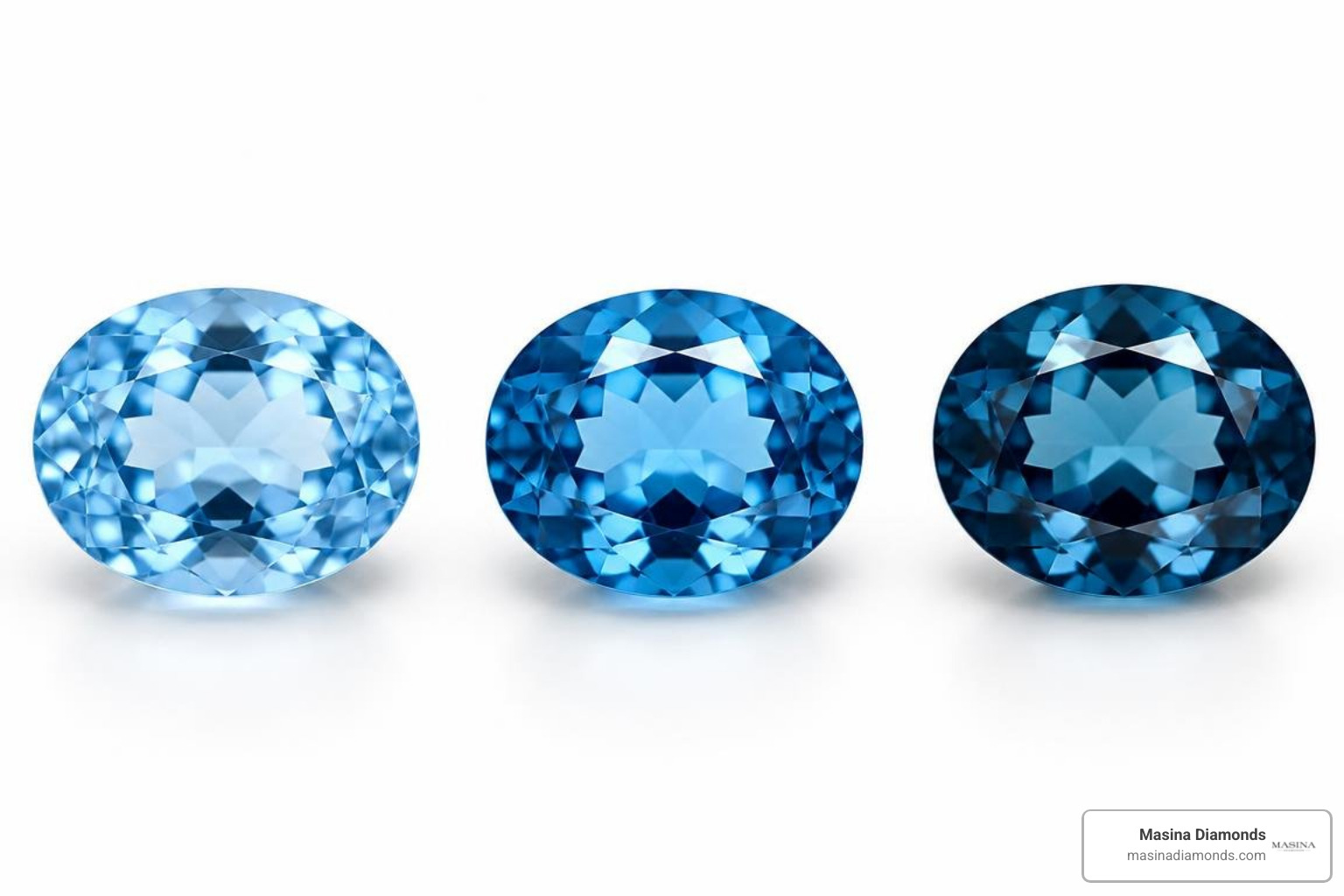
Sky Blue Topaz
Sky blue topaz displays a delicate, pastel blue reminiscent of a clear morning sky. It is the lightest of the three varieties, offering soft saturation and a gentle, icy brilliance. Because of its light tone and watery blue hue, sky blue topaz is frequently chosen as an accessible alternative to fine aquamarine. It pairs effortlessly with white gold or platinum settings to create a crisp, modern aesthetic.
Swiss Blue Topaz
Swiss blue topaz is celebrated for its intense, vivid neon or electric blue coloration. Sitting comfortably at a medium tone with high saturation, this gem delivers immediate visual impact. It has a bright, summery personality that captures and reflects light with remarkable energy. If you want a gem that pops across the room and showcases bright turquoise-to-cerulean tones, Swiss blue is an exceptional choice.
London Blue Topaz
London blue topaz is the darkest, richest, and most dramatic variety on the market. It exhibits a deep, inky navy hue with sophisticated steely-blue or slight greenish undertones. Because of its moody depth and velvety saturation, London blue offers an air of vintage luxury. It is often selected by fine jewelry collectors and couples seeking a unique, gemstone-centered ring that evokes the royal elegance of a deep blue sapphire.
Pricing Breakdown: What Does a 1 Carat Blue Topaz Cost?
Because topaz crystals are naturally abundant and modern enhancements yield consistent, uniform batches, blue topaz remains one of the most accessible fine gemstones in the jewelry world. While large statement gems over 10×8 mm command slight premiums, a standard 1-carat stone is remarkably budget-friendly.
When evaluating a pricing chart of Topaz, you will find that per-carat costs remain relatively stable across standard sizes, rising mainly when moving from lighter to deeper color saturations.
| Topaz Variety | Typical Color Tone | Average Price (1 Carat Loose Stone) | Primary Visual Appeal |
|---|---|---|---|
| Sky Blue | Light, pastel watery blue | $30 – $55 | Subtle, airy sparkle; aquamarine look |
| Swiss Blue | Vivid, electric medium blue | $45 – $80 | High energy, bright tropical brilliance |
| London Blue | Deep, inky navy with steely undertone | $45 – $85 | Moody, rich, vintage sophistication |
Factors That Influence 1 Carat Blue Topaz Value
While a 1-carat stone generally falls between $30 and $85, several key criteria determine where a specific gem lands within that range:
- Color Saturation and Depth: As outlined in the fundamental Topaz Quality Factors defined by gemological institutes, rich and highly saturated hues (such as London and Swiss blue) command slightly higher prices than pale sky blue stones.
- Irradiation & Processing Time: The deeper the blue, the longer the treatment process. London blue requires extensive neutron bombardment and lengthy resting periods, creating higher production overhead compared to rapid electron-treated sky blue gems.
- Precision of the Cut: Custom, precision-cut gemstones that maximize light performance and eliminate color zoning sell at a modest premium over commercial native cuts.
- Carat Weight Thresholds: Gemstone prices often take small leaps at milestone weights (e.g., 2, 5, and 10 carats). At the 1-carat mark, pricing is remarkably linear and consistent.
1-Carat Blue Topaz vs. Aquamarine: Price and Appearance Comparison
Because sky blue topaz and aquamarine share a pastel blue palette, shoppers often compare the two. However, aquamarine is a variety of the beryl mineral family, whereas topaz is a silicate mineral with fluorine and aluminum.
Natural aquamarine achieves its color through iron impurities during geological formation. High-quality aquamarines with deep color saturation are exceptionally rare. As seen when analyzing aquamarine price per carat data, fine aquamarine can command anywhere from $200 to over $800 per carat, whereas a treated 1-carat blue topaz of comparable clarity remains well under $100.
| Feature | 1 Carat Blue Topaz (Sky / Swiss) | 1 Carat Aquamarine |
|---|---|---|
| Mineral Species | Topaz | Beryl |
| Mohs Hardness | 8.0 | 7.5 – 8.0 |
| Typical Clarity | Type I (Virtually eye-clean / IF-VVS) | Type I to II (Eye-clean to slight inclusions) |
| Color Source | Irradiation + Heat Enhancement | Natural Trace Elements (Iron) + Mild Heat |
| Average Cost (1 ct) | $30 – $80 | $80 – $400+ (Quality dependent) |
| Refractive Index | 1.61 – 1.63 (Crisp, vitreous luster) | 1.57 – 1.58 (Soft, watery luster) |
Quality Factors: Cut, Clarity, and Treatments
To get the most beauty out of a 1-carat blue gem, it helps to understand how cut, clarity, and laboratory certifications interact.
When selecting high-end colored gemstones, consulting a GIA Certificate Colored Stones report ensures full transparency regarding the species, natural origin, and enhancement status of your stone.
Standard Shapes and Calibrated Dimensions for a 1 Carat Blue Topaz
Because blue topaz rough is relatively uniform and readily available, cutters produce standard "calibrated sizes." Calibrated dimensions allow jewelry designers to set stones seamlessly into pre-cast or custom-engineered mounts without expensive recutting.
A 1-carat blue topaz typically translates to the following millimeter dimensions depending on its geometric shape:
- Round Brilliant: 6.0 mm diameter
- Oval Cut: 7.0 × 5.0 mm
- Emerald / Octagon Cut: 7.0 × 5.0 mm or 6.0 × 4.0 mm (depth dependent)
- Cushion Cut: 6.0 × 6.0 mm or 6.5 × 5.5 mm
- Pear Shape: 7.0 × 5.0 mm or 8.0 × 5.0 mm
- Princess / Square Cut: 5.5 × 5.5 mm
Clarity Grading and Enhancement Disclosures
Topaz is classified as a "Type I" gemstone by major grading laboratories. This means that high-grade facet material is virtually free of eye-visible inclusions. When shopping for a 1-carat stone, you should expect eye-clean clarity (often grading at VVS or VS equivalent). There is rarely a reason to settle for a visibly flawed or heavily included blue topaz.
Regarding enhancements, virtually all blue topaz on the global market begins as colorless or pale rough that undergoes controlled irradiation followed by heat stabilization. This process permanently alters the crystal lattice to yield stable, permanent color that will not fade under normal sunlight or daily wear. In accordance with Federal Trade Commission (FTC) guidelines, reputable jewelers always disclose these standard enhancements.
Durability and Design: Is Blue Topaz Suitable for Everyday Rings?
With a rating of 8 on the Mohs hardness scale, blue topaz is a durable gemstone that resists scratching from dust, glass, and household surfaces. This makes it an attractive, resilient option for daily wear, including anniversary rings, pendants, and alternative engagement rings.
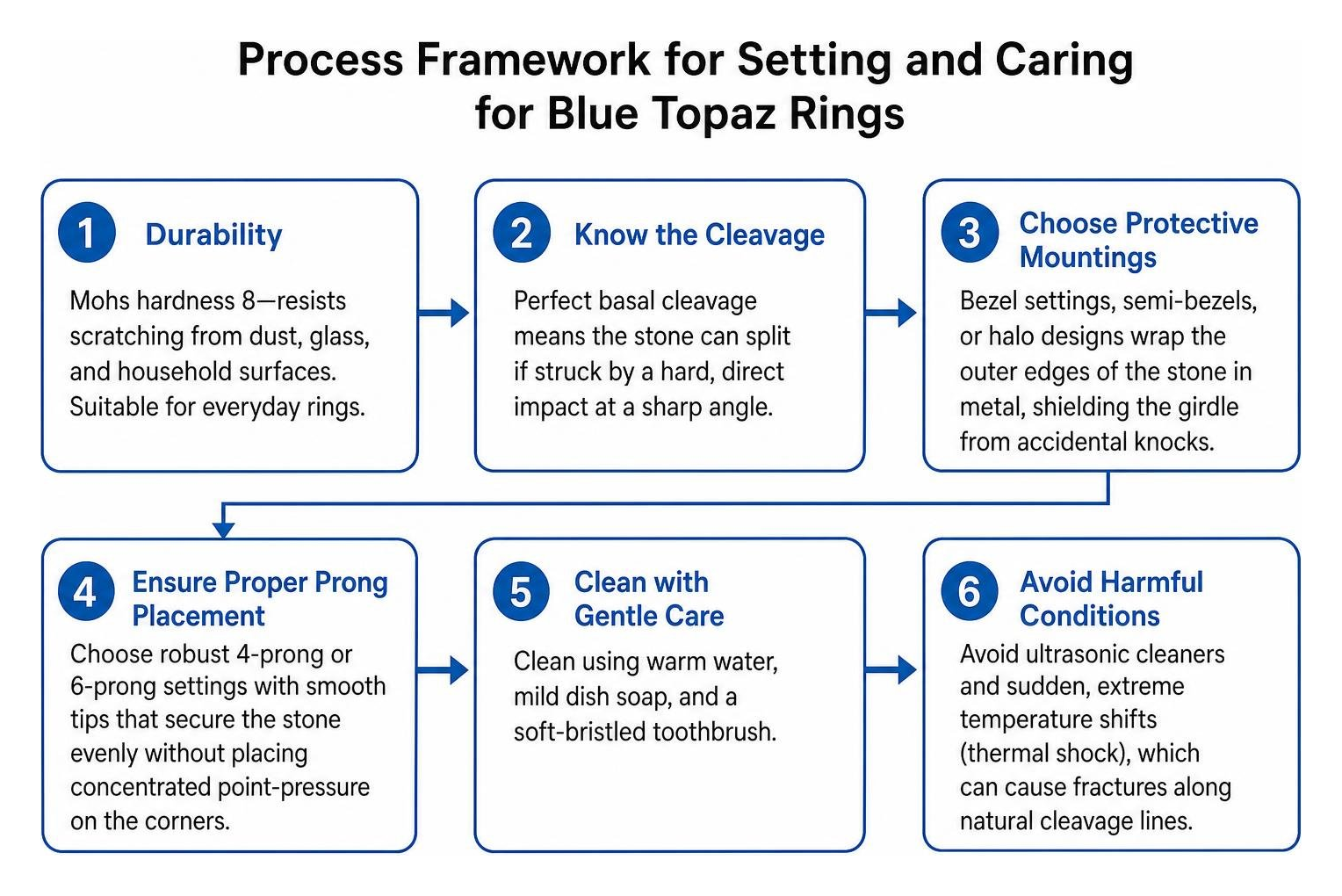
However, like diamonds, topaz possesses perfect basal cleavage. This means the crystal structure has internal planes along which it can split if struck by a hard, direct impact at a sharp angle. To ensure a 1-carat blue topaz ring lasts a lifetime:
- Choose Protective Mountings: Bezel settings, semi-bezels, or halo designs wrap the outer edges of the stone in metal, shielding the girdle from accidental knocks against countertops.
- Ensure Proper Prong Placement: If you prefer a classic prong mount, choose robust 4-prong or 6-prong settings with smooth tips that secure the stone evenly without placing concentrated point-pressure on the corners.
- Clean with Gentle Care: Clean your blue topaz jewelry using warm water, mild dish soap, and a soft-bristled toothbrush. Avoid ultrasonic cleaners and sudden, extreme temperature shifts (thermal shock), which can cause fractures along natural cleavage lines.
When planning a one-of-a-kind ring, partnering with our master jewelers for Custom Jewelry in Atlanta GA allows you to tailor both the protective setting and the overall aesthetic around your hand-selected center gem.
Frequently Asked Questions about 1-Carat Blue Topaz
Are all 1-carat blue topaz gemstones heat and radiation treated?
Yes, nearly all commercially available blue topaz gemstones have undergone irradiation and heat treatment. Natural, untreated blue topaz does occur in nature, but its color is typically an extremely faint, washed-out blue. The rich Sky, Swiss, and London shades you see in fine jewelry are achieved by exposing natural colorless topaz to laboratory-controlled electron beams or neutron bombardment, followed by heat stabilization. This treatment is uniform, completely safe, and permanent.
What is the visual difference between Swiss blue and London blue topaz?
Swiss blue topaz features an energetic, bright cerulean tone with vibrant saturation that resembles a tropical ocean. In contrast, London blue topaz is significantly darker, exhibiting an inky, slate-blue or midnight-navy hue, often with subtle grey or forest-green undertones. Swiss blue delivers high-contrast brilliance, while London blue offers moody, understated elegance.
Can I use a 1-carat blue topaz in an engagement ring?
Yes. With a Mohs hardness of 8, blue topaz is durable enough for everyday engagement rings when set in a secure, protective mounting. Because topaz has basal cleavage, it is wise to choose settings like bezels, low-profile baskets, or halos that protect the stone's edges from direct impact.
Conclusion
Whether you are drawn to the airy, delicate tones of Sky Blue, the electric vibrancy of Swiss Blue, or the deep, dramatic allure of London Blue, a 1-carat blue topaz offers an unmatched balance of fine brilliance, durability, and affordability.
To explore how blue topaz compares against other natural and lab-created gems, explore our comprehensive guide to ring stone types. When you are ready to bring your vision to life, visit our Atlanta showroom or use our online design tools to craft a custom jewelry piece that reflects your personal style.