Birthstones by Month: A Quick Guide to Every Gem
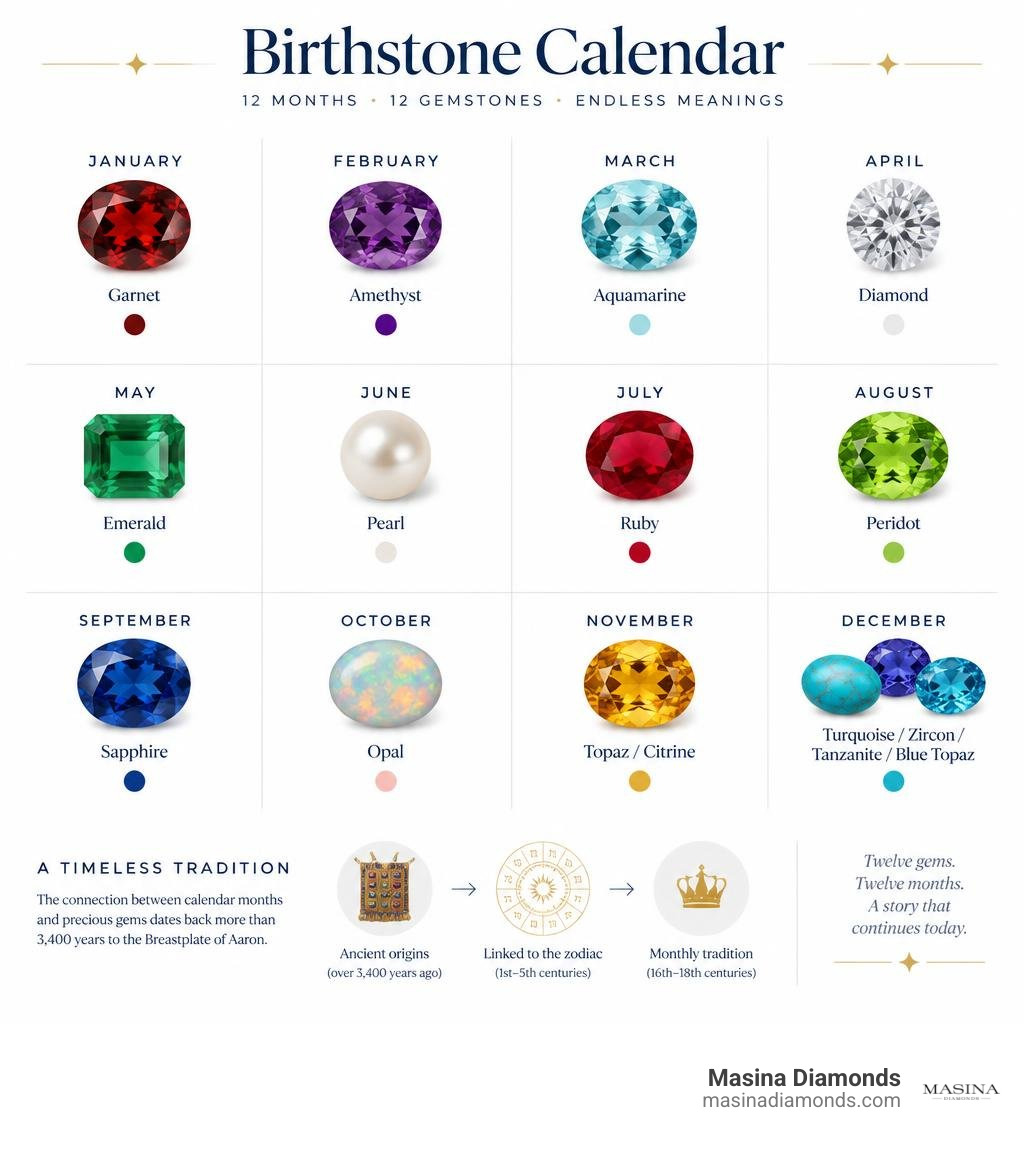
Birthstones by month pair each calendar month with one or more gemstones. The most widely used modern list is: January garnet, February amethyst, March aquamarine, April diamond, May emerald, June pearl or alexandrite, July ruby, August peridot or spinel, September sapphire, October opal or tourmaline, November topaz or citrine, and December turquoise, zircon, tanzanite, or blue topaz.
These gems can make a ring, necklace, or gift feel personal. But beauty is only part of the choice: diamond, ruby, and sapphire are strong options for daily-wear rings, while softer stones such as pearl, opal, and turquoise need more protection.
The tradition reaches back to ancient stories about twelve symbolic stones and was later organized into the modern jewelry list standardized in 1912. Some months have several accepted stones because older traditional choices remain popular alongside later additions, including tanzanite for December and spinel for August.
At Masina Diamonds, we have spent more than 40 years creating custom jewelry, engagement rings, and luxury pieces in Atlanta. We help clients turn birthstones by month into lasting designs that fit their story, style, and everyday life.
History and Evolution: Where the Monthly Gemstone Tradition Began
The connection between calendar months and precious gems traces back more than 3,400 years to the Breastplate of Aaron described in the biblical Book of Exodus. This sacred ceremonial garment held twelve distinct gemstones representing the twelve tribes of Israel. Centures later, 1st-century Jewish historian Flavius Josephus and 5th-century Saint Jerome connected these twelve breastplate stones with the twelve signs of the zodiac, and eventually to the months of the calendar year.
In early European traditions—particularly in Poland between the 16th and 18th centuries—it became fashionable to own all twelve stones and rotate them monthly, wearing whichever gem corresponded to the current month to channel its unique celestial energy.
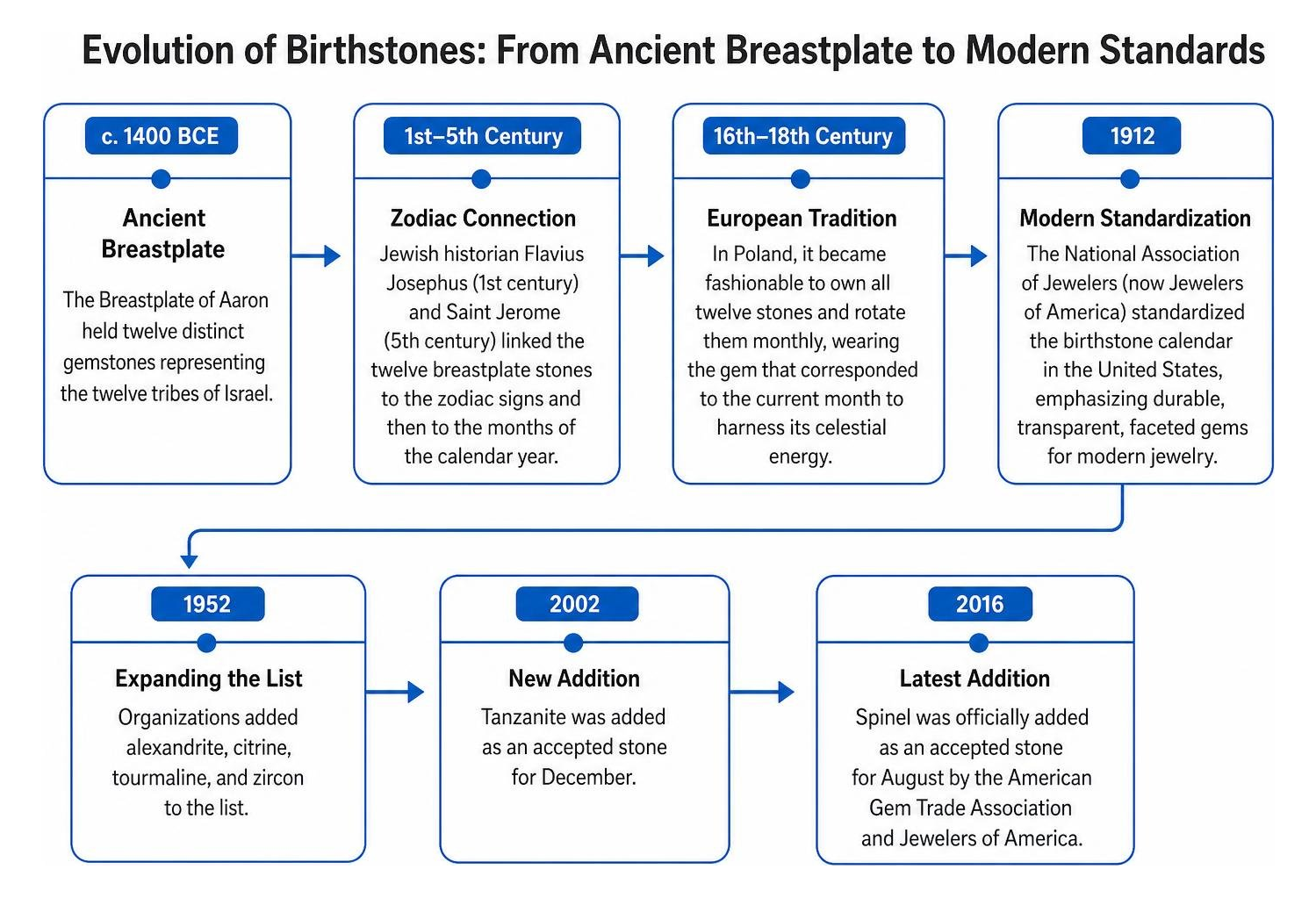
The official list we know today took shape in 1912 when the National Association of Jewelers (now Jewelers of America) met in the United States to standardize the calendar. This commercial alignment resolved centuries of regional confusion and emphasized durable, transparent faceted gems that fit beautifully in contemporary jewelry settings. For a deeper look at the mineral compositions of these crystals, you can explore this geological overview of birthstones.
The list continues to evolve to reflect new gem discoveries and market availability. In 1952, organizations added stones like alexandrite, citrine, tourmaline, and zircon. Tanzanite joined December in 2002, and spinel was officially added to August in 2016 by the American Gem Trade Association and Jewelers of America.
How Modern and Traditional Birthstones by Month Differ
The primary difference between modern and traditional birthstones comes down to material clarity, regional folklore, and setting practicality. Traditional birthstone lists relied heavily on opaque, cabochon-cut minerals and ornamental stones such as bloodstone, sardonyx, lapis lazuli, and turquoise.
When the 1912 committee met, they favored transparent, faceted crystals that could be set cleanly into pronged rings, matching modern diamond settings. Instead of eliminating the historic stones, jewelers preserved them alongside the newer choices. Discovering the historic traditional stones for birthday months allows you to choose between ancient metaphysical lore and modern brilliance.
Complete Guide to Birthstones by Month: Colors, Meanings, and Rarity
Every gemstone carries a unique balance of geological history, physical durability, color range, and metaphysical lore. Authoritative organizations such as the Gemological Institute of America define educational gemological standards that help buyers evaluate gem quality, treatments, and authenticity.
| Month | Modern Stone | Traditional Stone | Primary Color | Meaning & Symbolism | Mohs Hardness | Rarity Tier |
|---|---|---|---|---|---|---|
| January | Garnet | Garnet | Deep Wine Red | Protection, Vitality, Constancy | 6.5 – 7.5 | Common to Rare |
| February | Amethyst | Amethyst | Royal Purple | Clarity, Sobriety, Peace | 7.0 | Readily Available |
| March | Aquamarine | Bloodstone | Pastel Sea-Blue | Serenity, Safe Travels, Hope | 7.5 – 8.0 | Moderate |
| April | Diamond | Diamond | Brilliant Colorless | Eternal Love, Strength, Invincibility | 10.0 | High Value |
| May | Emerald | Emerald | Lush Vivid Green | Rebirth, Wisdom, Abundance | 7.5 – 8.0 | Very Rare |
| June | Alexandrite / Pearl | Pearl / Moonstone | Color-Change / Lustrous White | Purity, Balance, Transformation | 8.5 (Alex) / 2.5–4.5 (Pearl) | Exceptional (Alex) |
| July | Ruby | Ruby | Pigeon’s Blood Red | Passion, Courage, Prosperity | 9.0 | Ultra Rare |
| August | Peridot / Spinel | Sardonyx | Lime Green / Vibrant Red | Strength, Harmony, Protection | 6.5–7.0 (Peridot) / 8.0 (Spinel) | Moderate |
| September | Sapphire | Sapphire | Deep Velvet Blue | Truth, Sincerity, Royalty | 9.0 | High Value |
| October | Tourmaline | Opal | Multicolored / Iridescent | Creativity, Magic, Emotional Healing | 7.0–7.5 (Tourm) / 5.5–6.5 (Opal) | Moderate to Rare |
| November | Citrine | Topaz | Golden Yellow / Warm Amber | Warmth, Success, Joy | 7.0 (Citrine) / 8.0 (Topaz) | Readily Available |
| December | Tanzanite / Blue Zircon | Turquoise / Lapis Lazuli | Violet-Blue / Sky Blue | Intuition, Fortune, Good Health | 6.0–7.0 (Tanzanite) / 5.0–6.0 (Turq) | Limited Supply (Tanzanite) |
Month-by-Month Gemstone Profiles and Symbolism
January: Garnet
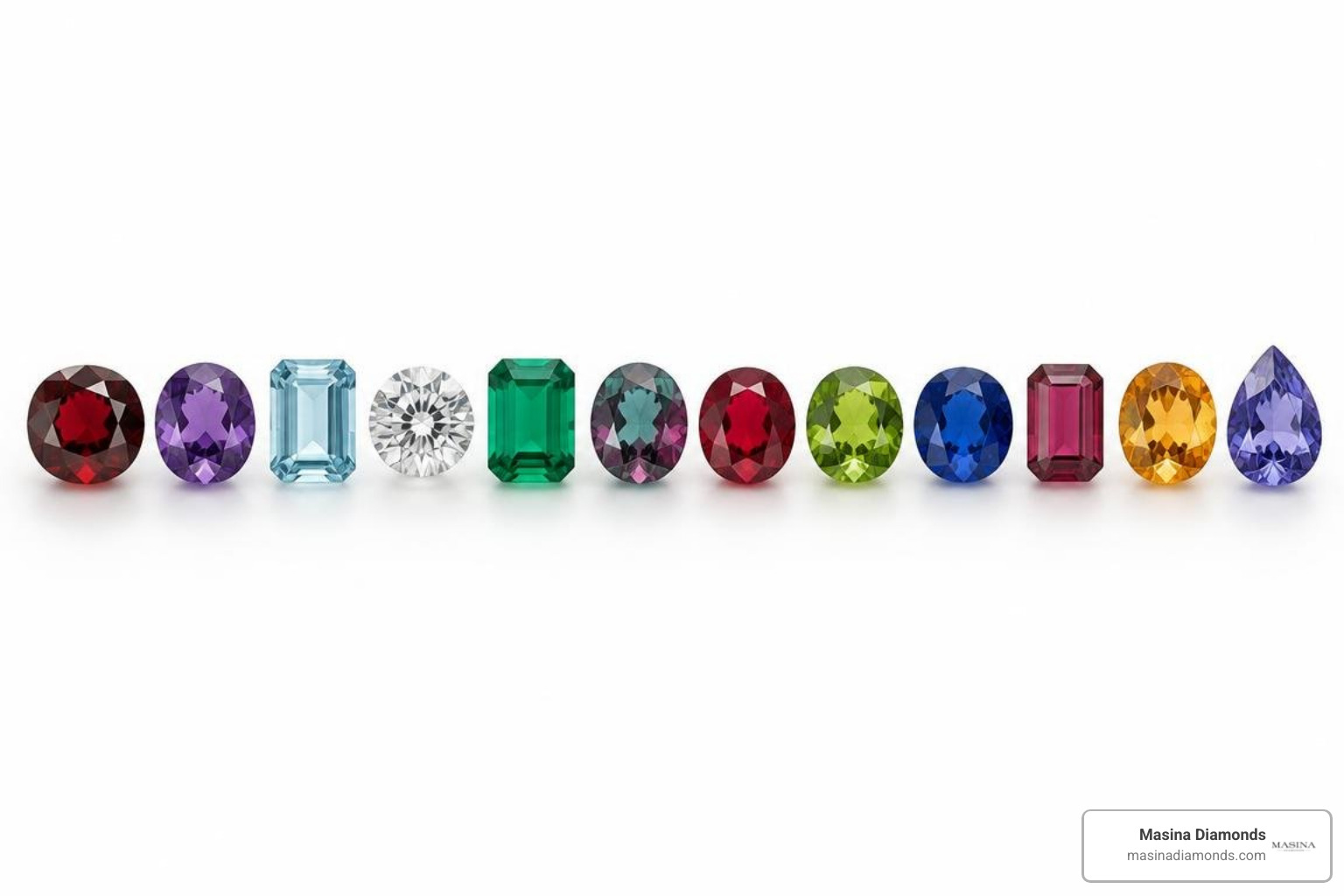
Derived from the Latin granatus (meaning "seed-like," referencing pomegranate seeds), garnets have served as protective talismans since the Bronze Age. While deep pyrope red is most famous, garnets occur in every hue—from brilliant mandarin spessartites to rare green tsavorites. Reviewing a comprehensive birthstones by month list highlights how diverse January's mineral family truly is.
February: Amethyst
Amethyst, the royal purple variety of crystalline quartz, draws its name from the ancient Greek amethystos ("not intoxicated"). The Greeks carved drinking chalices from amethyst believing it prevented drunken excess. Amethyst symbolizes clear judgment, mental peace, and poise. It remains one of the most accessible and affordable fine gemstones on the market today.
March: Aquamarine & Bloodstone
Reflecting the serene tones of seawater, aquamarine is the blue-to-blue-green variety of beryl. Roman sailors carried aquamarine amulets carved with the image of Neptune for safe ocean voyages. Traditional bloodstone, an opaque dark-green chalcedony flecked with red iron jasper, was historically treasured as a symbol of endurance and sacrificial courage.
April: Diamond
Formed deep in the Earth’s mantle under intense pressure and temperatures exceeding 2,000°F, diamonds are the hardest natural mineral known (scoring 10 on the Mohs scale). Symbolizing indestructible love and truth, natural diamonds remain the world's most sought-after gemstone for engagement rings and luxury milestone gifts.
May: Emerald
The prized green variety of beryl, emerald has symbolized renewal, lush spring growth, and royalty from the mines of Cleopatra to modern high jewelry. Natural emeralds naturally develop internal inclusion networks—poetically called jardin (French for garden)—which prove natural formation and give each stone its unique character.
June: Alexandrite, Pearl & Moonstone
June boasts three distinct gemstones:
- Alexandrite: Discovered in Russia’s Ural Mountains in the 1830s, this chrysoberyl exhibits a color-change effect ("emerald by day, ruby by night"), shifting from teal green under sunlight to raspberry red under incandescent light. Fine natural alexandrite commands $5,000–$15,000+ per carat.
- Pearl: An organic gem grown inside living mollusks, pearls represent purity and timeless grace.
- Moonstone: A feldspar mineral exhibiting adularescence, a glowing, billowy light reminiscent of moonbeams.
July: Ruby
Revered in Sanskrit as Ratnaraj ("King of Gems"), ruby is the red variety of corundum, colored by chromium. Top-tier natural rubies exhibiting vivid "pigeon’s blood" red are rarer than colorless diamonds of comparable size and can fetch record-breaking sums at auction. They represent vitality, passion, and boundless energy.
August: Peridot, Spinel & Sardonyx
- Peridot: Formed in volcanic basalt or carried to Earth inside pallasite meteorites, peridot glows with an olive-lime vibrancy.
- Spinel: Added in 2016, natural spinel is a brilliant, durable stone that was historically mistaken for ruby in royal crown jewels (such as the British Imperial State Crown's "Black Prince's Ruby").
- Sardonyx: A layered brown-and-white banded onyx, prized by Romans for signet seal rings.
September: Sapphire
Sapphire, the blue sister mineral to ruby in the corundum family, embodies celestial wisdom, fidelity, and royal dignity. While velvet cornflower blue is standard, fancy sapphires occur naturally in yellow, pink, peach, green, and vibrant orange.
October: Tourmaline & Opal
- Opal: Renowned for its rainbow "play-of-color," opal captures shifting spectral flashes within its microscopic silica spheres. Australia produces approximately 95% of the global gem opal supply.
- Tourmaline: Loved for its unmatched rainbow of colors, including bi-color "watermelon" crystals and electric neon Paraíba varieties.
November: Citrine & Golden Topaz
- Citrine: A golden variety of quartz that brings sunshine, positive energy, and financial prosperity (historically called the "Merchant's Stone").
- Topaz: A hard, dense aluminum silicate occurring in rich imperial peach-orange, sherry brown, and bright blues.
December: Tanzanite, Turquoise, Zircon & Blue Topaz
- Tanzanite: Mined exclusively within a single 4 km² strip at the base of Mount Kilimanjaro in Tanzania, tanzanite shows captivating trichroism (flashing blue, violet, and burgundy). Geologists estimate the world's primary supply will be exhausted within the next 30 to 50 years.
- Turquoise: An ancient talisman of good health, protection, and desert skies.
- Blue Zircon: A brilliant natural gemstone boasting optical fire and dispersion that rivals diamonds.
Lab-Grown vs. Natural Birthstone Options
Modern gemology makes it possible to enjoy the identical chemical, optical, and physical properties of expensive gemstones through sustainable laboratory creation.
Lab-grown diamonds, rubies, sapphires, emeralds, and alexandrites are not cheap imitations or glass simulants—they are authentic crystalline structures grown under controlled conditions duplicating the Earth's geological processes. When considering modern jewelry design, exploring beyond diamonds with vibrant gemstones in both lab-created and mined varieties gives you maximum stylistic flexibility.
| Gemstone Type | Natural Mined (Avg. Cost/ct for Fine Quality) | Lab-Created (Avg. Cost/ct) | Chemical & Physical Match | Durability / Mohs Hardness |
|---|---|---|---|---|
| Diamond (April) | $1,500 – $8,000+ | $250 – $600 | 100% Identical Carbon Crystal | 10.0 |
| Alexandrite (June) | $5,000 – $15,000+ | $60 – $250 | 100% Identical Chrysoberyl | 8.5 |
| Ruby (July) | $1,000 – $10,000+ | $40 – $150 | 100% Identical Corundum | 9.0 |
| Emerald (May) | $1,200 – $6,000+ | $80 – $300 | 100% Identical Beryl | 7.5 – 8.0 |
| Sapphire (September) | $800 – $4,000+ | $40 – $150 | 100% Identical Corundum | 9.0 |
| Amethyst / Citrine | $5 – $30 | N/A (Mined is already accessible) | Natural Quartz | 7.0 |
Durability and Wearability: Choosing the Right Gemstone for Jewelry
Not every gemstone is built for daily wear in an engagement ring or low-profile band. Gemstone durability depends heavily on hardness, toughness, and chemical resistance. Mineralogist Friedrich Mohs established the Mohs Hardness Scale in 1812 to rank scratch resistance from 1 (talc) to 10 (diamond).
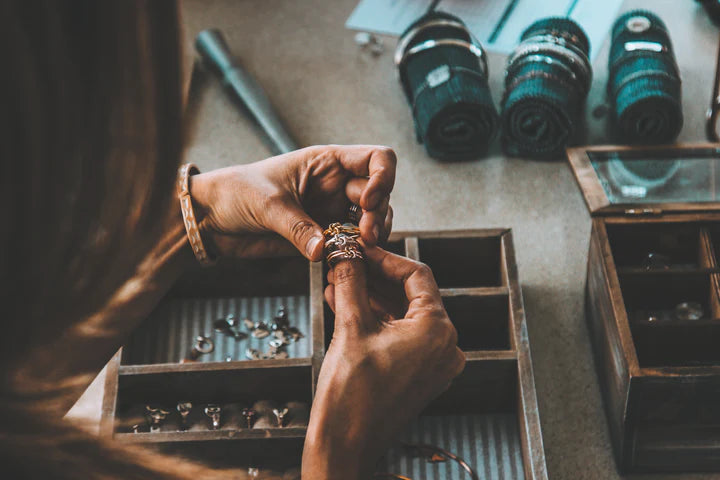
When designing a piece you intend to wear every day, our guide to selecting ring stone types details how mounting styles safeguard different crystal structures:
- Daily Wear Champions (Mohs 8–10): Diamond, Ruby, Sapphire, Spinel, and Alexandrite easily resist daily friction, airborne dust (which contains microscopic quartz at Mohs 7), and knocks against hard surfaces.
- Moderate Durability (Mohs 7–8): Emerald, Aquamarine, Garnet, Tourmaline, and Topaz make exceptional rings, but they benefit from protective settings (such as bezels, flush mounts, or sturdy v-prongs) to shield their edges from impacts.
- Special-Care & Delicate Gems (Mohs 2.5–6.5): Pearl, Opal, Turquoise, and Tanzanite are soft, brittle, or porous. They absorb household chemicals, cosmetics, perfumes, and hot water. These gems perform best in protected settings like pendants, earrings, or occasional-wear cocktail rings.
Styling and Setting Birthstones by Month in Everyday Jewelry
To ensure your fine birthstone jewelry maintains its brilliance across decades, keep these practical styling guidelines in mind:
- Match Metal Colors to Gem Undertones: Warm yellow gold enhances the rich red of garnets, the lime hues of peridot, and the golden glow of citrine. Cool platinum and 14K white gold highlight the crisp blue of aquamarine, the royal brilliance of sapphire, and the fire of diamonds.
- Design Protective Settings: For softer stones like emerald, opal, or tanzanite, request a full metal bezel or protective halo that absorbs accidental bumps.
- Know Safe Cleaning Practices: Never place emeralds, opals, pearls, or turquoise into ultrasonic cleaners or high-heat steam systems. Clean fine gemstones with a soft baby toothbrush, warm water, and gentle dish soap.
Frequently Asked Questions About Birthstones
What is the difference between birthstones and zodiac stones?
Birthstones are directly tied to the twelve Gregorian calendar months (January through December) and follow the standardized international jewelry trade list. Zodiac stones correspond to the twelve astrological star signs (such as Aries, Leo, or Scorpio), which span dates across two calendar months based on planetary positions. While birthstones follow a standardized trade system, zodiac stone traditions vary across Western, Vedic, and Chinese astrological practices.
Can you wear a birthstone that is not your birth month?
Yes. There is no historical or practical rule preventing you from wearing a gemstone associated with a different month. Many people choose stones based on color preferences, metaphysical healing qualities, or to honor loved ones. Stacking birthstone rings or wearing multi-gem pendants featuring the birthstones of your children, spouse, or parents is a classic custom design tradition.
Which birthstone is the rarest and most valuable?
Fine natural alexandrite (June) is widely considered the rarest of all traditional birthstones, particularly in clean, unheated gems over one carat displaying a dramatic color change from green to red. Natural unheated rubies ("pigeon's blood" from Burma/Myanmar) and untreated emeralds with high clarity also command exceptional auction prices that exceed fine colorless diamonds on a per-carat basis.
Conclusion
Birthstones transform fine jewelry from a simple accessory into a meaningful, personalized story. Whether you are celebrating your own milestone, crafting a custom mother's ring set with your children's gems, or designing a vibrant alternative engagement ring, understanding the history, durability, and qualities of each gem ensures your piece will last for generations.
At Masina Diamonds, we combine more than four decades of master craftsmanship in Atlanta with our interactive 3D Ring Builder, giving you the power to bring any gemstone vision to life. Explore our bespoke birthstones by month meanings and jewelry guide to start styling your personalized heirloom today.