What Does a 0.23 Carat Diamond Cost?
A natural, colorless 0.23-carat diamond with eye-clean clarity (VS1–SI1) and fine color (F–H) typically retails loose between $200 and $450 in the United States, depending on cut grade and grading laboratory. Rare fancy colored stones of the same weight, such as Fancy Intense Yellow, can exceed $3,000 due to their natural scarcity. There is no single 0.23 carat diamond price, because cut, color, clarity, and certification all shift the final figure. A published Korean reference quotes 310,000 KRW per carat for a natural G/VVS1 stone, while a 0.23-carat natural Fancy Intense Yellow diamond is listed at 13,013 PLN. Those figures come from different markets and describe very different stones, so neither is a reliable U.S. retail estimate. For your budget, compare quotes for diamonds of the same weight, cut, color, clarity, and grading report.
At Masina Diamonds, we've spent over 40 years crafting custom engagement rings and fine jewelry in Atlanta. We bring that experience to every 0.23 carat diamond price conversation, helping you weigh sparkle and quality against what you want to spend.
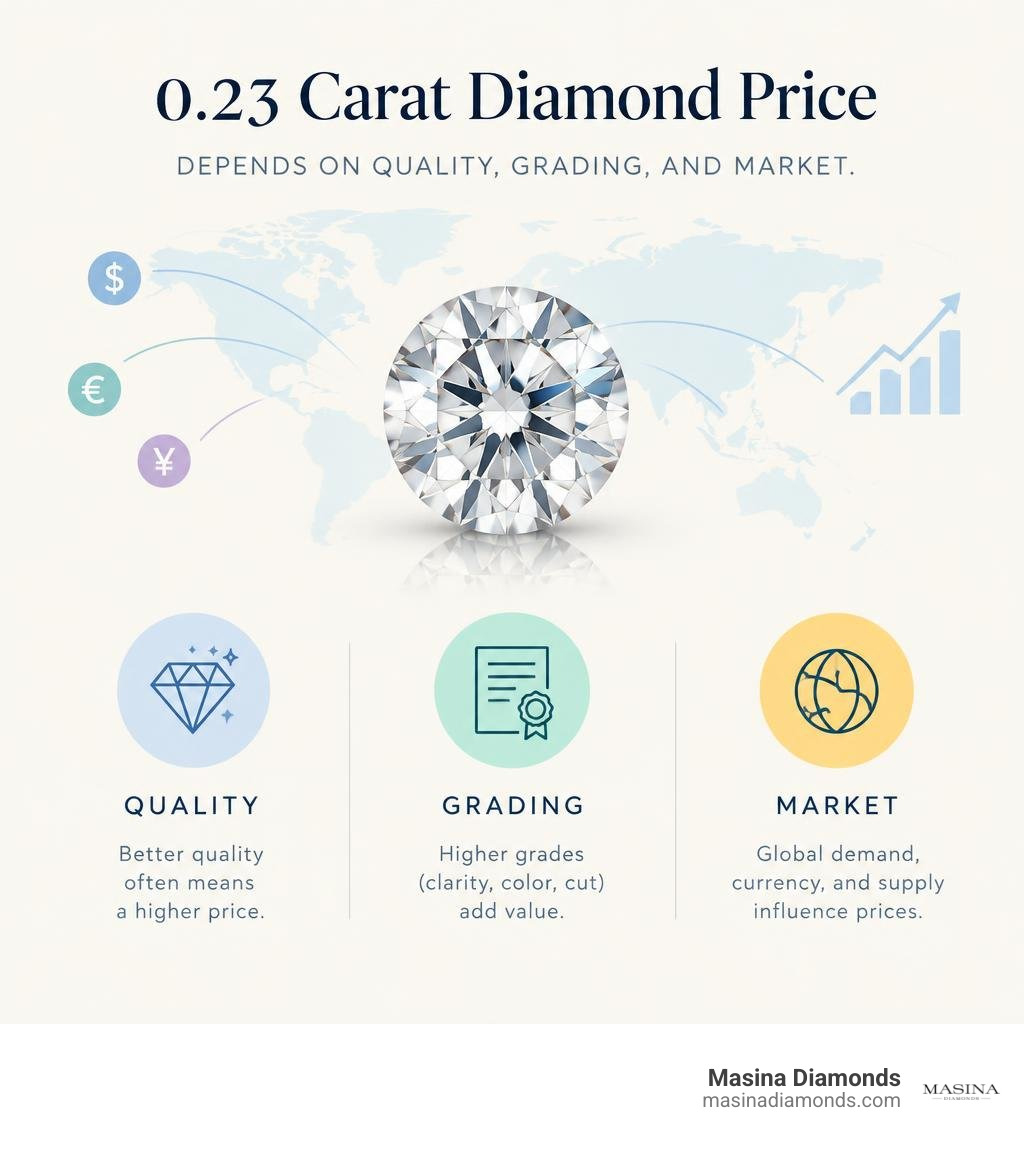
Current 0.23 Carat Diamond Price and Global Market Benchmarks
When evaluating diamond costs, you are not simply paying for raw physical weight; you are navigating a global marketplace dictated by currency exchange rates, laboratory grading standards, and strict supply grids. A 0.23-carat stone—often referred to in the jewelry trade as a "23-pointer" because one full carat contains 100 points—sits in an accessible segment of fine jewelry. Gaining a clear perspective on understanding diamond carat weight will help you see why these specific dimensions offer exceptional value.
To understand how regional exchanges value these gems, take a look at live international market data. For instance, the Seoul Gold Exchange index provides wholesale baseline valuations in East Asia, while European specialty houses highlight the significant premium placed on natural colored stones.
The following table breaks down representative market data across various grades, regional hubs, and currencies:
| Carat Weight | Color / Clarity | Shape & Cut Grade | Grading Authority | Market / Currency Reference | Equivalent USD (Approx.) |
|---|---|---|---|---|---|
| 0.23 ct | G / VVS1 | Round Brilliant, Very Good | Woojin Lab | 310,000 KRW / ct | ~$55 – $75 (Loose Wholesale) |
| 0.23 ct | F / VVS1 | Round Brilliant, Very Good | Virgin Lab | 320,000 KRW / ct | ~$60 – $80 (Loose Wholesale) |
| 0.23 ct | G / VVS1 | Round Brilliant, Very Good | Hyundai Lab | 270,000 KRW / ct | ~$48 – $65 (Loose Wholesale) |
| 0.23 ct | G / VVS1 | Round Brilliant, Fair/Good | Uncertified / Other | 180,000 KRW / ct | ~$30 – $45 (Loose Wholesale) |
| 0.23 ct | Fancy Intense Yellow / SI2 | Cushion Modified, Very Good | European Certified | 13,013.00 PLN | ~$3,200 – $3,400 (Retail) |
| 0.23 ct | E–F / VS1–VS2 | Round Brilliant, Excellent | GIA / IGI | U.S. Retail Benchmark | ~$250 – $450 (Finished Retail) |
Just as we see when analyzing 0.22 carat diamond price figures, subtle changes in color and clarity create noticeable shifts in cost. However, currency conversion and regional demand account for only part of the equation.
Price per Carat Across Weight Categories
Diamond pricing does not scale in a simple straight line. Instead, the industry uses structured weight grids (such as 0.20–0.29 ct, 0.30–0.39 ct, 0.40–0.49 ct, and 0.50–0.69 ct). When a rough crystal yields a polished diamond that crosses into a higher weight tier, the base price per carat jumps dramatically.
For example, within the wholesale 0.20 to 0.29 carat bracket:
- A 0.20 ct G/VVS1 stone might be listed at 280,000 KRW per carat.
- A 0.23 ct G/VVS1 stone rises to 310,000 KRW per carat.
- A 0.29 ct G/VVS1 stone commands up to 470,000 KRW per carat.
While a modest 10 pointer diamond size (0.10 carat) is commonly priced as commercial melee with minimal per-carat premiums, a standalone 0.75 carat diamond commands a far higher price per carat due to geological rarity. A 0.23 carat diamond strikes a sweet spot: it is substantial enough to be graded as an individual solitaire or prominent accent stone, yet remains just below the premium pricing thresholds of larger diamonds.
Price Discrepancies by Grading Laboratory
A diamond's paper credentials directly influence its market price. Premier international grading laboratories—primarily the Gemological Institute of America (GIA), HRD Antwerp, and the International Gemological Institute (IGI)—adhere to strict, standardized criteria.
When a stone is assessed by a local or secondary grading laboratory, the standards for color and clarity are often more lenient. A diamond certified as G/VVS1 by a secondary lab might only achieve an H/VS2 or I/SI1 grade if reviewed under strict GIA guidelines. As highlighted in our pricing benchmark table, a G/VVS1 stone can trade at 310,000 KRW under a respected regional certificate, drop to 270,000 KRW under another domestic lab, and fall to 180,000 KRW with an unvetted report. Savvy buyers always verify the testing entity behind the certificate.
Core Valuation Factors: The 4Cs and Beyond
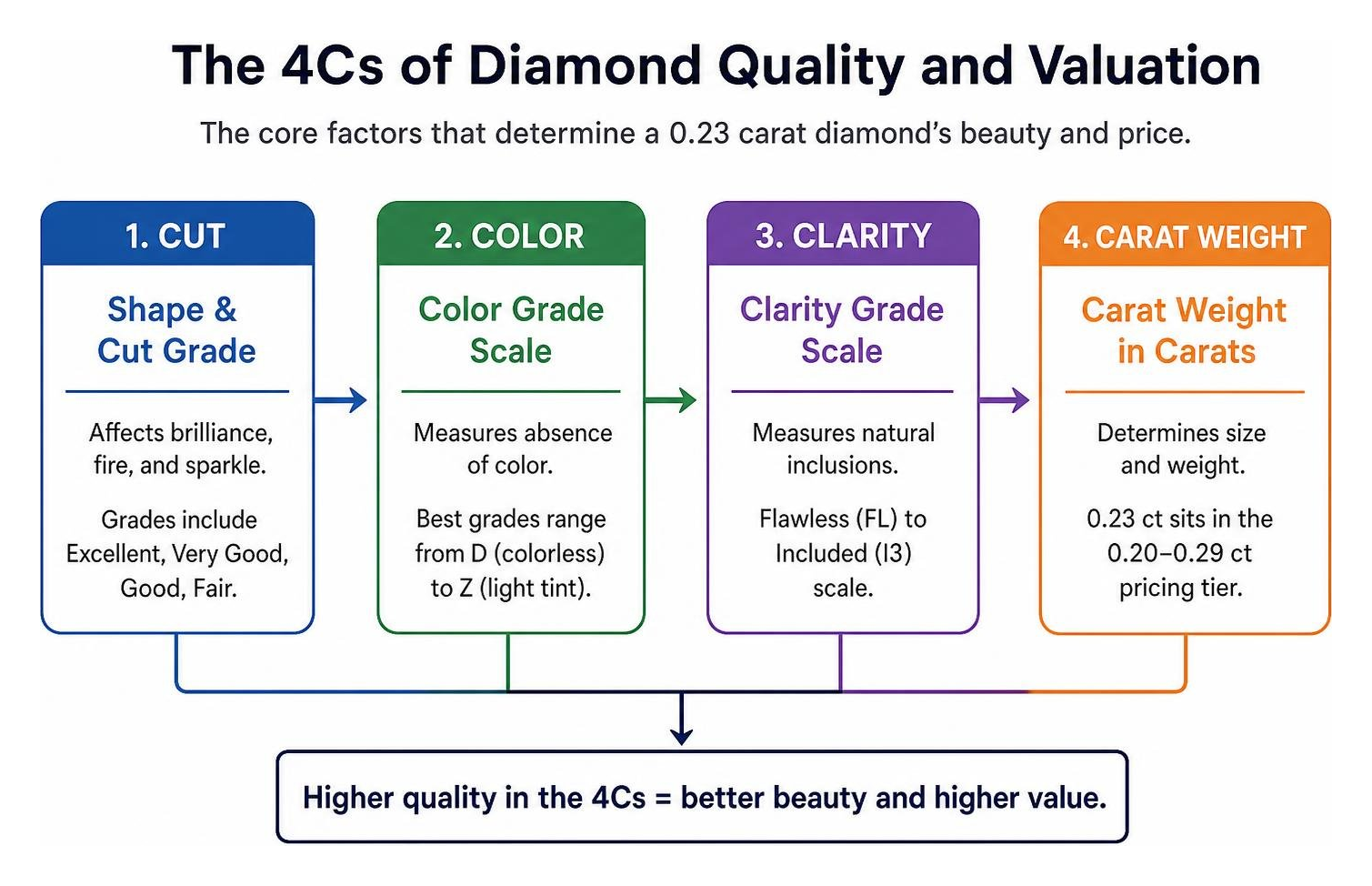
Whether you are designing a custom engagement ring or building a pendant, mastering the fundamentals of diamond value is essential. Knowing how to buy a diamond without breaking the bank starts with understanding how the classic 4Cs—Cut, Color, Clarity, and Carat weight—operate on a 0.23-carat scale.
How the 4Cs Impact 0.23 Carat Diamond Price
Each of the four main attributes impacts visual performance and pricing in specific ways:
- Cut: The quality of the cut determines how light moves through the diamond. A Round Brilliant cut commands a premium because cutting it requires discarding more of the rough crystal, but it delivers unmatched brilliance. An Excellent cut grade ensures the stone appears vibrant and bright, preventing light from leaking out through the bottom.
- Color: Color is graded from D (completely colorless) down to Z (light yellow or brown). In smaller 23-point stones, the human eye struggles to distinguish between high color grades. A D-color diamond commands a substantial premium over a G or H stone, even though both appear bright white once set in white gold or platinum.
- Clarity: Ranging from Flawless (FL) to Included (I3), clarity tracks internal inclusions and surface blemishes. In a 0.23-carat gem, inclusions are tiny. A VS1 or VS2 stone is completely eye-clean, offering the same visual appeal as a VVS1 stone without the added cost.
- Carat Weight: A 0.23-carat stone weighs exactly 46 milligrams (0.046 grams). To explore how this size balances with everyday ring wear, review our Diamond carat complete guide.
Secondary Quality Factors: Cut Details, Polish, Symmetry, and Fluorescence
Beyond the main 4Cs, several subtle characteristics influence final valuation:
- Polish and Symmetry: Rated from Excellent to Poor, crisp faceting ensures light reflects evenly across the crown. A drop from Excellent to Good can soften wholesale trading prices by 5% to 10%.
- Girdle Thickness: A girdle that is "Extremely Thin" risks chipping during setting, whereas an "Extremely Thick" girdle hides dead weight in the middle of the stone, making the 0.23-carat diamond look smaller than it should.
- Culet Size: The culet should be None or Pointed. A large, visible culet creates a dark window in the center of the table facet.
- Fluorescence: When exposed to long-wave ultraviolet light, some diamonds emit a soft blue glow. In top-tier colorless stones (D through F), medium to strong fluorescence can lower value by 15% to 25% due to the risk of a hazy appearance. In warm-toned stones (I through K), faint blue fluorescence can actually neutralize yellow undertones, making the diamond look whiter.
Price Variations: Fancy Colored vs. Colorless Diamonds
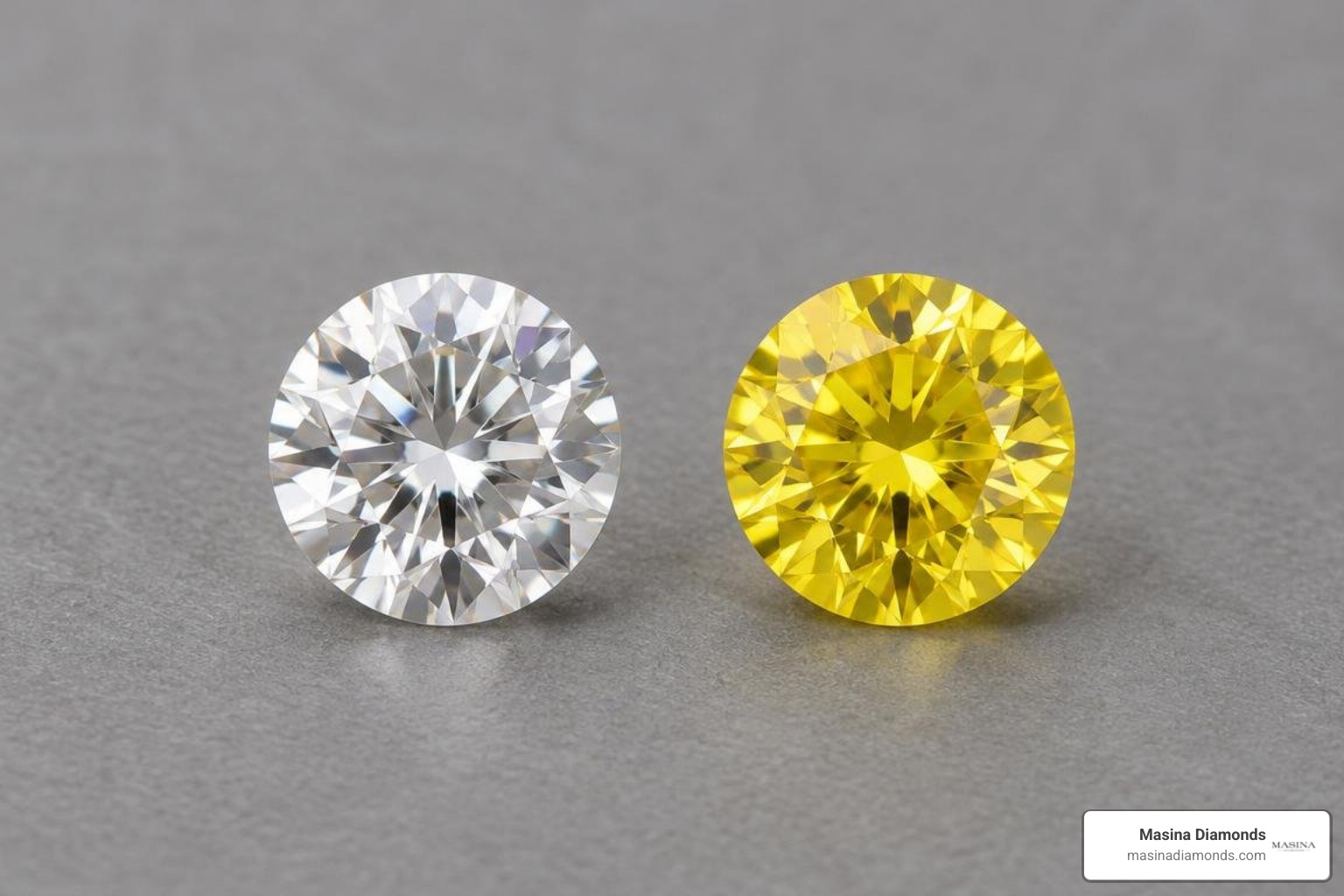
A common point of confusion is the vast price difference between a standard near-colorless diamond and a natural fancy colored diamond of the exact same 0.23-carat weight.
| Characteristic | 0.23 ct Natural Colorless (E / VS1) | 0.23 ct Natural Fancy Intense Yellow (SI2 / VG) |
|---|---|---|
| Primary Value Driver | Cut proportions, high clarity, lack of color | Color saturation, purity of hue, rarity |
| Typical Clarity Impact | Significant: Eye-cleanliness is expected | Secondary: Inclusions are forgiven for intense color |
| Wholesale / Retail Cost | ~$250 – $450 USD | ~13,013 PLN ($3,200 – $3,400+ USD) |
| Rarity Tier | Readily accessible commercial supply | Geological anomaly (Top fraction of mined rough) |
| Best Setting Use | Center stone, vintage clusters, wedding band accents | Standout collector pieces, vibrant two-tone rings |
Fancy Intense Yellow vs. Colorless 0.23 Carat Diamond Price
While a traditional diamond drops in value as it displays faint yellow tints on the D-to-Z scale, crossing into the "Fancy" classification changes the rules entirely. Natural colored diamonds owe their hues to trace elements trapped during crystal formation—such as nitrogen clusters creating rich yellow tones.
Because natural fancy colored diamonds represent less than 0.1% of global diamond production, a 0.23-carat Natural Fancy Intense Yellow stone commands thousands of dollars, whereas a natural near-colorless gem of identical weight costs a few hundred. Color intensity, tone, and saturation outweigh clarity when pricing these rare collector stones.
Resale Value and Buying Advice
Understanding resale realities ensures you make well-informed buying decisions. Whether you are balancing how to budget for an engagement ring or deciding how much money to spend on a wedding ring, setting realistic financial expectations is key.
Resale Reality and Secondary Market Benchmarks
A common industry reality is that pre-owned diamonds rarely fetch their initial retail purchase price upon resale. Retail prices factor in design, master setting labor, overhead, and certification expenses.
When assessing secondary-market diamond valuations:
- Secondary Market Pricing: Secondary-market offers typically sit 40% to 70% below wholesale benchmark sheets (such as the Rapaport index).
- Missing Paperwork: Evaluating a diamond without an accredited lab report requires factoring in grading costs, which lowers its baseline offer.
- Damaged Facets or Outdated Proportions: If a diamond has chipped facets or poor symmetry, it may require professional recutting. Recutting a 0.23-carat stone can easily drop its weight below 0.20 carats, moving it into a lower pricing bracket and reducing its value.
For smaller stones, incorporating the diamond into a new bespoke piece—such as combining it with other accents in a larger 1.2 carat diamond ring design—often yields far better lasting value.
Considerations When Buying or Evaluating a 0.23 Carat Diamond
To protect your investment and secure the best quality for your budget, keep these key points in mind:
- Prioritize Cut Quality Over Clarity: An Ideal or Excellent cut grade ensures a 0.23-carat stone maximizes light return and looks bright across the hand, whereas high clarity grades like VVS1 add cost without visible visual benefit at this scale.
- Verify Laboratory Credentials: Insist on an independent grading report from an internationally recognized body (like GIA or IGI) to ensure the stated color and clarity grades are accurate.
- Inspect Under Standard Lighting: View the gem under daylight and spot lighting to check for unwanted milkiness or strong fluorescence haziness.
- Calculate Finished Mount Costs: That custom metalwork, prong setting, and complementary side stones make up a meaningful portion of the final piece's cost alongside the center gem.
- Retain Documentation: Always store original laboratory certificates, purchase invoices, and insurance appraisals in a secure location to preserve provenance and verified value.
Frequently Asked Questions About 0.23 Carat Diamonds
How much is a 0.23 carat diamond worth today?
A natural, colorless 0.23-carat diamond certified with eye-clean clarity (VS1–SI1) and fine color (F–H) typically retails loose between $200 and $450 in the United States, depending on the cut grade and grading lab. Fancy colored stones of the same weight, such as Fancy Intense Yellow, can exceed $3,000 due to their natural rarity.
Is a 0.23 carat diamond suitable for an engagement ring?
Yes. A 0.23-carat diamond measures approximately 3.95 mm in diameter for a standard round brilliant cut. It makes a delicate, minimalist solitaire, and it works wonderfully within vintage halo mountings, three-stone rings, or custom-contoured bridal bands.
What makes fancy colored 0.23 carat diamonds so much more expensive?
Fancy colored diamonds are rare geological anomalies. While millions of carats of near-colorless diamonds are mined annually, only a tiny fraction exhibit vivid, naturally occurring colors like intense yellow, pink, or blue. This extreme scarcity drives high demand among collectors and investors.
Conclusion
Choosing the right diamond comes down to balancing aesthetic appeal, quality, and budget. While a 0.23-carat stone may seem modest on paper, prioritizing an Excellent cut and eye-clean clarity yields a bright, lively gem that holds its own in any custom design.
For over four decades, our team at Masina Diamonds has helped clients in Atlanta craft bespoke fine jewelry and one-of-a-kind engagement rings. Using our interactive 3D Ring Builder, we bring your vision to life with complete transparency at every step. Ready to find the right stone for your project? Take a moment to explore diamond carat options or schedule an appointment with our master jewelers today.