Why Choose a 14kt Engagement Ring?
14kt engagement rings are a practical choice for everyday wear. They contain 58.3% gold, blended with other metals for added strength. Compared with 18kt gold, 14kt gold usually costs less and holds up better to daily use, though any ring can scratch or need repairs. Choose the color you love, then check the setting, stone details, and care needs before you buy.
We are Masina Diamonds, an Atlanta jeweler with over 40 years of experience in diamond engagement rings and custom jewelry. We help couples design 14kt engagement rings that fit their style, daily life, and budget.
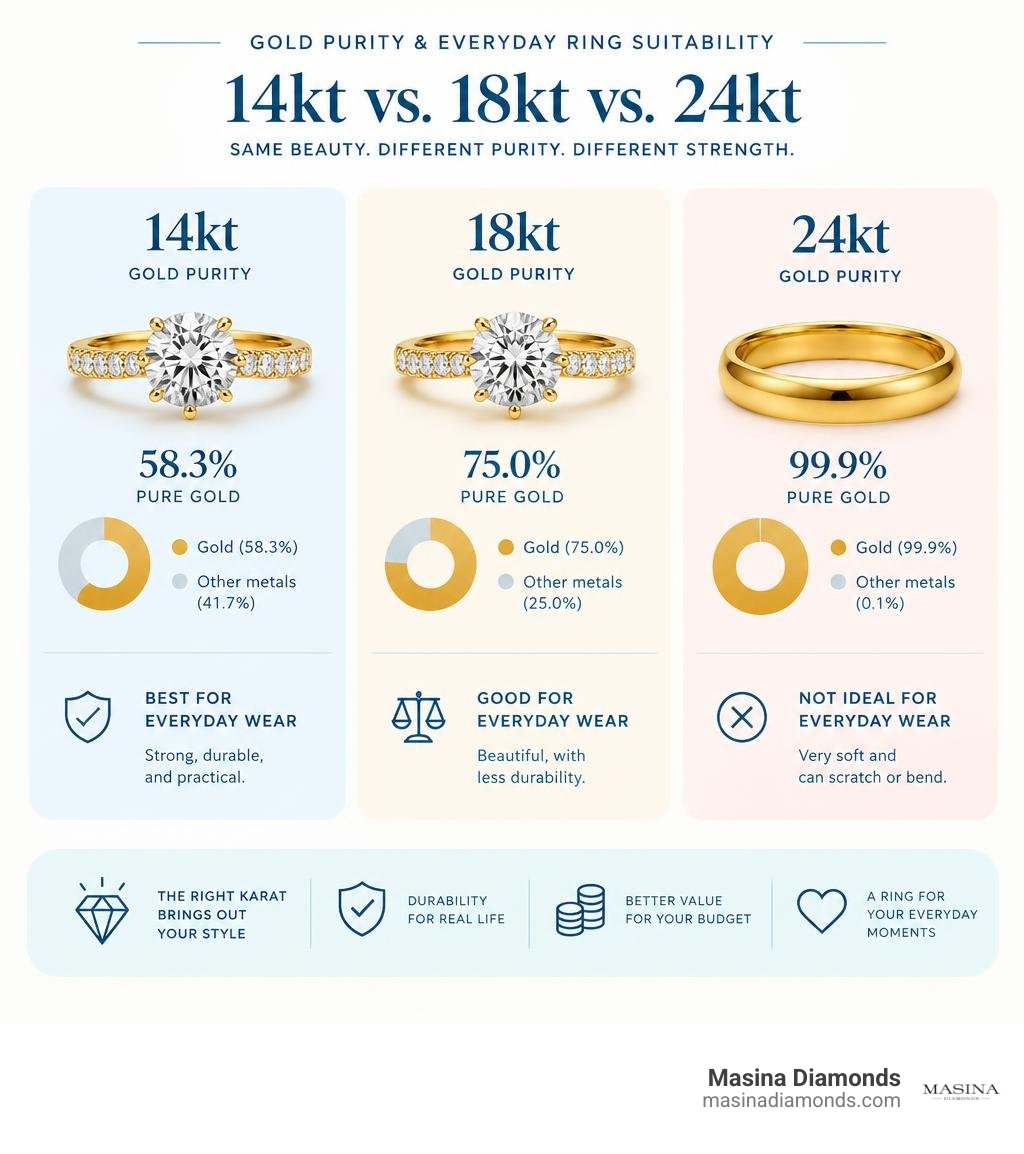
As of October 2026, gold purity continues to be a cornerstone decision for couples shopping for bridal jewelry. In the United States, roughly 70% of bridal shoppers select a gold band, and among gold options, 14 karat reigns supreme. In fact, 14k gold accounts for over 90% of all gold engagement ring sales nationwide.
The reason for this enduring popularity is simple: 14kt gold sits in the sweet spot of luxury and resilience. Pure gold (24 karat) is famously soft and malleable—so soft that you could bend a pure gold band with your bare hands, which makes it unsuitable for holding a precious diamond securely. By alloying pure gold with durable base metals like copper, silver, zinc, or nickel, jewelers create a composite metal that withstands the bumps, knocks, and daily routines of modern life without losing its radiant luster.
Whether you are beginning your search with a clear vision or exploring metals for the first time, understanding how karats affect durability, color, and cost will empower you to make the right investment.
Understanding Gold Purity: 14kt vs. 18kt Gold
When shopping for fine jewelry, the term "karat" (abbreviated as "k" or "kt") measures the ratio of pure gold to other alloyed metals on a 24-part scale.
- 24kt Gold: 24 out of 24 parts gold (99.9% pure). It features an intense, reddish-yellow color but lacks the structural integrity required to hold gemstones.
- 18kt Gold: 18 out of 24 parts gold (75.0% pure, alloyed with 25% other metals). It has a richer, deeper golden hue and is heavily favored in European markets and high-end luxury fashion.
- 14kt Gold: 14 out of 24 parts gold (58.3% pure, alloyed with 41.7% other metals). It is engineered for maximum strength, resilience, and practical longevity.
To help you compare your options, take a look at how these two bridal favorites match up across everyday performance criteria:
| Feature | 14kt Gold | 18kt Gold |
|---|---|---|
| Gold Purity | 58.3% pure gold (Stamped 585 or 14K) | 75.0% pure gold (Stamped 750 or 18K) |
| Vickers Hardness (HV) | ~130–160 (Higher scratch resistance) | ~120–140 (Softer, shows wear faster) |
| Relative Cost | Baseline (10–15% lower setting cost) | Premium (Higher raw gold content) |
| Color Saturation | Subtle, balanced warm tones | Deep, rich, vibrant yellow |
| Everyday Wear Suitability | Excellent for active lifestyles | Good, best for gentle to moderate wear |
If you appreciate the warm tone of traditional gold but need an everyday setting that resists scuffs, browsing through fine 14k yellow gold jewelry is a wonderful starting point to observe how subtle and balanced this alloy appears in person.
Durability and Everyday Wear for Gold Alloys
Durability in fine jewelry involves both hardness (resistance to surface scratching) and tensile strength (resistance to bending or snapping). On the Vickers Hardness Scale, standard 14kt alloys regularly score higher than 18kt alloys because the higher concentration of base metals—such as copper and zinc—reinforces the internal crystal matrix of the metal.
What does this mean for your ring? It means the prongs gripping your center stone will better resist snagging and bending out of shape when you reach into your purse, lift weights, or handle daily chores. While no precious metal is entirely scratch-proof, a 14kt gold ring maintains its shape over decades of constant wear with minimal metal loss during routine polishings.
Price Comparison and Value Retention
Because 18kt gold contains 75% pure gold by weight compared to 14kt gold's 58.3%, it directly tracks higher against spot gold commodity pricing. On average, selecting a 14kt gold setting saves you 10% to 15% compared to the exact same design cast in 18kt gold.
Typical 14kt gold ring settings range from $300 to $1,200 depending on the complexity of the design, accent stones, and metal weight. Choosing 14kt allows you to redirect more of your overall engagement budget toward a larger, higher-grade center stone or a custom matching wedding band.
In terms of long-term value, 14kt gold jewelry holds dependable intrinsic value. In secondary markets, well-crafted 14kt gold engagement rings generally retain 60% to 70% of their base metal and diamond trade value, fluctuating alongside global precious metal indices.
Why 14kt Engagement Rings Offer the Best Value and Durability
There is a distinct reason why 62% of brides surveyed choose 14kt gold when designing their bridal sets: it eliminates the need to compromise between beauty, structural security, and financial value.
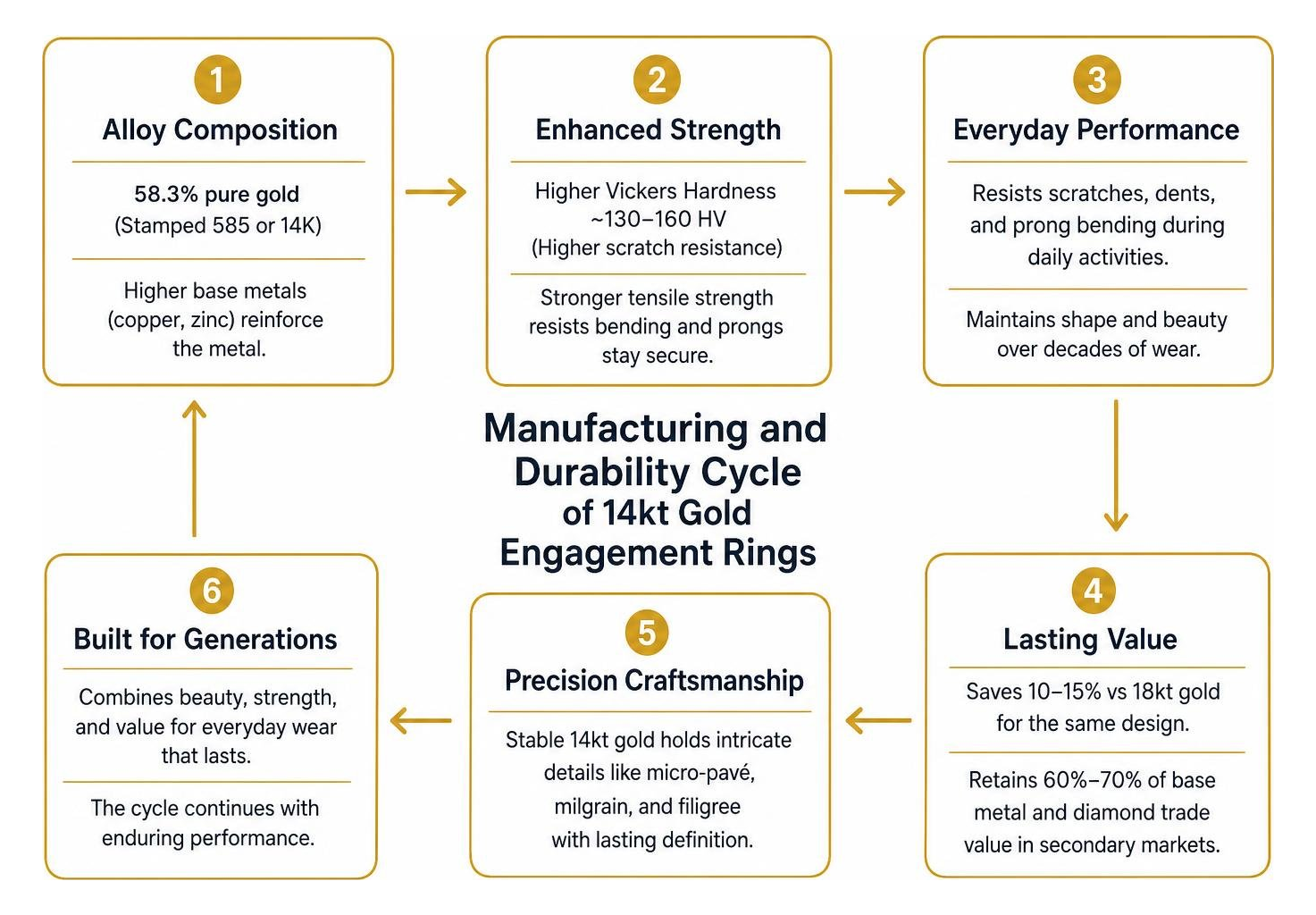
When commissioning custom engagement rings, working with 14kt gold provides master jewelers with an exceptionally stable canvas. Intricate details like micro-pavé bands, hand-applied milgrain edges, and vintage filigree hold their sharp definition over the years far better than softer high-karat alternatives.
| Pros of 14kt Gold | Cons of 14kt Gold |
|---|---|
| Superior scratch and dent resistance | Contains slightly less pure gold (58.3%) |
| Prongs retain tension firmly around diamonds | May trigger mild reactions in nickel-sensitive skin (~10%) |
| Cost savings can be reallocated to the center gem | Color is slightly less saturated than 18kt yellow gold |
| Exceptional durability for delicate vintage/pavé styles | White gold requires occasional rhodium replating |
Popular Metal Colors for 14kt Engagement Rings
Gold does not come out of the ground in white or rose; its color is shaped by the master alloying process. Because 14kt contains 41.7% alloy metals, jewelers can tailor its hue with remarkable precision:

- 14kt Yellow Gold: Alloyed with a harmonious mix of copper, silver, and zinc. It produces a soft, champagne-warm glow that looks timeless without looking overly brassy.
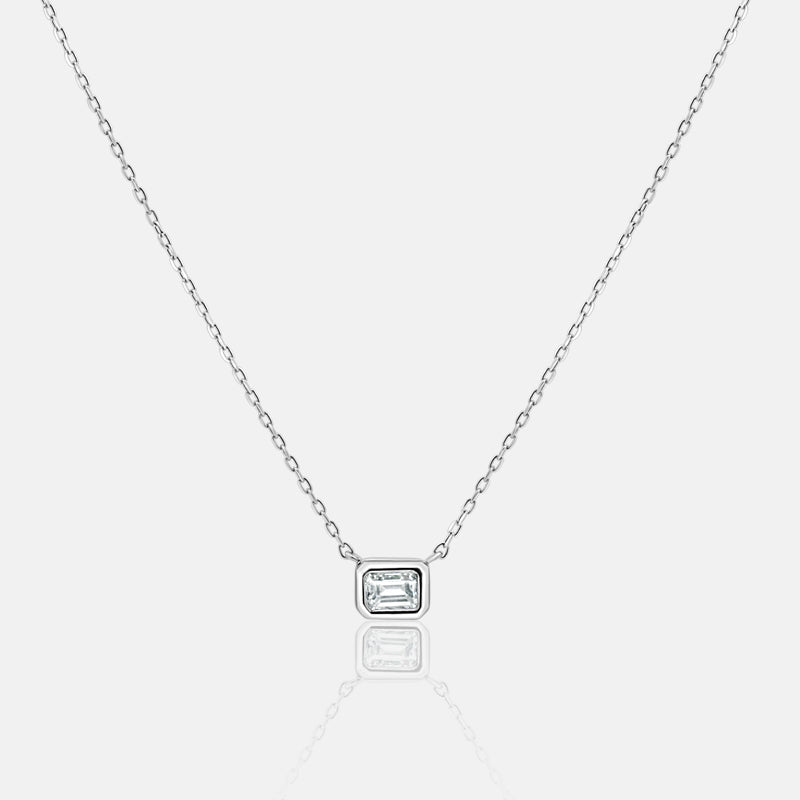
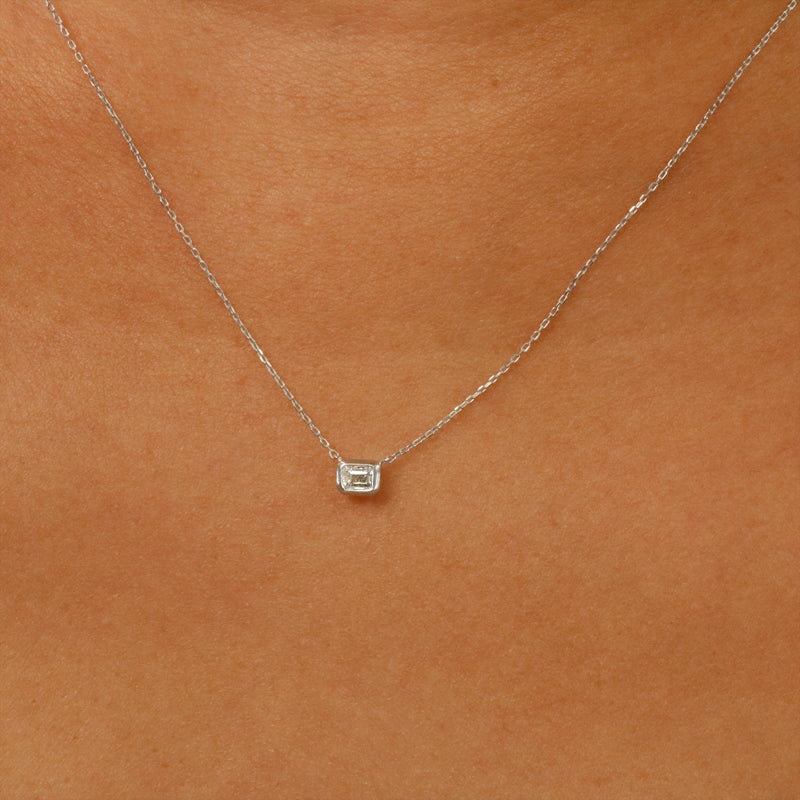
- 14kt White Gold: Alloyed with bright white metals like nickel, silver, or palladium, and coated in a brilliant layer of rhodium. Exploring 14k white gold jewelry showcases how this alloy achieves a mirror-bright, platinum-like appearance at a fraction of the weight and expense.
- 14kt Rose Gold: Created by increasing the proportion of copper in the alloy mix. 14kt rose gold possesses a warm, romantic blush that is durable and resistant to tarnish.
Skin Sensitivities and Hypoallergenic Factors
Pure gold is completely hypoallergenic and inert. However, the alloy metals used in gold jewelry can occasionally trigger mild skin sensitivities.
Approximately 10% of the population experiences mild contact dermatitis when exposed to trace amounts of nickel, which is historically used in some white gold alloys to give the metal its silver tone. If you or your partner have sensitive skin or a known nickel allergy, let your jeweler know. We can craft your ring using nickel-free 14kt white gold alloys (utilizing palladium or silver blends) or recommend standard 14kt yellow or rose gold, which rarely contain nickel.
Best Styles and Gemstone Pairings for 14kt Gold Settings
The structural versatility of 14kt gold makes it an ideal match for virtually any gemstone cut or jewelry architecture. Because the prongs remain stiff and secure, it provides a stable foundation for heirloom-quality center stones.
Couples exploring diamond engagement rings in Atlanta GA can leverage the warm or cool undertones of different 14kt alloys to optimize their diamond's visual presentation.

Diamond Shapes and Colored Gemstones
- Elongated Cuts & Fancy Shapes: Shapes with pointed or exposed corners—such as pear, marquise, and radiant cuts—demand rigid prongs to protect the tips from chipping. 14kt gold delivers this necessary strength.
- Warm Undertones and Near-Colorless Diamonds: If you are selecting classic oval engagement rings, pairing them with 14kt yellow or rose gold allows you to choose diamonds in the G through J color grading ranges without noticing faint warmth, as the metal naturally complements the stone.
- Vibrant Gemstones: The deep, royal hue of natural sapphire engagement rings creates a breathtaking visual contrast against the crisp backdrop of 14kt white gold or the vintage warmth of yellow gold.
Trending Settings and Ring Finishes
14kt gold accommodates a wide spectrum of stylistic aesthetics:
- Classic Solitaires: A minimalist simple engagement ring highlights the diamond, allowing a polished 14kt gold band to provide understated elegance.
- Halo & Pavé Styles: For those who adore extra brilliance, halo engagement rings in Atlanta GA utilize sturdy 14kt beads to lock small accent stones firmly in place, keeping them safe from loosening during daily wear.
- Modern Bezel Mounts: A smooth collar of 14kt gold wrapping entirely around the diamond offers maximum protection for active lifestyles, pairing clean industrial lines with reliable stone security.
- Surface Finishes: Beyond high-polish shine, 14kt gold can be customized with satin, matte, brushed, or hammered finishes to give modern or vintage bands distinct tactile character.
Practical Care and Quality Checklist for Buyers
A fine engagement ring is designed to last generations, but it requires thoughtful maintenance to keep its brilliance intact.
When you purchase a ring, verify the authentic hallmarks stamped inside the shank. A genuine 14kt gold piece will be stamped with either "14K", "14KT", or the metric fineness number "585" (indicating 58.5% gold purity).
How to Clean and Maintain 14kt Engagement Rings
Caring for 14kt gold at home is simple and safe:
- Warm Soaking: Fill a small bowl with warm water and a few drops of mild, lotion-free dish soap. Soak your ring for 15 to 20 minutes to dissolve built-up skin oils and lotions.
- Soft Brushing: Use an extra-soft toothbrush to gently clean beneath the diamond basket and behind the prongs. Never use abrasive toothpastes or harsh chemical cleaners like chlorine or bleach, which can erode gold alloys.
- Rinse & Dry: Rinse thoroughly with warm water (make sure the sink drain is plugged!) and pat dry with a lint-free microfiber cloth.
- Professional Checkups: We recommend scheduling professional jewelry care in Atlanta GA every 6 to 12 months. An expert jeweler will inspect the prongs under magnification and use ultrasonic and steam equipment to restore the ring to showroom condition.
For 14kt white gold rings, plan to have the rhodium plating reapplied every 1 to 3 years. This quick, non-destructive treatment restores the ring's ultra-bright, icy white sheen.
What to Check Before Purchasing
Before finalizing your ring purchase, run through this practical quality checklist:
- Prong Construction: Ensure the prongs are uniform, thick enough to endure friction, and flush against the gemstone's crown.
- Center Stone Certification: Verify that your diamond is certified by an independent laboratory (such as the Gemological Institute of America or IGI). This applies whether you select natural mined stones or modern lab diamonds.
- Smooth Finishing: Run your fingers around the metal edges and inner gallery. The band should feel smooth and balanced, with no sharp mold lines or uneven casting pits.
- Warranty & Sizing Support: Confirm the jeweler offers clear resizing policies, lifetime cleaning, and routine maintenance coverage.
Frequently Asked Questions About 14kt Gold Rings
Can 14kt gold be worn every day without tarnishing?
Yes. 14kt gold is highly resistant to tarnish and corrosion. Under normal daily conditions—such as washing your hands, showering, and working—14kt gold will not rust or discolor. However, you should avoid exposing your ring to harsh chemicals, particularly swimming pool chlorine or household bleach, which can weaken the alloy matrix over time.
Does 14kt white gold turn yellow over time?
14kt white gold contains a natural warm undertone because it is made of 58.3% pure yellow gold. To achieve a bright white chrome look, jewelers electroplate white gold with rhodium. Over years of friction against the skin, this micro-layer of rhodium slowly thins, revealing the warm, champagne-toned white gold beneath. A quick, inexpensive rhodium dip fully restores its mirror-bright white finish.
Is 14kt gold easy to resize and repair?
14kt gold is one of the easiest and most reliable metals for jewelers to work with. It responds well to torch and laser welding, allowing seamless adjustments whether you need the band sized up or down. If your ring ever takes a heavy hit, experienced bench jewelers providing jewelry repair in Atlanta GA can easily retip worn prongs or reshape the band without compromising the ring's structural integrity.
Conclusion
Choosing an engagement ring is an exciting milestone that blends personal romance with practical engineering. A 14kt gold ring gives you the best of both worlds: genuine precious gold luxury combined with the everyday resilience needed to withstand decades of adventures together.
By saving on the setting through 14kt gold, you gain greater freedom to invest in an extraordinary center diamond or a completely unique custom design.
For a deeper look into selecting the right metal shade for your skin tone and lifestyle, explore our comprehensive guide to white gold vs yellow gold for engagement rings. When you are ready to bring your vision to life, visit Masina Diamonds in Atlanta to try on designs, inspect stones in person, and build the heirloom ring you will cherish forever.