Why the Rolex Explorer II 16570 Keeps Winning Collectors Over
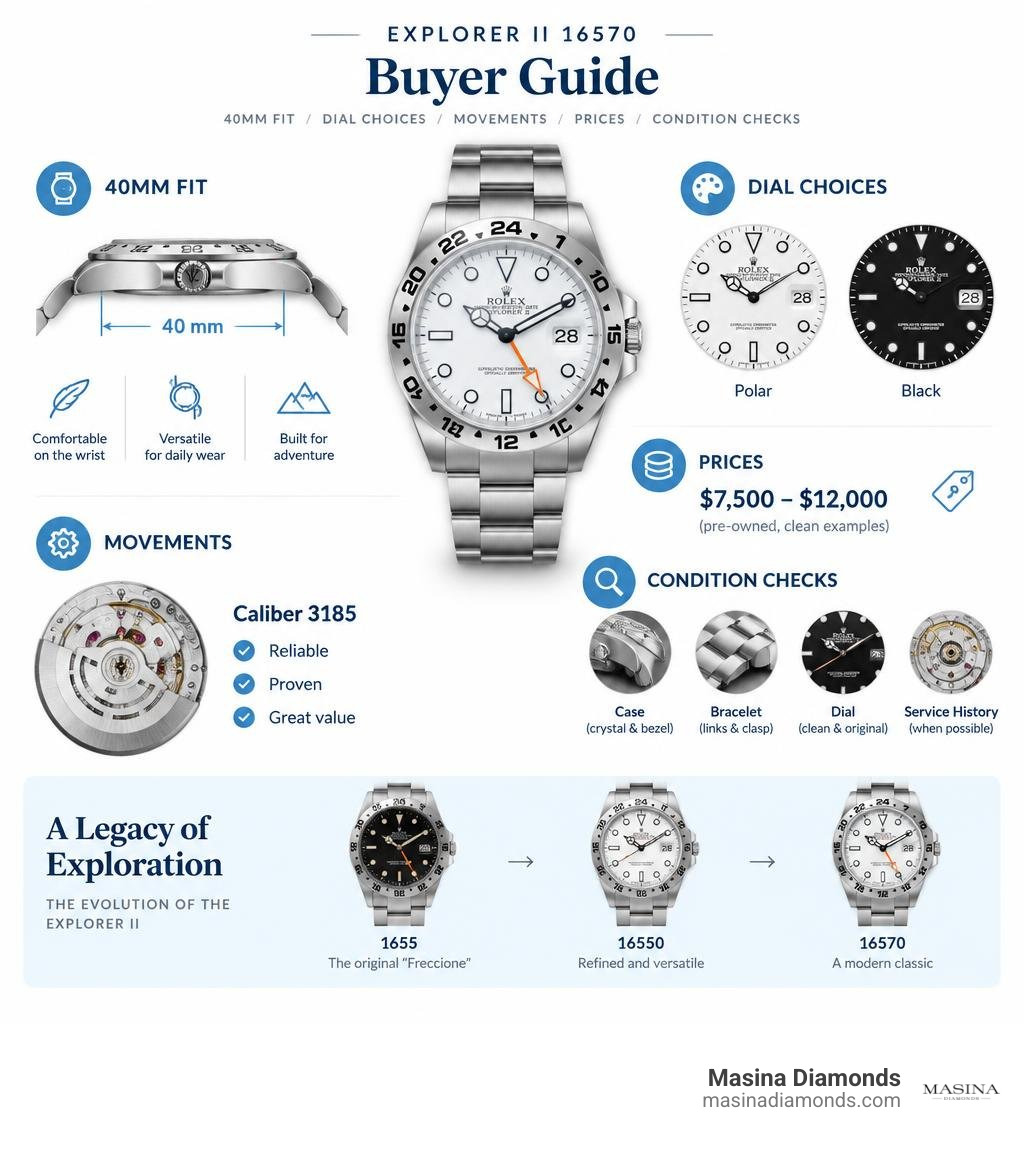
The Explorer II 16570 is a strong choice if you want a Rolex to wear often, not just admire. Its 40mm case is easier to wear than the 42mm model that followed it, while its fixed steel bezel and second-time-zone hand make it a useful travel watch. Clean pre-owned examples often fall between $7,500 and $12,000, though condition and originality matter more than any single price guide.
For most buyers, a well-kept Caliber 3185 is the better value than paying extra for a later 3186. Choose the white Polar or black dial by what you enjoy wearing, then check the case, bracelet, dial, and service history before you buy.
We are Masina Diamonds, a family-owned Atlanta jeweler with over 40 years of craftsmanship and experience with luxury watches. That background shapes our explorer ii 16570 review: we focus on the details that make a watch worth keeping.
Heritage and Evolution of the Rolex Explorer II 16570
The story of the Explorer II is unique in horology. While the Submariner conquered ocean depths and the GMT-Master ruled transcontinental aviation, the Explorer II targeted subterranean cave exploration. When Rolex introduced the original Explorer II reference 1655 in 1971—frequently called the "Freccione" due to its arrow-shaped orange hand—it was designed specifically for speleologists working in pitch darkness. In caves where night and day blur, the fixed 24-hour bezel combined with the 24-hour hand acted as an AM/PM indicator rather than a dual-time complication.
Understanding the historical evolution of the Explorer line reveals why the reference 16570 became the mechanical pinnacle of classic tool-watch design. In the mid-1980s, the transitional reference 16550 introduced modern elements: a sapphire crystal, modern Mercedes hands, and the Caliber 3085 movement with an independently adjustable local hour hand. However, the 16550 was short-lived.
In 1989, Rolex released the reference 16570. This reference refined everything that made the transitional piece great while perfecting the mechanics inside a streamlined 40mm profile. With a 22-year production run spanning from 1989 to 2011, the 16570 bridged vintage charm and modern durability.
Design Nuances, Proportions, and Dial Configurations
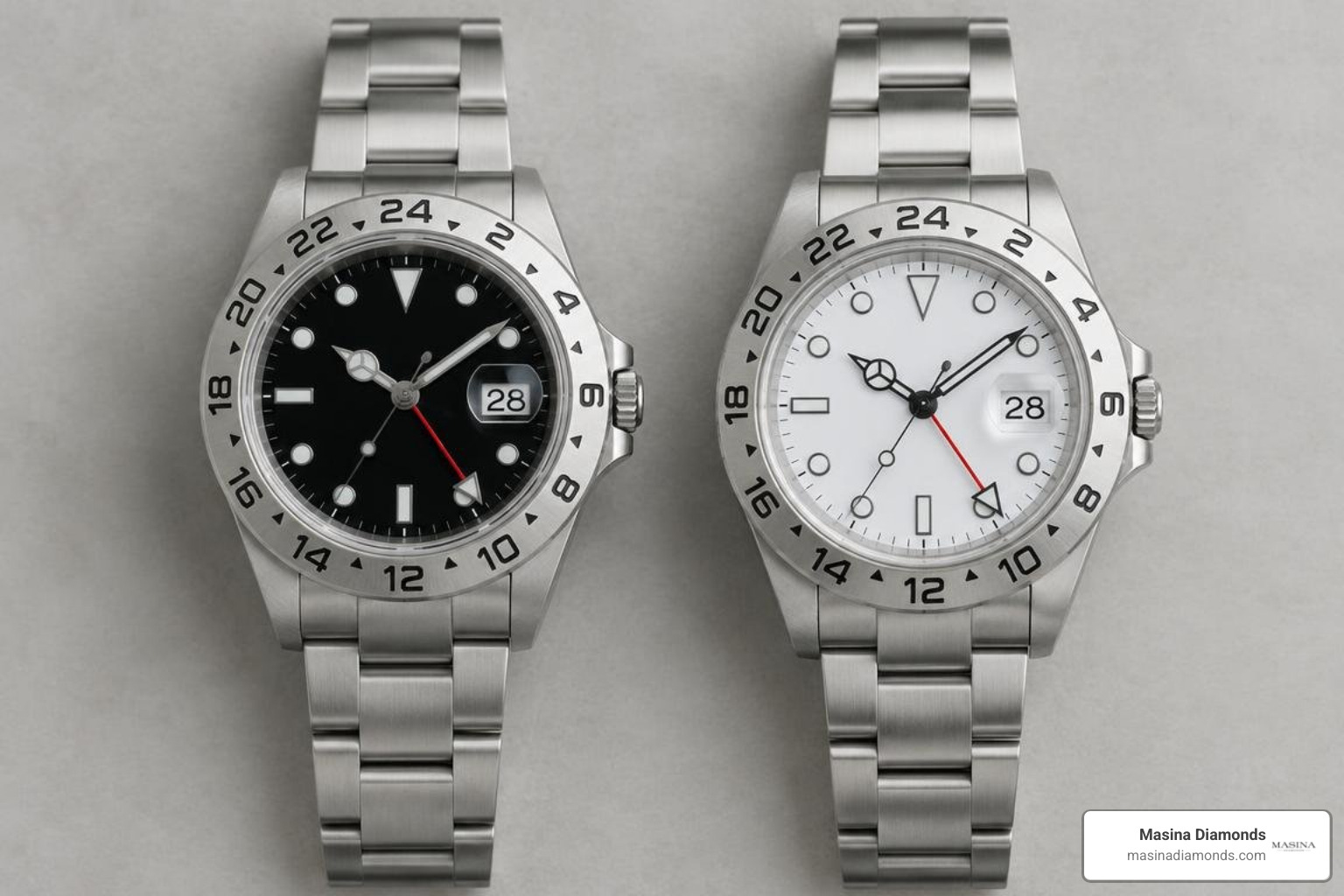
The reference 16570 represents the golden ratio of five-digit sports watches. Built with a 40mm case diameter, a slim 12.2mm thickness, a 47mm lug-to-lug distance, and a standard 20mm lug width, the watch rests flush against the wrist.
Its fixed stainless steel bezel features radial brushing with engraved, enamel-filled 24-hour numerals. The downward slope of the bezel gives the watch a sleeker visual profile on the wrist compared to flat ceramic bezels. For a broader perspective on how sports models compare within the Crown's historical catalog, our comprehensive guide to Rolex watches breaks down the essential lineage.
Dial Variations: Black Dial vs. White Polar Explorer II 16570
The 16570 was offered in two dial variants:
- The Classic Black Dial: Features a glossy black finish with applied 18k white gold surrounds around the luminous hour markers. It offers a classic aesthetic reminiscent of the Submariner, slipping beneath a cuff with minimal visual fanfare.
- The "Polar" White Dial: Designed for extreme contrast, the Polar dial features high-contrast blackened marker surrounds and black-coated Mercedes hands. This blackened finish eliminated legibility issues present on the earlier 16550 and gave the Polar its distinct look.
Early tritium Polar dials from the early 1990s can develop a warm, cream-colored patina on the hour markers, referred to by Italian collectors as Chicchi di Mais (corn kernels). On the secondary market, pristine Polar dials command a notable price premium over black dials.
Case Proportions: 40mm Ref. 16570 vs. Modern 42mm Successors
In 2011, Rolex discontinued the 16570 in favor of the reference 216570, which grew to 42mm and introduced the oversized Maxi dial with thicker hands. Rolex refreshed the model again with the reference 226570, retaining the 42mm footprint.
| Specification | Explorer II Ref. 16570 | Explorer II Ref. 216570 | Explorer II Ref. 226570 |
|---|---|---|---|
| Production Years | 1989 – 2011 | 2011 – 2021 | 2021 – Present |
| Case Diameter | 40.0 mm | 42.0 mm | 42.0 mm |
| Case Thickness | 12.2 mm | 12.4 mm | 12.5 mm |
| Lug-to-Lug Distance | 47.0 mm | 50.1 mm | 50.0 mm |
| Lug Width | 20.0 mm | 21.0 mm | 22.0 mm |
| GMT Hand Style | Slender Red Hand | Large Orange Hand | Large Orange Hand |
| Lume Material | Tritium / LumiNova / Super-LumiNova | Chromalight (Blue) | Chromalight (Blue) |
The classic 40mm proportions make the 16570 more versatile under a dress shirt, while modern 42mm references have a noticeably larger wrist presence.
Mechanical Architecture and Collector Variations
Reviewing the detailed specifications of the reference 16570 highlights its functional GMT movement. For most of its production run, the watch was powered by the Rolex Caliber 3185:
- 31 jewels, 28,800 beats per hour (4 Hz)
- 48-hour power reserve
- Independent jumping local hour hand for dual-time tracking
Around 2005 to 2006 (starting late in the D and Z serial runs), Rolex transitioned the 16570 to the Caliber 3186. This movement increased the power reserve to 50 hours, introduced the blue Parachrom hairspring for improved antimagnetic performance, and eliminated the characteristic "hand wobble" of the 24-hour hand during time setting on the 3185.
The Four Production Eras of the Explorer II 16570
The reference 16570 evolved through four distinct eras:
- Era 1 (1989 – ~1997): Tritium dials marked "T<25" or "SWISS - T<25", drilled lug holes, stamped hollow end link (HEL) Oyster bracelets (reference 78360/78790).
- Era 2 (1998 – 1999): Transitional "Swiss Only" dials utilizing early LumiNova phosphorescent compound, drilled lug holes.
- Era 3 (2000 – ~2005): Super-LumiNova dials marked "SWISS MADE", solid end links (SEL bracelet reference 78790A), and the transition from drilled lug holes to smooth "no-holes" cases around 2003 (Y/F serials).
- Era 4 (2006 – 2011): Implementation of the Caliber 3186 movement, laser-engraved "ROLEX ROLEX ROLEX" inner rehaut (M and V serials), and solid end link Oyster bracelets.
Rolex 16570 vs. GMT-Master II 16710 Sibling Comparison
The Explorer II 16570 and GMT-Master II 16710 share the same mechanical architecture and 40mm case dimensions, but they differ in design and purpose:
| Feature | Explorer II Ref. 16570 | GMT-Master II Ref. 16710 |
|---|---|---|
| Bezel Construction | Fixed radial brushed stainless steel | Bidirectional rotating aluminum bezel |
| Time Zones Tracked | 2 Time Zones | 3 Time Zones |
| Aesthetic Profile | Understated, utilitarian tool watch | High-contrast sports pilot watch |
| Common Colorways | Black or Polar White dial | Pepsi (BLRO), GMT-Master II Coke 16710 (RONR), Black (LN) |
| Market Value Range | $7,500 – $12,000 | $10,500 – $15,500+ |
The fixed steel bezel on the 16570 makes it a more discreet, durable everyday watch at a more accessible secondary market entry point.
Market Valuation, Buyer Pitfalls, and Investment Outlook
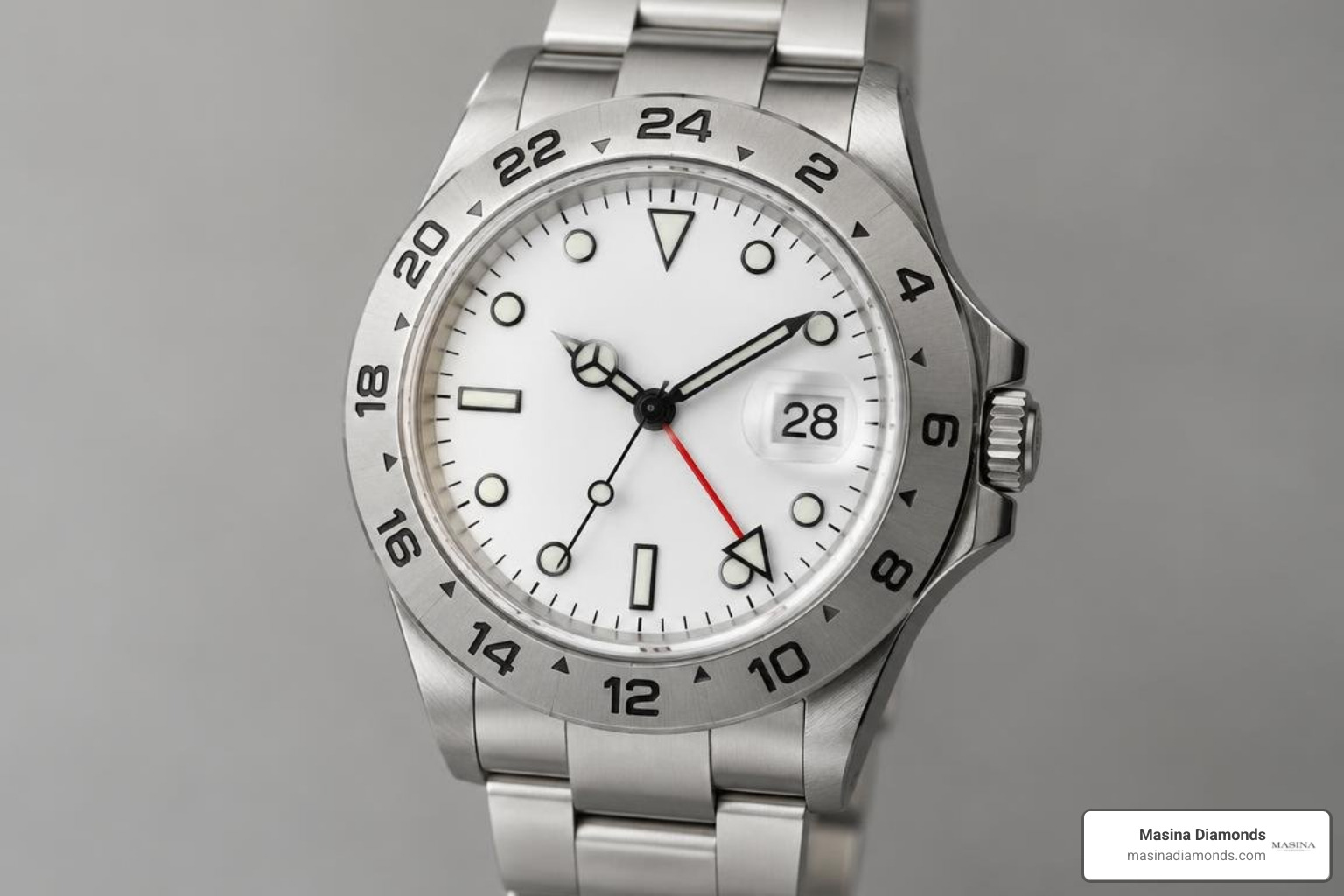
With an original retail MSRP of $6,325, well-kept 16570 examples trade between $7,500 for honest black-dial models and $12,000+ for late-production Polar dials with Caliber 3186, original boxes, and paperwork.
When evaluating a pre-owned 16570, keep these condition points in mind:
- Case Finishing: Ensure the case retains its original factory chamfers and sharp brushed lug tops rather than rounded edges from over-polishing.
- Bracelet Stretch: Early hollow end link bracelets (pre-2000) are prone to link sag and wear over decades of use.
- Dial and Hand Authenticity: On early tritium watches, verify that the hands match the warm patina of the dial markers. Mismatched glow under UV light can indicate service replacement hands.
Whether you are evaluating a tool watch or a classic rotating-bezel model like the Datejust Turn-O-Graph, choosing verified pieces is essential. For comprehensive purchasing strategies, review our guidance on finding the best place to buy a Rolex.
Frequently Asked Questions About the Explorer II 16570
How much does a Rolex Explorer II 16570 cost in 2026?
Pre-owned 16570 models typically range from $7,500 to $12,000. Black-dial models without papers sit at the lower end, while mint Polar dials with original boxes, papers, and late Caliber 3186 movements sit at the top of the range.
What is the difference between Caliber 3185 and Caliber 3186?
The Caliber 3186 introduces a blue Parachrom hairspring for improved resistance to shocks and temperature swings, while eliminating the slight 24-hour hand wobble found on the Caliber 3185 when jumping the local hour hand.
Is the Rolex Explorer II 16570 comfortable for smaller wrists?
Yes. Thanks to its 40mm diameter, 47mm lug-to-lug span, and 12.2mm thickness, the 16570 sits flat and balances comfortably on wrists measuring 6.25 inches and larger.
Conclusion
The Rolex Explorer II 16570 remains a standout in neo-vintage sports watches. It delivers true dual-time utility, historic tool-watch design, and balanced 40mm case proportions that wear easily every day.
If you are exploring fine luxury watches, custom jewelry, or curated estate pieces in the greater Atlanta area, work with our trusted Atlanta luxury watch consultants at Masina Diamonds. Our family is proud to bring more than four decades of dedicated jewelry and watch expertise to your collection.