Birthstones by Month: A Quick January-to-December List
Here is the modern birthstones by month list, including widely recognized alternative stones:
| Month | Birthstone(s) |
|---|---|
| January | Garnet |
| February | Amethyst |
| March | Aquamarine, Bloodstone |
| April | Diamond |
| May | Emerald |
| June | Pearl, Alexandrite, Moonstone |
| July | Ruby |
| August | Peridot, Spinel, Sardonyx |
| September | Sapphire |
| October | Opal, Tourmaline |
| November | Topaz, Citrine |
| December | Turquoise, Tanzanite, Zircon |
Birthstones can make a ring, pendant, or gift feel personal. But color is only one part of the choice. A diamond, ruby, sapphire, and spinel are strong options for everyday rings, while softer stones such as pearl, opal, and turquoise need more protection and care.
The tradition reaches back to the twelve gems described on the biblical Breastplate of Aaron. Over centuries, those gem associations shifted into month-based traditions. The modern U.S. list was standardized in 1912, then expanded to include tanzanite for December in 2002 and spinel for August in 2016.
At Masina Diamonds, we have spent more than 40 years helping Atlanta clients create custom engagement rings and fine jewelry. This birthstones by month list is a practical starting point for choosing a stone that fits your story, style, and daily life.
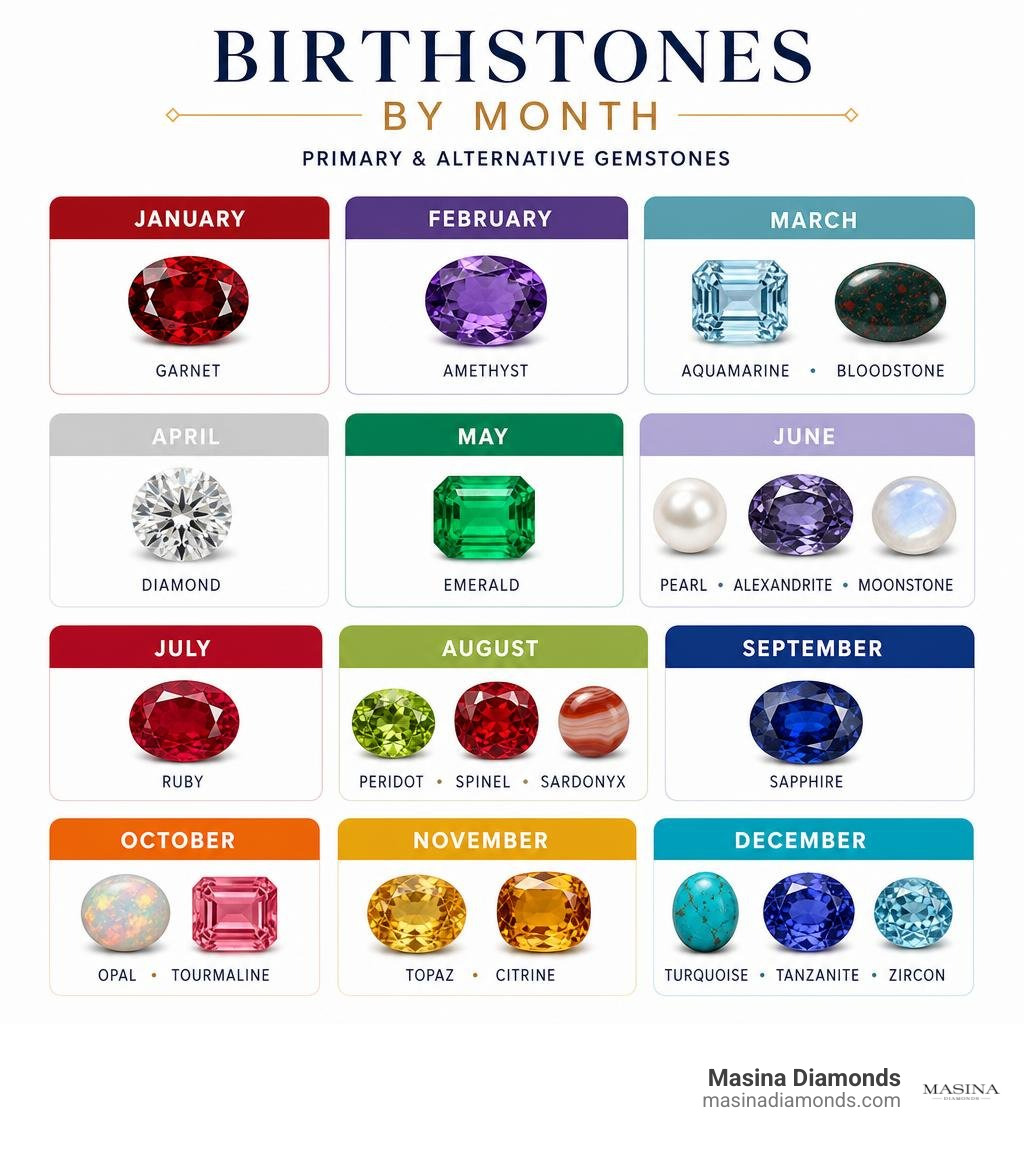
The Complete Birthstones by Month List: January to December
Every gemstone carries a distinct geological makeup, physical hardness, and storied history. To see how each monthly gem compares across colors, hardness ratings, and historical symbolism according to authorities like GIA Birthstones, refer to the comprehensive table below:
| Month | Primary & Alternative Gems | Traditional & Modern Colors | Mohs Hardness | Symbolic Meaning & Attributes |
|---|---|---|---|---|
| January | Garnet | Deep red, orange, vibrant green (Tsavorite) | 6.5 – 7.5 | Protection, vitality, safe travels, and devotion |
| February | Amethyst | Lilac to deep royal purple | 7.0 | Sobriety, mental clarity, serenity, and courage |
| March | Aquamarine, Bloodstone | Pastel blue-green, dark green with red flecks | 7.5 – 8.0 (Aqua) / 6.5 – 7.0 (Bloodstone) | Calm waters, physical strength, courage, and vitality |
| April | Diamond | Colorless, fancy yellow, pink, blue, champagne | 10.0 | Eternal love, invincibility, strength, and brilliance |
| May | Emerald | Rich lush green to bluish-green | 7.5 – 8.0 | Rebirth, wisdom, prosperity, and emotional growth |
| June | Pearl, Alexandrite, Moonstone | Shimmering white, color-changing green-to-red, iridescent blue-sheen | 2.5 – 4.5 (Pearl) / 8.5 (Alex) / 6.0 – 6.5 (Moonstone) | Purity, transformation, good fortune, and intuition |
| July | Ruby | Vivid pigeon blood red | 9.0 | Passion, regal nobility, courage, and life force |
| August | Peridot, Spinel, Sardonyx | Olive lime green, fiery red, cobalt blue, banded reddish-brown | 6.5 – 7.0 (Peridot) / 8.0 (Spinel) / 6.5 – 7.0 (Sardonyx) | Protection against night terrors, renewal, and harmony |
| September | Sapphire | Royal velvet blue, pink, yellow, padparadscha peach | 9.0 | Divine wisdom, faithfulness, truth, and royal favor |
| October | Opal, Tourmaline | Play-of-color rainbow, vivid pink, bi-color watermelon green-pink | 5.5 – 6.5 (Opal) / 7.0 – 7.5 (Tourmaline) | Creative imagination, hope, emotional balance, and confidence |
| November | Topaz, Citrine | Golden imperial amber, sunny golden-yellow, bright blue | 8.0 (Topaz) / 7.0 (Citrine) | Warmth, wealth, joyful abundance, and vitality |
| December | Tanzanite, Turquoise, Zircon, Blue Topaz | Velvety violet-blue, robin's egg sky blue, vibrant vivid blue | 6.0 – 7.0 (Tanzanite) / 5.0 – 6.0 (Turquoise) / 7.5 (Zircon) / 8.0 (Blue Topaz) | Spiritual elevation, peaceful serenity, luck, and clarity |
January to March: Garnet, Amethyst, and Aquamarine
The year opens with minerals steeped in folklore and protective energy:
- January (Garnet): While most people picture a moody, deep pomegranate red, the garnet family is an expansive mineral group. It spans fiery mandarin spessartines, vivid green tsavorites, and golden grossulars. Historically, warriors and royalty carried garnet cabochons into battle as protective talismans against injury.
- February (Amethyst): This purple variety of quartz gets its regal color from trace elements of iron irradiated within the crystal matrix. The ancient Greeks coined its name from amethystos ("not intoxicated"), fashioning wine goblets out of carved amethyst crystal to ward off drunkenness and foster clear-headed negotiation.
- March (Aquamarine & Bloodstone): Aquamarine, the pastel blue-to-teal variety of the beryl family, gets its oceanic hue from iron impurities. For thousands of years, seafarers kept aquamarine aboard ships to calm turbulent waters. Bloodstone, the traditional March alternative, is an opaque dark-green jasper speckled with vibrant red iron oxide spots reminiscent of blood drops, traditionally prized for physical endurance and vigor. If you are comparing center gems for custom jewelry, check out A Guide to Ring Stone Types to see how beryl and quartz varieties perform over time.
April to June: Diamond, Emerald, Pearl, and Alexandrite
Spring brings the most coveted classic precious gems in fine jewelry:
- April (Diamond): Sitting at the absolute apex of mineral hardness (Mohs 10), diamond is made of pure carbon crystallized under extreme mantle heat and pressure. Revered for centuries as an emblem of unbreakable love and brilliance, diamonds come in an endless variety of natural and lab-created fancy hues. You can explore subtleties in grading with our Diamond Color Guide and discover how crystal purity affects light refraction through Understanding Diamond Clarity.
- May (Emerald): The lush green cornerstone of the beryl family, emerald gets its vibrant saturation from chromium and vanadium. Emeralds are famous for their natural internal inclusions, poetically referred to as a jardin (garden). These give each natural emerald a unique visual fingerprint. Discover how these verdant gems shine in bespoke settings through our curated gallery of Emerald Engagement Rings.
- June (Pearl, Alexandrite, & Moonstone): June offers a trio of distinct stones. Pearls are organic gems cultured within marine and freshwater mollusks, glowing with soft, iridescent nacre. Alexandrite, an exceptionally rare variety of chrysoberyl discovered in the Ural Mountains, is famous for its optical color-change phenomenon: vivid emerald-green by daylight and ruby-red under warm incandescent lighting ("emerald by day, ruby by night"). Moonstone rounds out the trio with its ethereal blue-white adularescence, a billowing optical shimmer that moves beneath the surface of the stone.
July to September: Ruby, Peridot, Spinel, and Sapphire
The summer months bring remarkable durability, fiery hues, and royal prestige:
- July (Ruby): The crimson sister of the corundum family, ruby is colored by chromium, which also causes intense internal red fluorescence under ultraviolet rays. The most prized rubies showcase an intense, glowing red historically known as "pigeon's blood." Fine natural, untreated rubies over three carats are among the rarest gems on Earth, commanding upwards of $1,000,000 per carat at international auctions.
- August (Peridot, Spinel, & Sardonyx): Peridot is an idiochromatic gem, meaning its golden lime-green color comes from its own basic chemical formula (iron silicate) rather than foreign impurities. Remarkable specimens have been recovered from pallasite meteorites, proving its origin is extraterrestrial as well as volcanic. Spinel, formally added to August in 2016, offers brilliant hardness (Mohs 8) and fiery red and cobalt hues. It was historically mistaken for ruby in European royal crown jewels, such as the famous Black Prince's Ruby.
- September (Sapphire): September belongs to sapphire, the corundum sibling to ruby. While prized for deep, velvety royal blue, sapphire occurs in every color imaginable except red—including bright canary yellow, blush pink, vivid green, and rare peach-pink padparadscha. Known historically as a symbol of divine wisdom and integrity, fine sapphires make outstanding alternatives to traditional center diamonds. Browse our collection of handcrafted Sapphire Engagement Rings to see how this durable gem complements modern bespoke mountings.
October to December: Opal, Tourmaline, Topaz, Citrine, and Tanzanite
The final quarter of the year is characterized by incredible color variety:
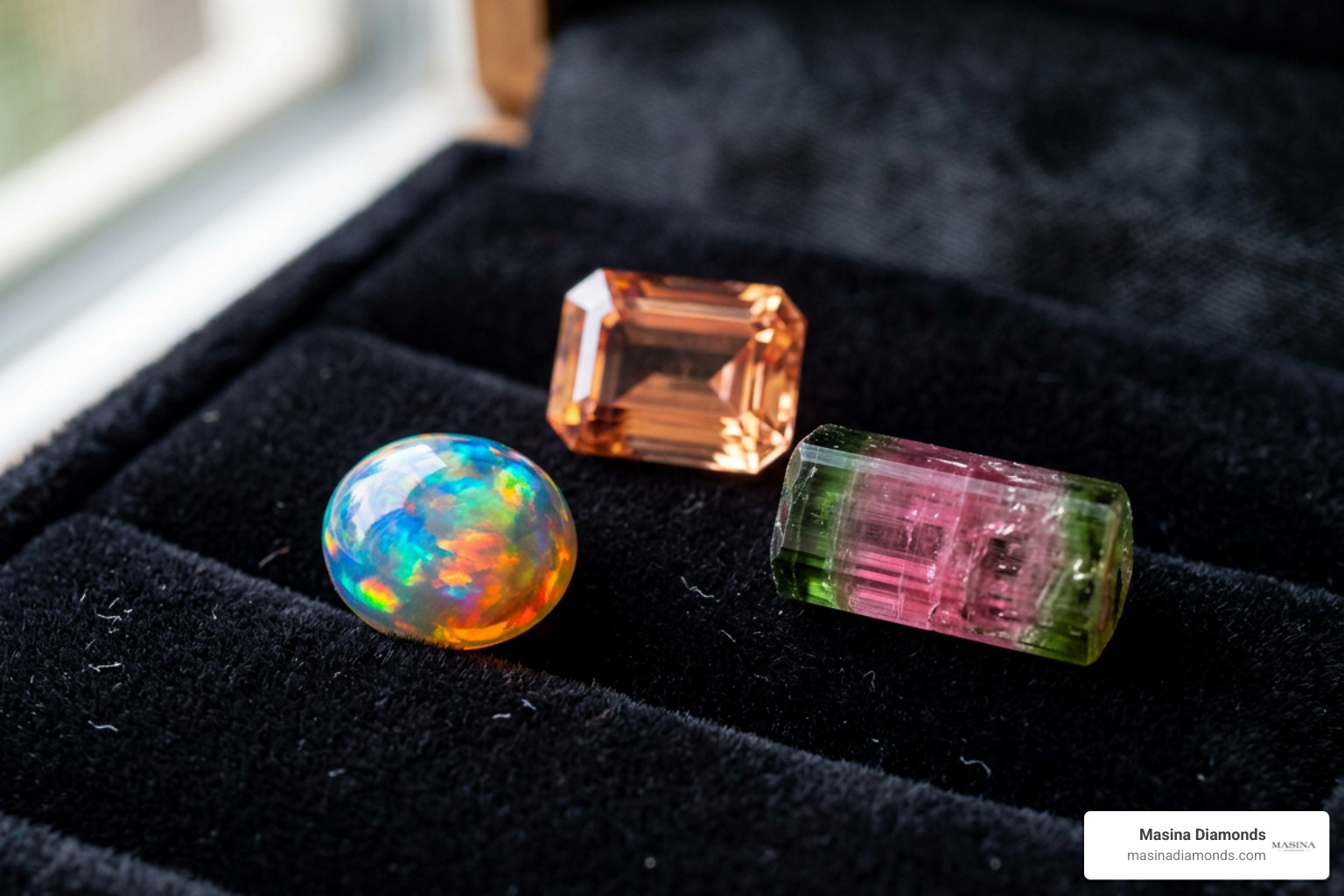
- October (Opal & Tourmaline): Opal features microscopic spheres of silica that diffract light to create a fiery "play-of-color." Australia produces roughly 95% of the world's precious opal, notably dazzling black opal from Lightning Ridge. Tourmaline is a complex boron silicate that occurs in virtually every shade, often displaying multi-color zoning within a single crystal, such as the famous "watermelon tourmaline" with its pink core and green rim.
- November (Topaz & Citrine): Imperial Topaz is a rich, golden-orange gemstone traditionally sourced from Ouro Preto, Brazil. Citrine, the sunny golden-yellow variety of quartz, takes its name from the French citron (lemon). Both stones are durable, bright, and offer abundant warmth during the late autumn months.
- December (Tanzanite, Turquoise, Zircon, & Blue Topaz): December features an array of cool blue gems. Tanzanite is a trichroic variety of zoisite found in only one place in the world: a narrow four-kilometer stretch at the foot of Mount Kilimanjaro in the Merelani Hills of Tanzania. Turquoise offers an opaque, sky-blue to robin's-egg hue with intricate dark matrix webbing. Natural blue zircon provides diamond-like fire and double refraction. For additional visual comparisons of these stones, take a look at Birthstones by Month: Chart and Photos.
Origins and Evolution of Monthly Gemstone Traditions
The tradition of associating gemstones with specific times of the year spans thousands of years of human history.
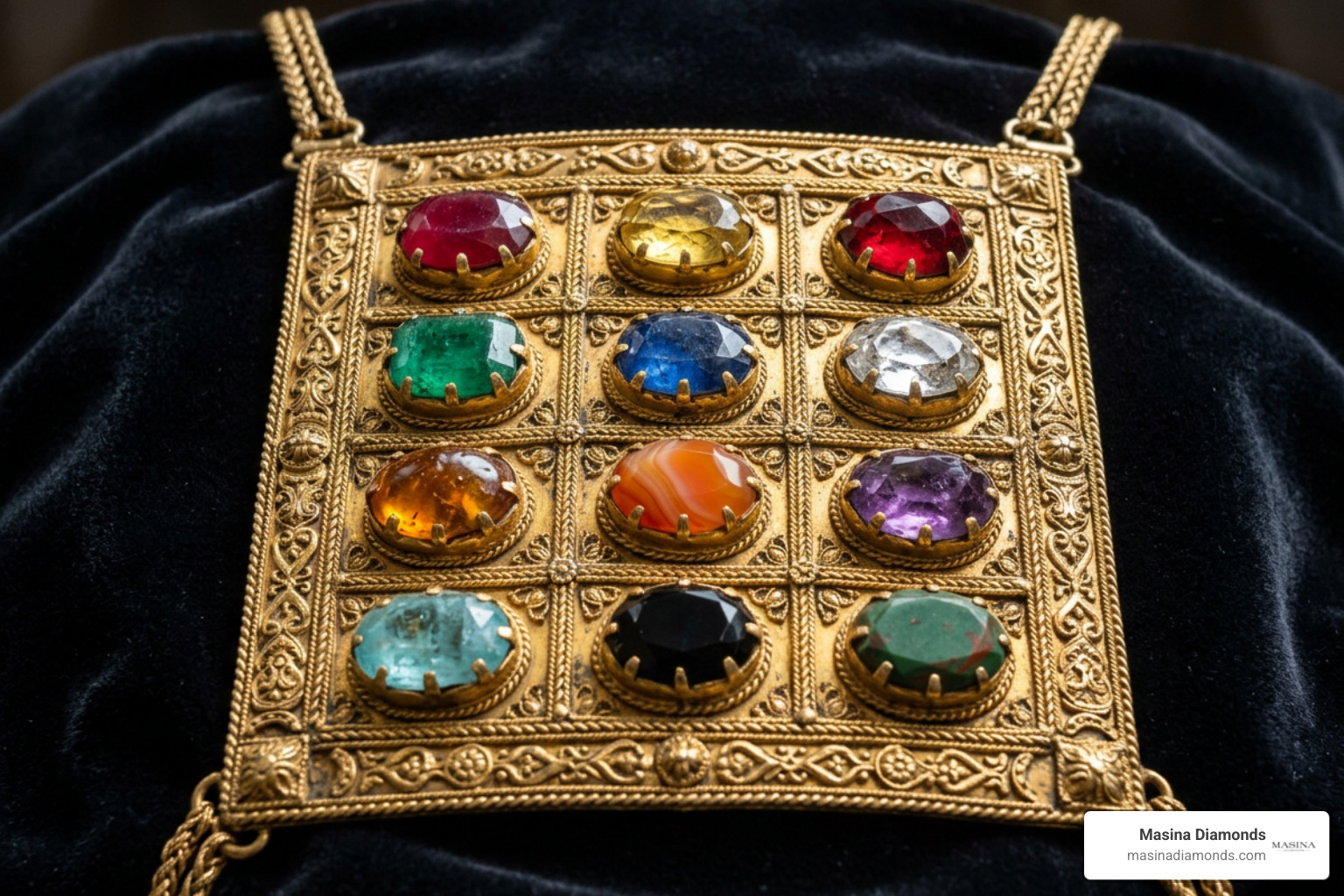
The earliest root of the twelve-gemstone system is found in the biblical Book of Exodus (Exodus 28:15–21), which details the golden Breastplate of Aaron (the High Priest of Israel). The breastplate was set with four rows of three engraved stones representing the twelve tribes of Israel:
- Row 1: Carnelian (sardius), chrysolite (topaz), and beryl (carbuncle)
- Row 2: Turquoise, sapphire, and emerald
- Row 3: Jacinth, agate, and amethyst
- Row 4: Chrysolite, onyx, and jasper
In the 1st century CE, the Jewish-Roman historian Flavius Josephus and the 5th-century theologian St. Jerome connected these twelve breastplate stones to the twelve signs of the Zodiac and, eventually, to the twelve months of the Julian calendar.
During the Middle Ages, the custom called for an individual to own all twelve stones, wearing a different gem each month when its talismanic power was believed to peak. The modern habit of wearing a single stone tied permanently to one's own birth month began in Poland between the 16th and 18th centuries, popularized by Jewish gem merchants and European aristocrats.
How the Official Birthstones by Month List Was Standardized
Before the early 20th century, birthstone selections varied wildly depending on regional folklore, country, and merchant inventory. In August 1912, the American National Retail Jewelers Association (now known as Jewelers of America) met in Kansas City to establish an official, standardized modern list for commercial jewelry.
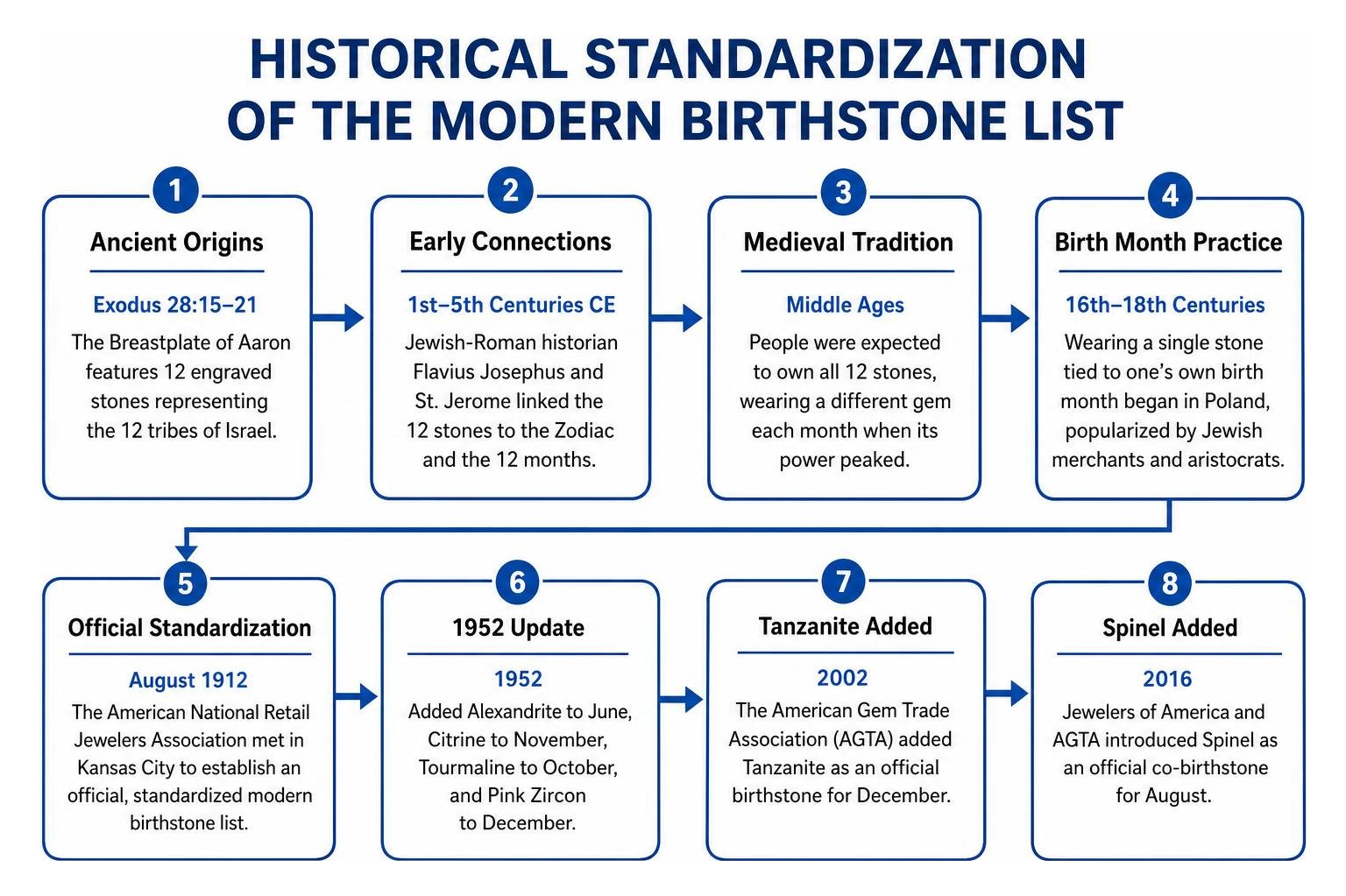
The 1912 committee shifted the list away from opaque, historic talismans toward transparent, durable, and commercially cut gemstones. The list has evolved through careful, deliberate additions:
- 1952: The Jewelry Industry Council updated the chart, adding Alexandrite to June, Citrine to November, Tourmaline to October, and Pink Zircon to December.
- 2002: The American Gem Trade Association (AGTA) added Tanzanite as an official birthstone for December, honoring its global popularity.
- 2016: Jewelers of America and AGTA introduced Spinel as an official co-birthstone for August alongside peridot and sardonyx.
Comparing Zodiac, Astrological, and Mystical Gemstone Systems
While modern birthstone charts align strictly with the twelve Gregorian calendar months, several ancient astrological and energetic gemstone systems remain popular:
- Tropical Zodiac Stones: Rather than matching the first through last day of a calendar month, astrological stones align with astrological constellations (e.g., Aries spans March 21 to April 19). For example, Emerald governs Taurus, while Ruby rules the sign of Leo.
- Hindu Navaratna Tradition: Dating back thousands of years in Vedic astrology, the Navaratna is a sacred talismanic arrangement of nine sacred gems representing the nine celestial bodies (the Sun, Moon, Mars, Mercury, Jupiter, Venus, Saturn, and the lunar nodes Rahu and Ketu). Wearing ruby (Sun) in the center surrounded by diamond, blue sapphire, emerald, and pearl is believed to harmonize cosmic energies.
- Mystical (Tibetan) Birthstones: Rooted in ancient Tibetan Buddhist traditions, mystical birthstone charts assign stones based on spiritual energies and healing qualities intended to bring emotional balance during particular seasons of birth.
Gemstone Durability, Mohs Scale, and Everyday Wear
Understanding mineral durability is essential when choosing birthstone jewelry—especially for pieces worn daily, such as engagement rings or stacking bands.
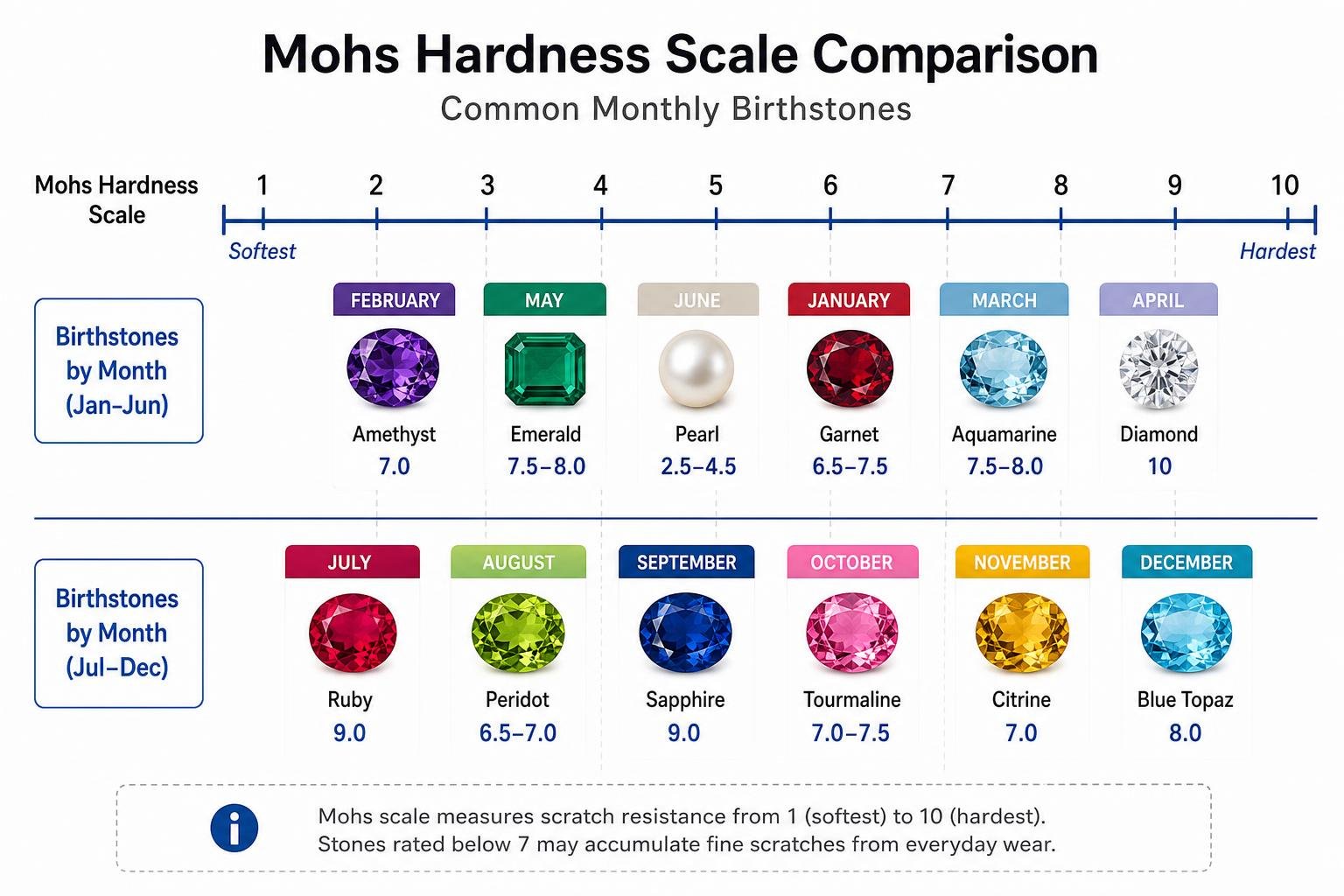
The Mohs Hardness Scale, established in 1822 by Friedrich Mohs, measures a mineral's relative resistance to scratching on a scale from 1 (talc) to 10 (diamond). Because airborne dust often contains microscopic quartz particles (Mohs 7), any gemstone rated below 7 will gradually accumulate fine scratches and lose its polish if exposed to daily wear without protective settings.
Choosing Everyday Jewelry from the Birthstones by Month List
When styling and designing custom fine jewelry, consider how each stone's hardness and internal cleavage affect daily wear:
- Daily Rings (Mohs 8–10): Diamond (10), Ruby (9), Sapphire (9), Alexandrite (8.5), Spinel (8), and Topaz (8) have exceptional scratch resistance and structural durability. They are well-suited for everyday engagement rings, eternity bands, and active wear. Explore how stone geometry highlights crystal brilliance by reading about Different Diamond Shapes.
- Occasional Rings or Protected Settings (Mohs 7–7.5): Emerald, Aquamarine, Garnet, Tourmaline, Amethyst, and Citrine have moderate to good hardness. However, emeralds often possess natural internal fissures (jardins) that make them susceptible to chipping if struck along a sharp corner. When setting emeralds, garnets, or quartz in rings, choose protective bezel or halo mountings rather than high-exposed prongs.
- Earrings, Brooches, and Pendants (Mohs 2.5–6.5): Pearl (2.5–4.5), Opal (5.5–6.5), and Turquoise (5–6) require gentle handling. Pearls dissolve when exposed to acidic perfumes, hairsprays, and swimming pool chlorine. Opals contain up to 20% water and can dry out or crack (craze) under extreme heat and rapid temperature swings. These delicate stones are best set in pendants, earrings, and special-occasion cocktail jewelry rather than daily-wear rings.
Natural vs. Lab-Grown Birthstones for Modern Jewelry
Modern gemstone synthesis offers exciting options for high-end birthstones:
- Chemical and Optical Identity: Lab-grown diamonds, sapphires, rubies, emeralds, and alexandrites are not cheap plastic or glass imitations. They share the identical crystalline structure, chemical composition, refractive index, and Mohs hardness of their earth-mined counterparts. To learn how modern plasma and high-pressure technologies grow genuine carbon crystals, read What is a Lab Created Diamond.
- Accessibility and Pricing: Natural, untreated ruby, fine emerald, and color-change Russian alexandrite can carry steep price tags in larger carat sizes. Selecting lab-created alternatives allows you to feature premium-color gems with pristine clarity at a fraction of the cost. If you are local to Georgia, explore our certified loose stones through Lab Grown Diamonds in Atlanta GA.
- When to Stay Natural: For naturally abundant gemstones—such as amethyst, citrine, blue topaz, garnet, and peridot—mined specimens are already budget-friendly, making lab-grown versions less necessary from a price perspective.
Frequently Asked Questions About Birthstones
Why do some months have multiple birthstones?
Months feature multiple birthstones because our modern chart combines ancient traditional folklore with modern gemological updates. Organizations such as Jewelers of America and the AGTA have introduced alternatives to provide buyers with diverse price points, durability options, and color choices. For instance, December includes affordable Blue Topaz, classic Turquoise, fiery Zircon, and rare velvety Tanzanite.
Which birthstone is the rarest and most expensive?
Natural, untreated Alexandrite (June) showing a crisp, 100% color change from daylight green to incandescent red is among the rarest and most expensive gems on Earth, often commanding $20,000 to over $70,000 per carat for gem-quality stones over one carat. Similarly, top-grade unheated Burmese "pigeon's blood" Rubies (July) and untreated Kashmir Sapphires (September) frequently outperform high-grade white diamonds at international auctions, occasionally exceeding $1,000,000 per carat.
Can you wear a birthstone that does not match your birth month?
Yes. Gemstone traditions are an enjoyable form of personal self-expression, not strict rules. Many jewelry lovers wear stones based on aesthetic preference, favorite colors, or to represent important milestones. Multi-stone "mother's rings," anniversary bands, and custom heirloom pieces often combine the birthstones of children, partners, or parents into a single personalized design.
Crafting Your Custom Birthstone Jewelry
Birthstones bridge ancient history, geological wonder, and personal sentiment. Whether you are searching for an emerald ring for May, an everyday sapphire pendant for September, or a custom anniversary band that brings together your family's monthly stones, selecting the right gem starts with balancing aesthetic beauty with long-term durability.
At Masina Diamonds, our family-owned Atlanta showroom has helped clients design bespoke engagement rings and custom fine jewelry for over four decades. Use our interactive 3D Ring Builder online to experiment with diamond shapes, precious colored gemstones, and custom settings, or stop by our Atlanta store to view loose gems in person.
To learn more about styling, symbolic origins, and gemstone settings, explore our complete Birthstones by Month: Meanings and Jewelry Guide.