Diamond Carat Weight: The Quick Meaning
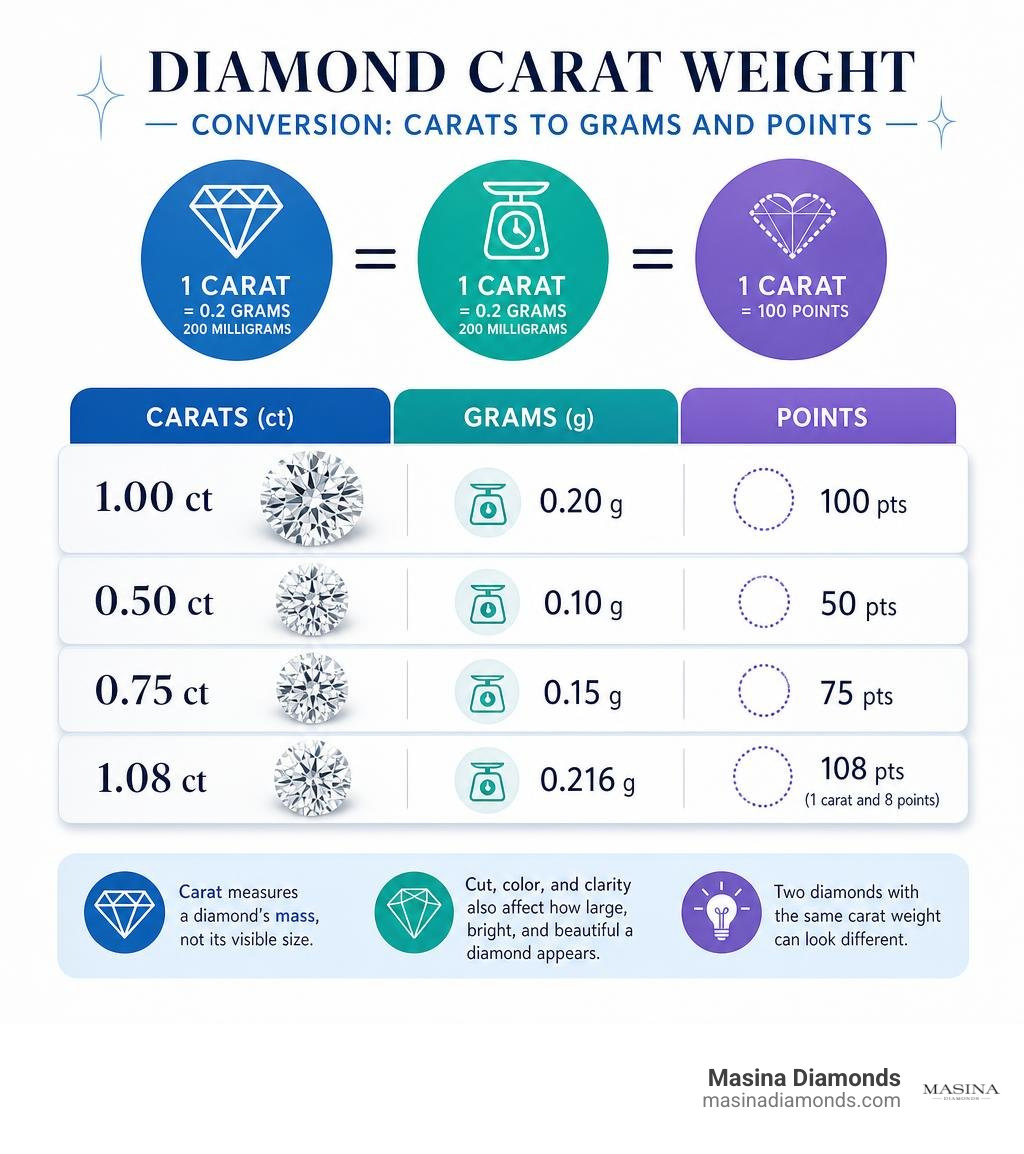
A diamond carat is a measure of a diamond's mass, not its visible size. One carat equals exactly 0.2 grams, or 200 milligrams, and is divided into 100 points.
| Quick carat-weight reference | Meaning |
|---|---|
| 1.00 ct | 1 full carat = 0.2 grams |
| 0.50 ct | 50 points = one-half carat |
| 0.75 ct | 75 points |
| 1.08 ct | One carat and 8 points |
Carat weight matters because it affects a diamond's rarity and price, but it is only one part of the picture. Cut, color, and clarity also shape how large, bright, and beautiful a diamond appears. Two diamonds with the same carat weight can look noticeably different on the hand.
Masina Diamonds has served Atlanta clients for more than 40 years with custom jewelry, engagement rings, and luxury watches. Our experience with diamond carat selection helps couples balance weight, appearance, quality, and budget before moving into the details.
What Is a Diamond Carat and How Is Weight Measured?
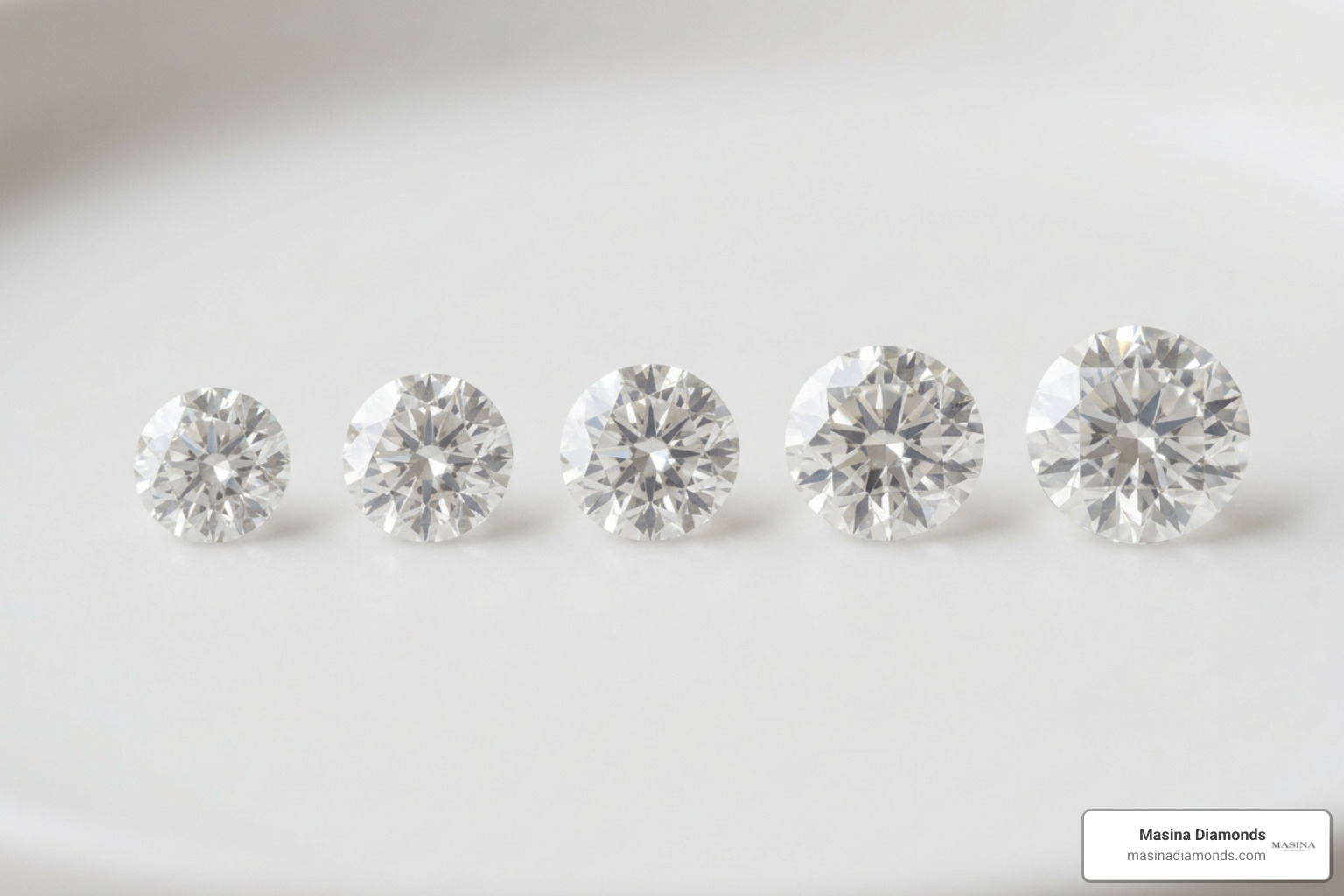
When people hear the word "carat," they often imagine physical dimensions—how wide, tall, or long a diamond looks when set in a ring. However, in gemology, a diamond carat measures strictly mass, not surface dimensions. While a higher carat weight frequently corresponds to a larger physical profile, the actual measurements depend heavily on how the stone is cut and shaped.
To evaluate diamond mass across global markets, master jewelers and gemological laboratories rely on a universally standardized metric unit. Whether you are inspecting a loose gemstone in our Atlanta showroom or reviewing an official grading report, understanding how this weight is measured gives you complete clarity when shopping for fine jewelry.
Defining the Diamond Carat: Mass, Grams, and Points
At its standard scientific definition, one metric carat (abbreviated as "ct") equals exactly 0.2 grams, or 200 milligrams. To put that into everyday perspective, a single 1.00-carat diamond weighs approximately the same as a single standard paperclip or a tiny piece of gum.
Because many diamonds featured in fine jewelry weigh less than one full carat, gemologists divide the carat into smaller fractional units called points. One carat is divided evenly into 100 points:
- 100 points = 1.00 carat (200 milligrams)
- 75 points = 0.75 carats (150 milligrams)
- 50 points = 0.50 carats (100 milligrams)
- 25 points = 0.25 carats (50 milligrams)
Each individual point represents precisely 2 milligrams of mass. This point scale allows jewelers and consumers to discuss subtle weight differences without using complicated decimal fractions of a gram. For instance, a jeweler referring to a "fifty-pointer" is describing a 0.50-carat diamond.
The vast majority of natural diamonds cut for consumer jewelry weigh one carat or less. Because larger natural rough diamonds are far rarer in nature, price increases exponentially as carat weight rises, making precise division critical during diamond valuation.
Industry Standards for Measuring and Expressing Carat Weight
In modern gemological laboratories like the Gemological Institute of America (GIA), extreme precision is paramount. Precision micro-balances calculate a diamond's weight down to the hundred-thousandth of a carat (0.00001 ct).
However, for commercial trade and grading documentation, these measurements are rounded to the nearest hundredth of a carat (0.01 ct). The gemological standard for rounding is remarkably strict: a diamond's weight is only rounded up to the next hundredth if the third decimal digit is a 9. For example:
- A stone weighing 0.998 carats is stated as 0.99 ct.
- A stone weighing 0.999 carats is rounded up to 1.00 ct.
When expressing diamond weights in writing, weights greater than one carat use decimal numbers followed by the abbreviation "ct" or "ctw" (carat total weight when referring to multiple stones). In verbal industry shorthand, a stone weighing 1.08 carats is called "one point oh eight carats" or simply "one oh eight."
Learning how carat weight is documented on official certification reports is an essential step in Understanding the 4Cs before making a diamond purchase.
The History and Standardization of the Carat System
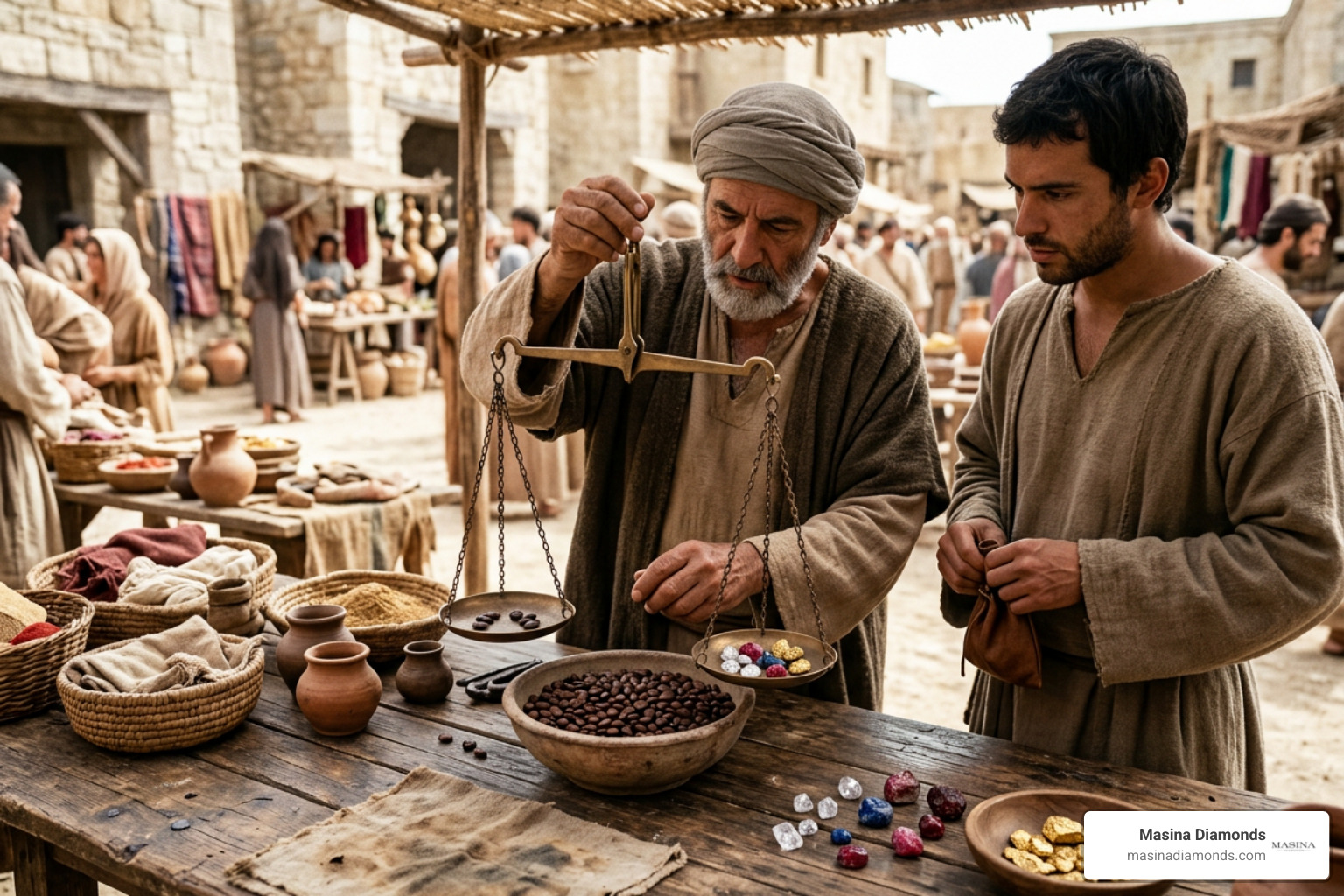
The methodology behind weighing precious gemstones spans thousands of years, evolving from ancient Mediterranean trade routes to contemporary international weight conferences.
Carob Seeds and Ancient Gem Weighing
The term carat finds its roots in the botanical world. It originates from the Ancient Greek word kerátion (meaning "carob seed" or "little horn"), referring to the seeds of the carob tree (Ceratonia siliqua). As merchant ships traveled across Mediterranean trade hubs, early traders required a standardized counterweight for balance scales to weigh small, high-value goods like gold and gemstones.
The carob seed was chosen based on an ancient belief: merchants believed that carob seeds possessed a uniform weight from seed to seed, making them ideal natural balance weights. As Mediterranean commerce expanded, kerátion entered the Arabic language as qīrāṭ, eventually passing into Italian as carato before entering English as carat.
Interestingly, modern scientific testing has debunked the ancient assumption of carob seed uniformity. Modern botanical studies demonstrate that carob seeds display as much mass variation as seeds from other plant species! Despite this historical myth, the practice of using seed counterweights laid the groundwork for gem measurement for centuries.
Historical Variations and 1907 Metric Standardization
Before modern standardization, the actual weight of a "carat" varied wildly depending on where you were in the world. A jeweler trading in Florence was using a completely different weight baseline than a merchant in London or Cyprus:
- Cyprus Carat: ~187 milligrams
- Ancient Roman Siliqua: ~189 milligrams
- Parisian Carat (1871 proposed standard): ~205 milligrams
- Livorno (Italy) Carat: ~215.99 milligrams
Because a difference of 25 milligrams could significantly alter the valuation of a rare diamond, global trade required a single, unified metric standard.
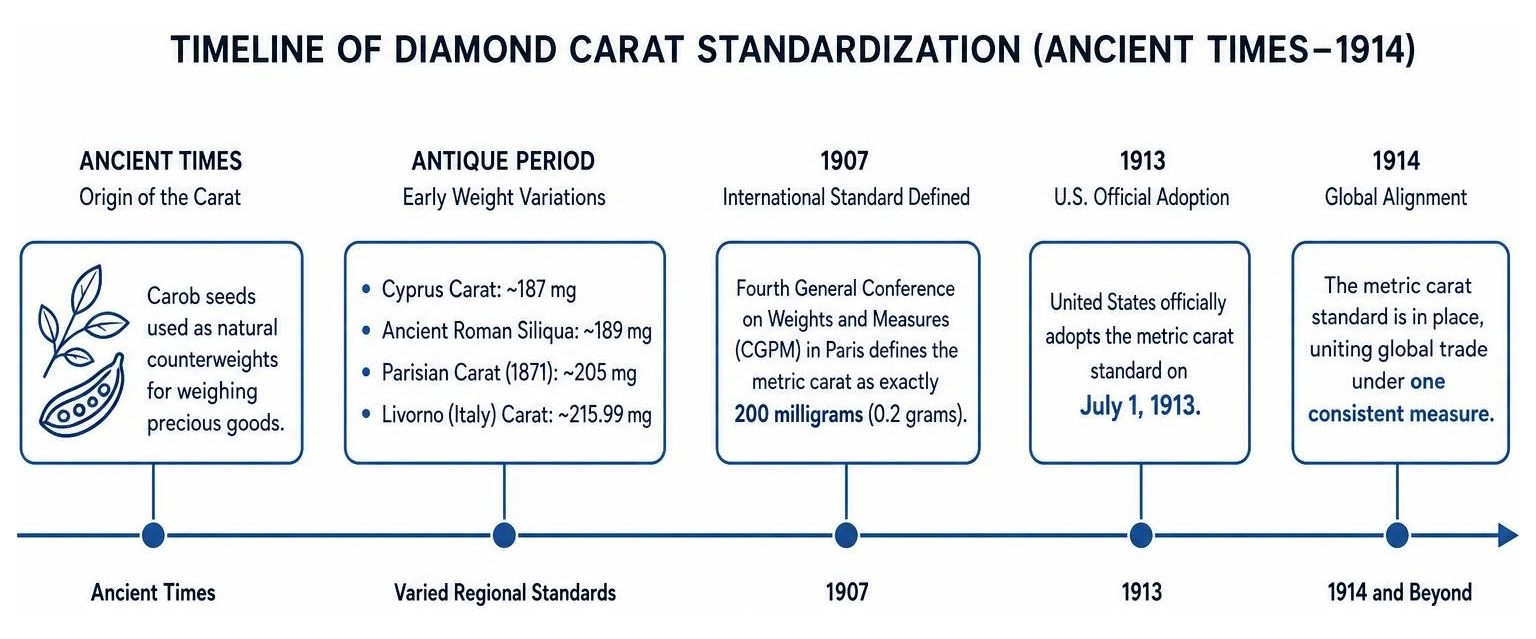
In 1907, at the Fourth General Conference on Weights and Measures (CGPM) in Paris, the international community officially defined the metric carat as exactly 200 milligrams (0.2 grams).
Global markets quickly adopted this standardized definition:
- 1907: Formal definition at the Fourth General Conference on Weights and Measures.
- 1913: Official adoption by the United States on July 1.
- 1914: Official adoption by the United Kingdom on April 1.
This standardization created uniform global confidence for gemstone trading. It also established terminology for ultra-rare specimens: for example, an extraordinary, completely flawless diamond weighing at least 100 carats (20 grams) is formally classified as a paragon.
How Carat Weight Relates to the 4 Cs of Diamonds
When selecting a diamond, focusing exclusively on carat weight can lead to disappointing results. Carat weight is only one of the traditional "4 Cs" of diamond grading established by the GIA—the others being Cut, Color, and Clarity.
A diamond's market value and visual appearance represent an intricate balance among all four criteria.
How Diamond Carat Interacts with Cut, Color, and Clarity
Carat weight influences price exponentially due to natural scarcity. However, a higher carat weight does not automatically make a diamond more beautiful. In fact, an improperly cut 2.00-carat diamond can look dull, dark, and visually smaller than a perfectly proportioned 1.50-carat diamond.
- Cut: The quality of a diamond's cut determines how light enters, refracts, and exits the stone. A masterfully executed Diamond Cut maximizes sparkle, brilliance, and fire. If a diamond is cut too deep to preserve carat weight in the base, it hides its mass out of sight beneath the setting while appearing smaller from above.
- Color: As diamonds grow larger in carat weight, body color becomes easier for the human eye to detect. Reviewing our guide on Decoding Diamond Color: A Comprehensive Guide helps you choose a color grade that stays bright and white as carat size increases.
- Clarity: Similar to color, larger diamond facets act as wider viewing windows into the stone. In higher carat weights, internal inclusions or surface blemishes are more visible. Exploring Understanding Diamond Clarity: A Guide to Flawless Beauty allows you to find an eye-clean threshold that delivers flawless beauty without paying for unnecessary clarity grades.
Visual Size vs. Carat Weight Across Shapes
Two diamonds with the exact same 1.00-carat weight can look drastically different in physical size on a ring finger depending on their shape and top surface area (table percentage and length-to-width ratio).
Certain elongated shapes distribute their mass across a broader surface area, creating the visual impression of a larger stone ("carat illusion"). Examining Different Diamond Shapes reveals how physical millimeter dimensions vary for standard 1.00-carat stones:
| Diamond Shape (1.00 Carat) | Average Physical Dimensions (mm) | Perceived Visual Size |
|---|---|---|
| Round Brilliant | ~6.50 mm × 6.50 mm | Standard / Balanced |
| Oval Cut | ~7.70 mm × 5.70 mm | Looks larger (elongated face) |
| Marquise Cut | ~10.00 mm × 4.75 mm | Looks significantly larger |
| Pear Shape | ~8.50 mm × 5.30 mm | Looks larger |
| Princess Cut | ~5.50 mm × 5.50 mm | Looks slightly compact |
| Emerald Cut | ~7.00 mm × 5.00 mm | Broad top view / open table |
By choosing an elongated shape like an oval, pear, or marquise, you maximize the visible surface area per carat of weight.
Diamond Carat vs. Karat: Key Differences Explained
In the jewelry world, few terms cause as much initial confusion as carat and karat. Because they are pronounced identically, consumers frequently mix them up when evaluating engagement ring specifications. However, they measure two completely different characteristics!
Understanding Carat for Gemstone Weight vs. Karat for Gold Purity
To keep your terminology straight when shopping for jewelry:
- Carat (ct): A measure of weight/mass used exclusively for gemstones, diamonds, and pearls. Derived from the carob seed, one carat equals 0.2 grams or 100 points.
- Karat (k or kt): A measure of purity used exclusively for gold precious metals. Derived from a medieval alloy scale, pure gold is rated at 24 karats (24k).
When reviewing a custom engagement ring, you might see both terms in the same specification sheet: for example, a 1.50-carat diamond set into a 18-karat yellow gold band. Understanding this distinction helps you navigate pricing structures when setting your ring budget. To explore budgeting strategies in detail, visit our guide on How to Budget for an Engagement Ring.
Frequently Asked Questions About Diamond Carat Weight
What is the exact weight of a 1-carat diamond in grams?
A 1-carat diamond weighs exactly 0.20 grams (or 200 milligrams). This is roughly equivalent to the physical weight of a standard paperclip.
How does diamond carat weight affect price?
Diamond pricing does not scale linearly with carat weight; it increases exponentially. Because large, gem-quality natural diamond crystals are far rarer in nature than smaller ones, a single 2.00-carat diamond will cost significantly more than two individual 1.00-carat diamonds of equal cut, color, and clarity. Furthermore, price points jump at major weight thresholds (such as 0.50 ct, 0.75 ct, 1.00 ct, and 1.50 ct).
What is a paragon diamond?
A paragon is a gemological classification for an exceptional diamond that is entirely flawless (internally and externally) and weighs at least 100 carats (20 grams). Paragons are among the rarest and most magnificent gemstones in human history.
Conclusion
Understanding diamond carat weight empowers you to choose a diamond that hits the perfect balance of size, brilliance, and value. While carat measures total mass, remembering how shape, depth, cut quality, and proportions interact ensures that every milligram translates into breathtaking beauty on your finger.
When reviewing loose diamonds, always insist on official certification from trusted gemological laboratories. Verifying your diamond's exact weight, cut, and color metrics through recognized independent testing—such as GIA Certificates—provides absolute certainty regarding your investment.
At Masina Diamonds, our family-owned team in Atlanta brings over 40 years of master craftsmanship and guidance to every client. Whether you want to compare different carat sizes side by side or utilize our interactive 3D Ring Builder to design a custom engagement ring, we are here to help.
Ready to find your ideal diamond weight and design? Explore Diamond Carats with Masina Diamonds or visit our Atlanta showroom today to consult with our master jewelers!