Why Rolex Watches Remain a Smart Luxury Purchase
Rolex watches combine proven mechanical engineering, recognizable design, and strong resale demand. For most buyers, the right choice comes down to three things: how you will wear it, which size feels right, and whether you are buying new or pre-owned.
| Quick buying question | Simple answer |
|---|---|
| Best first Rolex | An Oyster Perpetual or Datejust offers versatile daily wear and a broad range of sizes. |
| Best sport Rolex | The Submariner is the classic all-purpose dive watch; the GMT-Master II adds a second time zone for travel. |
| New price range | New Rolex models generally begin around $6,500-$6,750 and can rise above $75,000 in solid-gold configurations. |
| Pre-owned buying tip | Work with a trusted seller, request service and ownership records, and have the watch's case, movement, dial, and bracelet checked for authenticity. |
| Is it an investment? | Some references hold value very well, but buy the watch you want to wear rather than treating it as a guaranteed investment. |
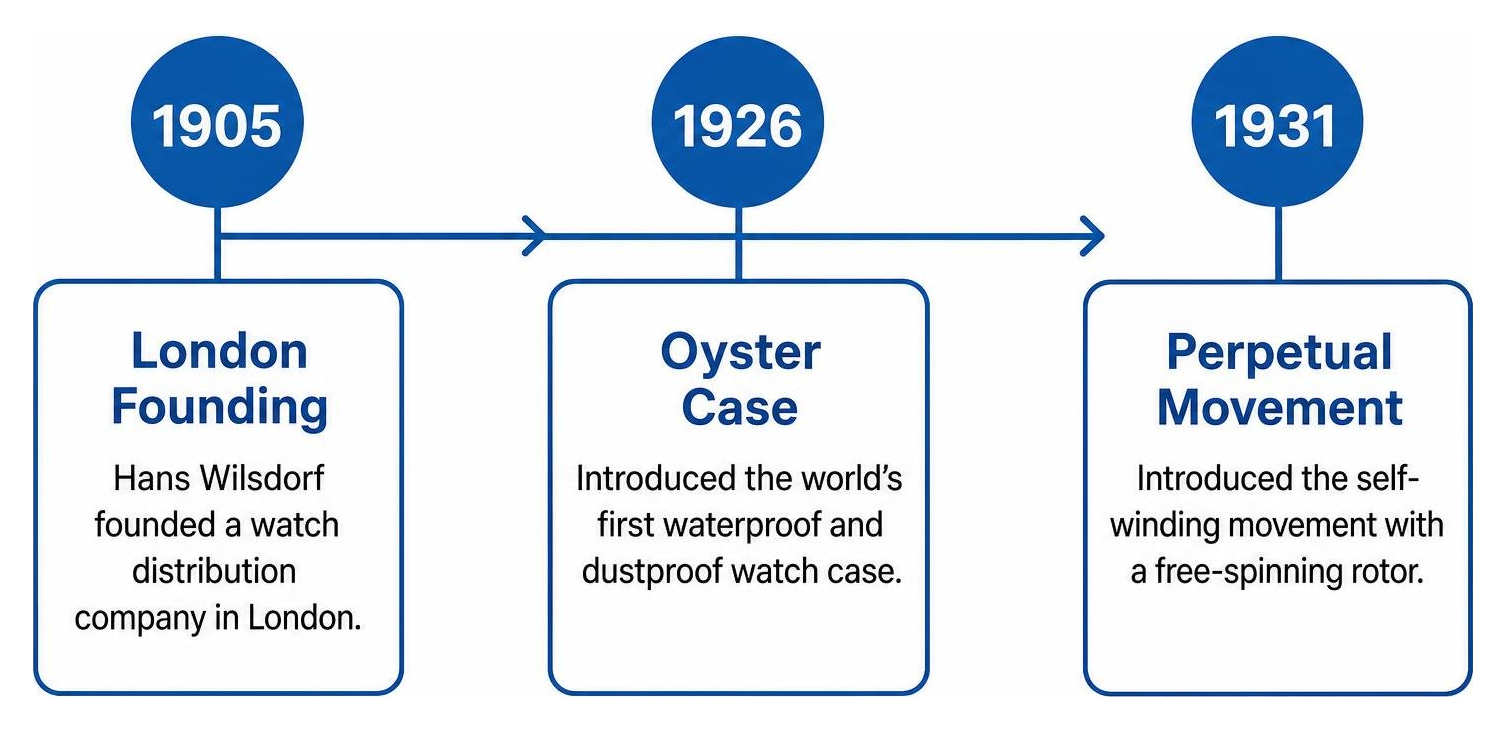
Rolex has built its reputation over more than a century, starting with the waterproof Oyster case in 1926 and the self-winding Perpetual rotor in 1931. Today, the brand makes roughly one million watches annually, spanning understated everyday models, rugged professional watches, and precious-metal statement pieces.
At Masina Diamonds, we have served Atlanta clients for more than 40 years with custom jewelry, engagement rings, and luxury timepieces, including Rolex watches. This guide will make the major models, pricing, ownership costs, and buying checks easier to compare before you choose.
History, Craftsmanship, and Technical Innovations
The story of Rolex began in 1905 when Hans Wilsdorf founded a watch distribution company in London. Driven by a vision to make precise, wrist-worn timepieces at a time when pocket watches dominated the market, Wilsdorf selected the name "Rolex" in 1908 because it was short, easy to pronounce across international languages, and visually symmetrical on a watch dial. In 1910, Rolex earned the first Swiss Certificate of Chronometric Precision granted to a wristwatch, establishing a legacy of accuracy that continues today.
To consolidate operations and escape wartime import tariffs, Wilsdorf relocated the firm to Geneva, Switzerland. Rolex operates across four highly specialized facilities in Switzerland, employing over 9,000 people. Movement production takes place in Bienne, while cases and precious metals are crafted at Plan-les-Ouates, dials and gem-setting are executed at Chêne-Bourg, and final assembly and corporate operations reside at global headquarters in Les Acacias.
Rolex built its industry reputation through breakthrough technical achievements:
- The Oyster Case (1926): The world's first waterproof and dustproof watch case, featuring a hermetically sealed screw-down bezel, caseback, and winding crown. To prove its utility, English swimmer Mercedes Gleitze wore an Oyster across the English Channel in 1927, and the timepiece emerged in perfect working order.
- The Perpetual Movement (1931): The precursor to modern self-winding mechanical movements, utilizing a free-spinning internal rotor that winds the mainspring with the natural movement of the wearer's wrist.
- Superlative Chronometer Certification: Modern rolex watches undergo internal laboratory testing after the movement has been cased, guaranteeing precision tolerances of -2/+2 seconds per day—more than twice as strict as standard COSC chronometer testing.
In-House Materials and Proprietary Metallurgy
Rolex maintains control over its metallurgy by operating an internal private foundry. Rather than purchasing standard metals, the manufacture casts its own gold and platinum alloys and formulates proprietary stainless steel blends:
- Oystersteel: Part of the 904L superalloy family, Oystersteel is extremely resistant to chemical corrosion and maintains an exceptional luster when polished. While most watchmakers rely on 316L steel, 904L requires specialized industrial machinery to forge and mill.
- 18 kt Everose Gold: Introduced in 2005, Everose is Rolex's patented 18 kt pink gold alloy. Formulated with pure gold, copper, and a touch of platinum, it prevents chlorine and salt-water exposure from fading the warm rose tone over time.
- Rolesor: Patented in 1933, Rolesor represents the union of Oystersteel and gold (yellow, Everose, or white) on a single timepiece, balancing daily durability with precious-metal sophistication. Fine examples like the Rolex Datejust 41 watch: Oystersteel and yellow gold showcase how two-tone styling delivers timeless contrast.
- RLX Titanium: A grade 5 titanium alloy selected for high-performance dive models like the Deepsea Challenge. It provides lightweight durability for oversized technical cases.
- Cerachrom Ceramic Bezels: Engineered from dense zirconium oxide, Cerachrom bezels are scratchproof, impervious to UV discoloration, and engraved with numerals coated in fine platinum or gold using Physical Vapour Deposition (PVD).
- Parachrom Hairspring: Crafted from a niobium-zirconium alloy, this blue hairspring remains unaffected by magnetic fields and offers up to ten times greater resistance to physical shocks than standard hairsprings.
Signature Bracelet and Clasp Technologies
The attachment between case and wrist is critical to daily wearing comfort. Rolex manufactures distinct bracelet and clasp designs engineered for specific watch lines:
- Oyster Bracelet: Introduced in the late 1930s, this iconic three-piece link design is rugged, sporty, and available across almost every model family.
- Jubilee Bracelet: Created in 1945 for the debut of the Datejust, this supple five-piece link bracelet features polished center links flanked by brushed outer links, offering a dressier wrist profile.
- President Bracelet: Reserved exclusively for the Day-Date line and select precious-metal Datejust models since 1956, this semi-circular three-piece link design features concealed ceramic inserts within the links to prevent stretching over decades of wear.
- Oysterflex Bracelet: Developed by Rolex, this technical strap integrates flexible titanium-nickel alloy blades inside high-performance black elastomer, providing the structural integrity of a metal bracelet with the flexibility of rubber.
- Clasp Systems: Modern bracelets utilize specialized closures including the hidden Crownclasp for a seamless appearance, the secure Oysterlock safety clasp for professional sports models, and comfort extensions like the Easylink 5mm system and micro-adjustable Glidelock dive extension.
Comparing Popular Collections of Rolex Watches
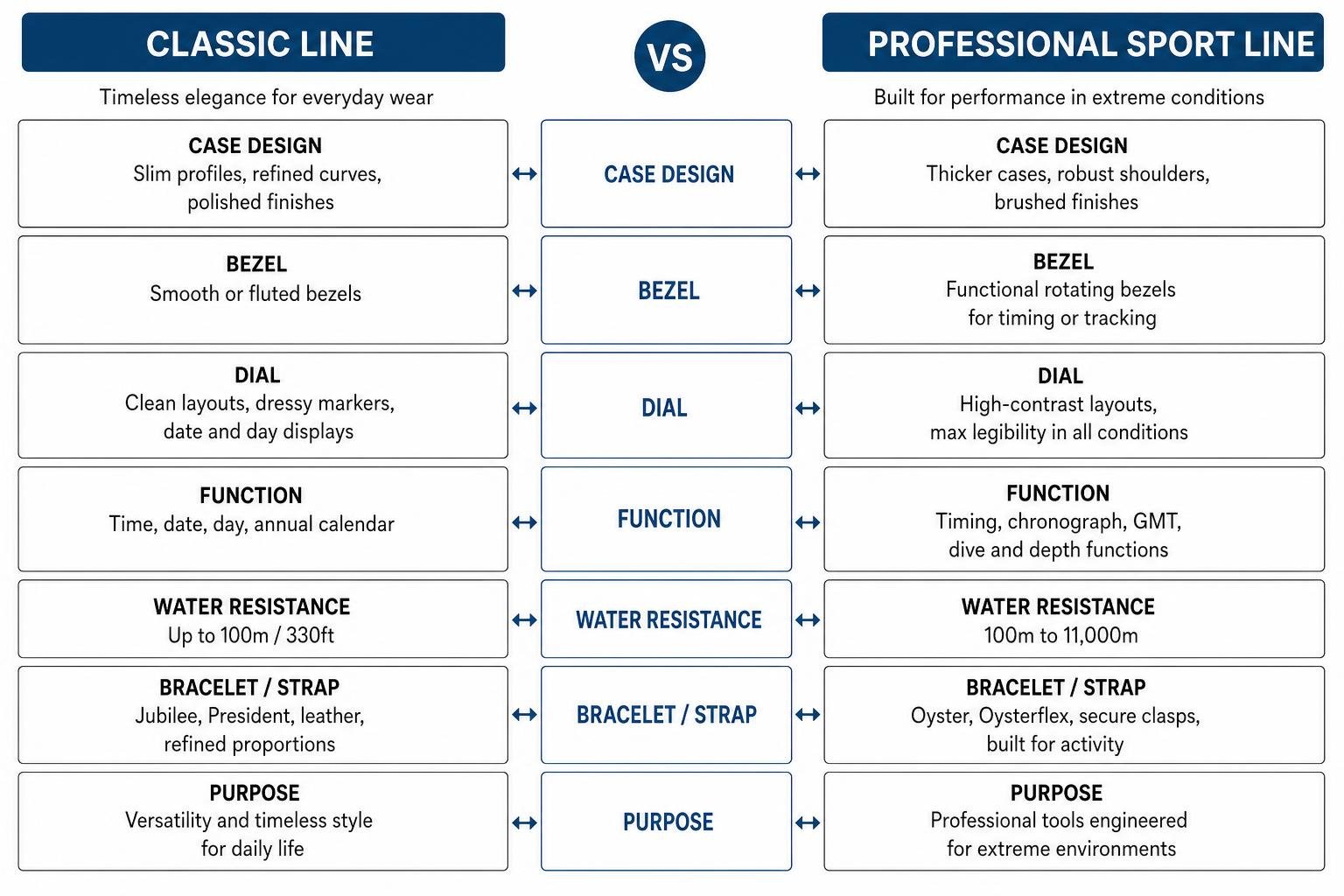
Rolex organizes its lineup into classic everyday watches, professional utility pieces, and high-complication timepieces. Understanding the differences in case geometry, depth ratings, and mechanical functions makes choosing the right piece straightforward.
| Model Collection | Available Case Sizes | Core Materials | Water Resistance | Signature Complications |
|---|---|---|---|---|
| Oyster Perpetual | 28mm, 31mm, 34mm, 36mm, 41mm | Oystersteel | 100m / 330ft | Time-only mechanical movement |
| Datejust | 31mm, 36mm, 41mm | Oystersteel, Rolesor, 18 kt Gold | 100m / 330ft | Instantaneous date at 3 o'clock with Cyclops lens |
| Day-Date | 36mm, 40mm | 18 kt Yellow/Everose/White Gold, Platinum | 100m / 330ft | Day of the week spelled in full + date |
| Submariner | 41mm | Oystersteel, Rolesor, 18 kt Gold | 300m / 1,000ft | Unidirectional 60-min timing bezel |
| Cosmograph Daytona | 40mm | Oystersteel, Rolesor, 18 kt Gold, Platinum | 100m / 330ft | 1/8th-second chronograph + tachymeter bezel |
| GMT-Master II | 40mm | Oystersteel, Rolesor, 18 kt Gold | 100m / 330ft | Independent 24-hour GMT hand + rotating bezel |
| Yacht-Master | 37mm, 40mm, 42mm | Oystersteel, Rolesium, Rolesor, Gold, Titanium | 100m / 330ft | Bidirectional timing bezel |
| Sea-Dweller / Deepsea | 43mm, 44mm, 50mm | Oystersteel, RLX Titanium, 18 kt Gold | 1,220m - 11,000m | Helium escape valve, deep-sea ratings |
| Sky-Dweller | 42mm | Oystersteel, Rolesor, 18 kt Gold | 100m / 330ft | Annual calendar (Saros) + dual time zone |
Classic Everyday and Dress Models
For versatile daily wear, the classic catalog provides timeless proportion and effortless styling:
- Datejust: The quintessential luxury wrist watch since 1945. Featuring an instantaneous date display magnified 2.5x by the Cyclops lens on the sapphire crystal, the Rolex Datejust collection ranges from smooth bezels to signature fluted precious-metal bezels. References like the Rolex Datejust 41 Blue Dial 126334 combine an Oystersteel case, white gold fluted bezel, and sunray dial finishing that reflects light from every angle.
- Oyster Perpetual: Serving as the purest expression of the Oyster case and Perpetual movement, this time-only collection provides a clean dial layout across a wide range of colorful dial finishes. A standout option for modern collectors is the vibrant Rolex Oyster Perpetual 41 Green Dial 124300.
- Day-Date ("President"): Debuted in 1956 in solid 18 kt gold or platinum, the Day-Date was the first watch to spell out the day of the week in full at 12 o'clock alongside the date window. Available in 36mm and 40mm configurations, it remains an iconic symbol of achievement.
- Perpetual 1908: Introduced as a modern interpretation of vintage dress watches, the 1908 features a slim case, sapphire exhibition back, and hand-finished movement detangling traditional elegance from sports aesthetic.
Iconic Sports and Professional Rolex Watches
Rolex professional models were originally developed as tool watches for ocean exploration, aviation, motorsports, and mountaineering:
- Submariner: Launched in 1953 as a dedicated tool for scuba divers, the Submariner features a 300-meter (1,000 feet) water resistance rating, a unidirectional ceramic bezel to track immersion times, and high-legibility Chromalight hour markers.
- Cosmograph Daytona: Built for professional race drivers, the Daytona features a high-frequency chronograph movement (Calibre 4131) and a tachymetric bezel to calculate speeds up to 400 units per hour. The stainless steel Rolex Cosmograph Daytona watch: Oystersteel is widely considered one of the most sought-after watches in luxury horology.
- GMT-Master II: Designed in 1955 for Pan American World Airways transatlantic pilots, this model uses a 24-hour hand paired with a bidirectional two-tone ceramic bezel to track two time zones simultaneously. Popular bi-color inserts include the grey-and-black bezel on the Rolex GMT-Master II 126710GRNR Bruce Wayne.
- Yacht-Master: Blending maritime tool utility with refined luxury styling, the Yacht-Master line offers comfortable case contours and bidirectional timing bezels. The striking platinum-bezel Rolex Yachtmaster Rhodium Dial 126622 stands out for its high-contrast dial and tactile feel.
- Explorer & Explorer II: Built for extreme environments, the Explorer line originated with the historic 1953 Everest expedition. The Explorer II adds an oversized orange 24-hour hand and fixed bezel designed for speleologists and polar explorers who need to distinguish day from night in perpetual darkness.
- Sea-Dweller & Deepsea: Built for commercial saturation divers, these models incorporate an automatic helium escape valve that releases built-in pressure during chamber decompression. Depth ratings start at 1,220 meters (4,000 feet) for the Sea-Dweller and reach 3,900 meters for the Deepsea.
High-Complication Timepieces
Rolex approaches horological complications through the lens of mechanical reliability and practical utility:
- Sky-Dweller: Designed for global travelers, the Sky-Dweller is Rolex's most complex modern timepiece. It incorporates an off-center 24-hour disc for a secondary time zone alongside the Saros annual calendar, which automatically differentiates between 30- and 31-day months using 12 subtle aperture windows around the dial hour indices.
- Ring Command System: Instead of adding extra pushers to the case exterior, the Sky-Dweller utilizes an interactive fluted bezel linked directly to the mechanical movement. Rotating the bezel selects which complication (date, local time, or reference time) is set via the central winding crown. The Rolex Sky-Dweller Blue Dial on Oyster Band 326934 shows how this complex architecture fits into an elegant everyday aesthetic.
Brand Comparisons, Pricing, and Ownership Costs
When comparing rolex watches against other prestige Swiss manufactures, distinct market dynamics and production philosophies become clear:
- Rolex vs. Omega: Omega offers outstanding industrial movements equipped with Co-Axial escapements and METAS Master Chronometer anti-magnetic certification up to 15,000 gauss. While Omega matches Rolex in technical precision and underwater performance, Rolex maintains higher average secondary-market value retention and deeper global brand recognition.
- Rolex vs. Tudor: Tudor operates as a sister brand under the Hans Wilsdorf Foundation umbrella. Tudor produces mechanical sports watches utilizing vintage heritage styling, high-grade movements, and titanium or steel cases at lower price points. However, Rolex commands proprietary internal metals, stricter finishing tolerances, and stronger asset liquidity.
Pricing for new rolex watches at authorized retail begins at roughly $6,500 to $6,750 for steel Oyster Perpetual models and scales past $75,000 for solid gold configurations of the Day-Date or gem-set Daytona lines. Because demand for steel sports models frequently exceeds annual factory output, secondary market pricing fluctuates based on model popularity and reference availability. Proven historical references have achieved world-record valuation highlights, such as actor Paul Newman's personal Rolex Daytona reference 6239 selling at auction for $17.75 million.
Price Performance and Investment Potential
While timepieces should primarily be purchased for enjoyment and daily wearing satisfaction, Rolex maintains one of the strongest resale liquidities in the luxury consumer goods market.
- Steel Sports Stability: Stainless steel sports references (such as the Submariner, GMT-Master II, and Daytona) historically hold value well due to consistent global demand and disciplined factory production volumes.
- Precious Metal Market Cycles: Solid 18 kt gold and platinum models involve higher initial capital outlay. While their prices fluctuate with precious metal commodity markets, they offer long-term asset value and heirloom appeal.
- Discontinued Reference Surges: When Rolex updates a case size or discontinues a dial color, secondary market demand for outgoing reference numbers often spikes among collectors seeking original configurations. Exploring verified Pre-Owned Rolex Watches is a reliable way to locate sought-after reference references that are no longer available at retail.
Servicing Intervals and Maintenance Costs
A mechanical watch requires routine lubrication and mechanical calibration to ensure reliable operation across decades of service:
- Service Frequency: Rolex recommends complete mechanical servicing approximately every ten years, assuming normal wear conditions and intact seal integrity.
- Standard Service Pricing: A standard overhaul for a time-and-date reference (such as a Datejust, Submariner, or Explorer) ranges from $800 to $1,200.
- Chronograph Service Pricing: Complex multi-part movements, such as the Calibre 4131 inside the Cosmograph Daytona, require broader disassembly and typically cost between $1,500 and $2,000 for factory service.
- Service Workflow: Standard service involves complete movement disassembly, ultra-sonic component cleaning, replacement of worn gears or mainsprings, fresh synthetic lubrication, replacement of all rubber caseback and crown gaskets, pressure-chamber waterproof testing, and post-casing timing calibration.
Buyer's Guide: Selection, Sizing, and Verification
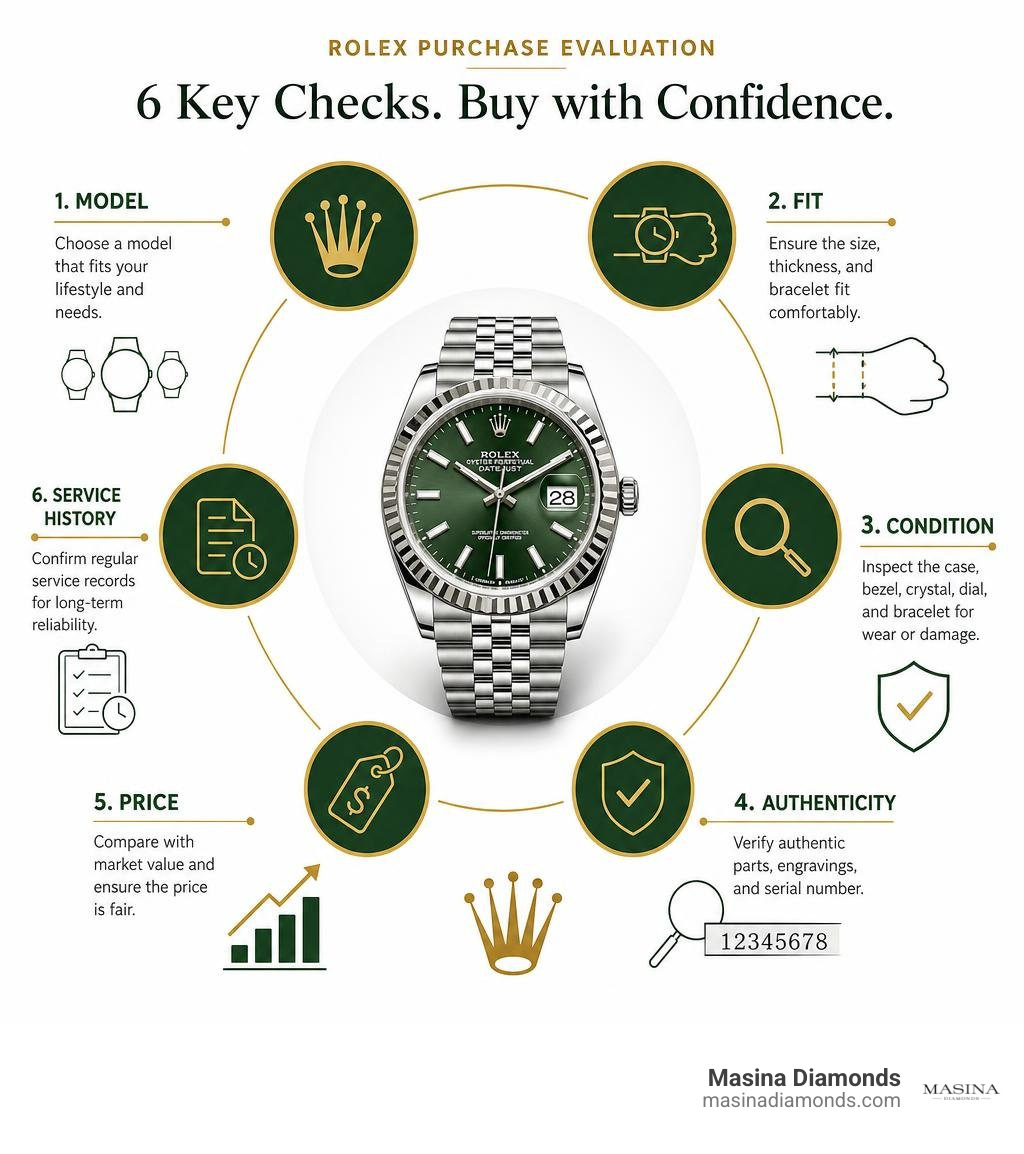
Selecting the right Rolex requires balancing personal style, physical wrist proportions, and proper verification procedures.
Wrist ergonomics depend on lug-to-lug span and case thickness as much as dial diameter. For example, a 40mm Daytona wears noticeably smaller than a 40mm Submariner due to its slimmer case profile and curved lugs.
How to Authenticate Pre-Owned Rolex Watches
Due to secondary market demand, thorough verification is essential when purchasing pre-owned luxury timepieces. Key structural and physical checks include:
- Engraved Rehaut: Modern Rolex references feature "ROLEX ROLEX ROLEX" repeat-engraved crisp around the inner metal ring (rehaut) beneath the sapphire crystal, with the watch's individual serial number sharply laser-etched at the 6 o'clock position.
- Micro-Etched Crown: On modern sapphire crystals, a minute Rolex coronet logo is laser-etched directly into the glass at the 6 o'clock position, visible under loupe magnification and angled light.
- Case and Lug Engravings: The reference number is deeply micro-milled into the case metal between the upper lugs, while the serial number is etched between the lower lugs on vintage models or on the inner rehaut on modern pieces.
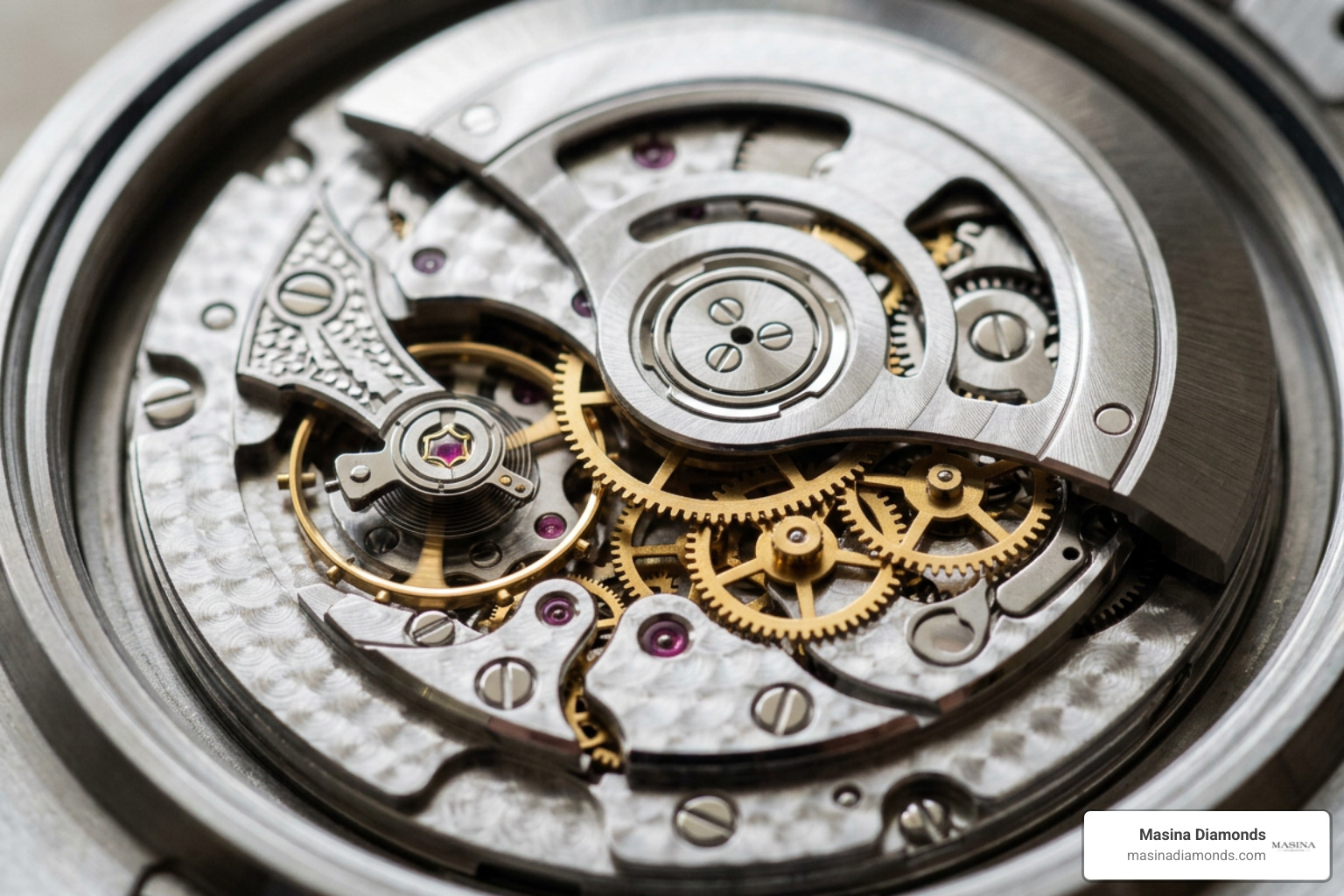
- Movement Calibre Inspection: Genuine Rolex internal movements feature clean bridge bevelling, violet synthetic ruby jewels, and a free-sprung balance wheel equipped with gold Microstella adjusting screws rather than cheap index regulators.
- Documentation Verification: Verify that serial numbers stamped onto the watch case match original international guarantee cards, service records, and provenance documents.
Best First Rolex for New Collectors
For buyers entering the luxury market, selecting an adaptable model ensures max wearability across diverse settings:
- Oyster Perpetual 36 or 41: The definitive entry point into the catalog. It offers legendary Oyster case durability, robust magnetic protection, and a clean dial profile suitable for casual and professional wear.
- Datejust 36 or 41: The quintessential everyday luxury watch. Combining a date window with an iconic bracelet, it transitions effortlessly from casual weekend wear to formal attire. Exploring our full collection of Rolex Watches provides an overview of available dial styles and metal choices.
- Submariner Date or No-Date: For buyers who prefer a sport-focused watch, the stainless steel Submariner provides unmatched durability, timeless dive styling, and strong long-term value retention.
Frequently Asked Questions About Rolex Watches
What is the entry-level price for a new Rolex watch?
A new Rolex from an authorized dealer begins at approximately $6,500 USD for a 36mm Oyster Perpetual in Oystersteel, while 41mm Oyster Perpetual models start around $6,750 USD. Prices increase based on model complexity, metal choice (Rolesor, Everose, Yellow Gold, Platinum), and gem settings.
How often does a Rolex watch require servicing?
Rolex officially recommends servicing your timepiece roughly once every ten years under normal wearing habits. However, if the watch is frequently exposed to saltwater or used during high-impact sports, having the waterproof gasket seals pressure-tested every two to three years ensures internal protection.
What makes Rolex watches hold their value so well over time?
Rolex maintains high market stability through strictly controlled manufacturing standards, proprietary high-grade materials (such as 904L Oystersteel and Everose gold), enduring design continuity across decades, and strong global secondary-market liquidity.
Conclusion
Choosing a Rolex is an investment in mechanical craftsmanship and timeless aesthetic heritage. Whether your lifestyle favors the classic versatility of a Datejust, the professional functionality of a GMT-Master II, or the horological complexity of a Sky-Dweller, evaluating case size, materials, and service condition ensures your watch brings enjoyment for generations.
At Masina Diamonds, our family-owned jewelry showroom in Atlanta brings over 40 years of trusted expertise and personalized guidance to every client. If you are selecting your first timepiece or expanding an established collection, our experienced specialists are here to help you navigate model references and authenticity checks.
Ready to explore iconic timepieces in person? Visit our Atlanta showroom or read our comprehensive Rolex Watch Guide Atlanta to discover the ideal timepiece for your wrist.