Why the Rolex Datejust Turn-O-Graph Matters
The Rolex Datejust Turn-O-Graph is a 36mm watch that pairs a Datejust’s date display with a rotating bezel for timing short intervals. It began in 1953 as the standalone Ref. 6202, often called Rolex’s first true tool watch. Later models joined the Datejust line, blending a useful timing feature with a dressier look. Rolex ended production in 2011, but the watch remains a distinctive choice for collectors.
At Masina Diamonds, we draw on over 40 years of Atlanta jewelry craftsmanship and luxury watch expertise to make the history of the datejust turn o graph easier to understand.
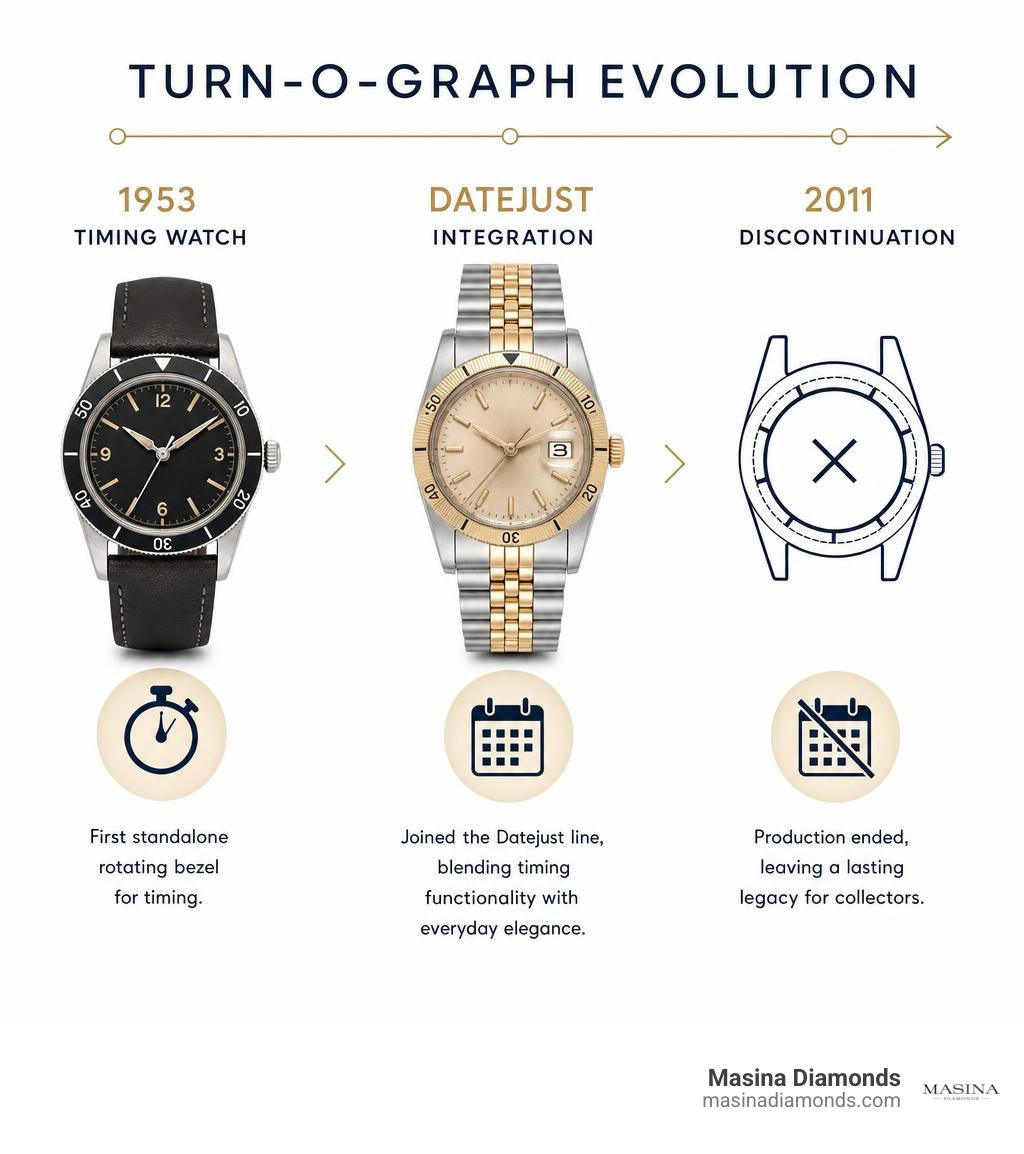
Origin Story: Rolex's First True Tool Watch and the 'Thunderbird' Legacy
Before the Submariner took over the deep ocean or the GMT-Master conquered transcontinental aviation, Rolex released an unexpected novelty in 1953: the Turn-O-Graph Reference 6202. While the 1937 Zerographe Reference 3346 had previously introduced an experimental rotating bezel to a handful of watches, the Reference 6202 was the very first mass-produced wristwatch in history to incorporate a bidirectional rotating bezel.
Rolex marketed the Reference 6202 as the "Simplest 'Stop-Watch' Ever." It did not rely on complex mechanical chronograph pushers or internal clutch systems. Instead, wearers simply aligned the zero marker on the graduated bezel with the minute hand to calculate elapsed minutes for phone calls, flight legs, or navigation checkpoints. For collectors reading through our comprehensive guide to Rolex watches, the Reference 6202 stands out as the fundamental blueprint that inspired Rolex's legendary tool watch lineage.
The U.S. Air Force Thunderbirds Connection
Shortly after its introduction, the watch caught the attention of the U.S. Air Force’s premier precision aerobatic flight demonstration squadron: the Thunderbirds. Formed in 1953, the team required a reliable, easily adjustable timepiece to synchronize maneuvers and track flight legs.
Individual pilots began using the Turn-O-Graph for timing intervals. Recognizing its utility, the U.S. Air Force officially approached Rolex to equip the squadron. Rolex seized the opportunity, producing special models bearing the Thunderbirds team insignia at the 6 o'clock position. In North American markets, Rolex capitalized on this partnership by officially marketing Turn-O-Graph models as the "Thunderbird."
The Shift from Standalone Tool to Datejust Collection
While the original Reference 6202 looked much like an early dive watch with its black insert and luminous dial, Rolex quickly realized that sports timing could coexist with everyday elegance. In 1954, Rolex introduced Reference 6309, integrating the model directly into the flagship Datejust family.
This transition added the signature 3 o'clock date window and magnified Cyclops crystal, creating a functional hybrid. Rather than maintaining the watch as a dedicated rugged instrument, Rolex evolved it into a versatile dress-sport watch suitable for both corporate meetings and athletic recreation.
The Evolution of the Rolex Datejust Turn-O-Graph: From Ref. 6202 to the Modern Era
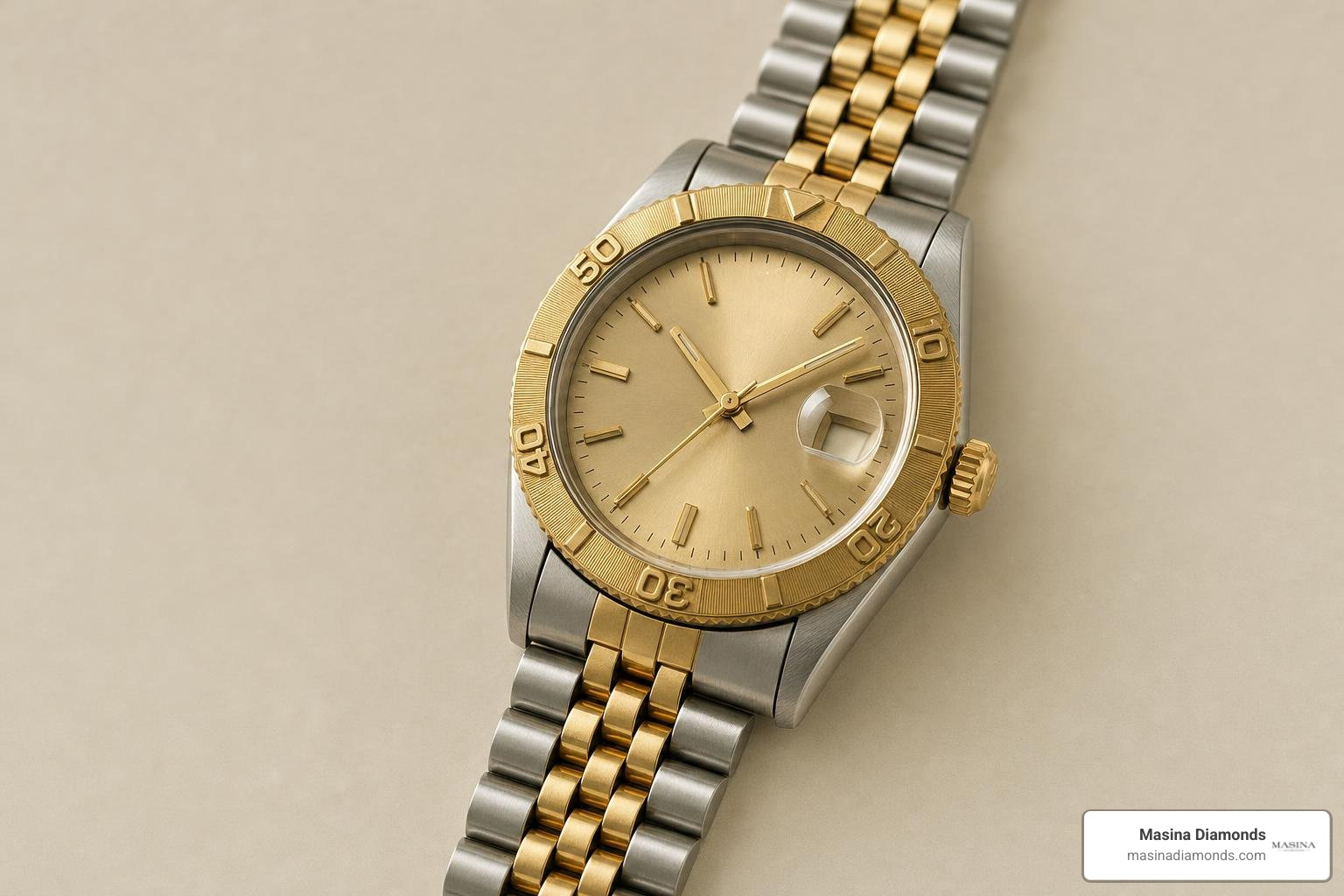
Across a six-decade production run spanning from 1953 until 2011, the Turn-O-Graph evolved across 10 distinct reference families. As Rolex upgraded case metallurgy, crystal technologies, and mechanical movements, the Turn-O-Graph adapted alongside its sibling models.
Key Reference Numbers Across Datejust Turn-O-Graph Generations
During the late 1950s and throughout the 1960s and 1970s, the iconic Reference 1625 established the modern visual identity of the collection. It featured an embossed, bi-directional rotating bezel made of solid gold with raised 10-minute numerical markers and intermediate baton indicators, driven by the workhorse Caliber 1570.
By the late 1970s and 1980s, the transitional five-digit references arrived. Models like the Ref. 16264 brought scratch-resistant sapphire crystals, high-beat Caliber 3035 and 3135 movements, and quickset date functionality to the lineup.
| Reference | Production Era | Bezel Material | Crystal Type | Caliber Movement | Notable Design Features |
|---|---|---|---|---|---|
| 6202 | 1953–1954 | Steel / Aluminum insert | Acrylic | Caliber A260 / 743 | Black timing insert; no date window; original tool watch |
| 6309 / 6609 | 1954–1959 | Steel, Two-Tone, Yellow Gold | Acrylic | Caliber 1065 | Integrated into Datejust family; added Cyclops date window |
| 1625 | 1959–1977 | Two-Tone, Yellow Gold, White Gold | Acrylic | Caliber 1565 / 1570 | Embossed fluted bezel with raised timing numerals |
| 16253 / 16264 | 1977–2003 | Two-Tone, Steel & White Gold | Sapphire | Caliber 3035 / 3135 | Quickset date; modern sapphire crystal; fluted relief bezel |
| 116264 / 116263 | 2004–2011 | White, Yellow, or Everose Rolesor | Sapphire | Caliber 3135 | Red seconds hand; red date wheel; polished fluted turning bezel |
The Final Generation: References 116264, 116263, and 116261
In 2004, Rolex unveiled the six-digit generation, which included the stainless steel and white gold Ref. 116264, the yellow Rolesor 116263, and the Everose Rolesor 116261.
This generation introduced distinct visual upgrades:
- A bright red central sweep seconds hand.
- A matching red "TURN-O-GRAPH" dial script.
- A solid red or alternating "roulette" (red odd, black even) date disc.
- Solid-link modern Oyster and Jubilee bracelets with concealed Crownclasps.
Inside ticked the in-house Caliber 3135 automatic movement, operating at 28,800 vibrations per hour (vph) across 31 jewels with up to a 50-hour power reserve.
Defining Design Features and Comparisons with Iconic Rolex Tool Watches
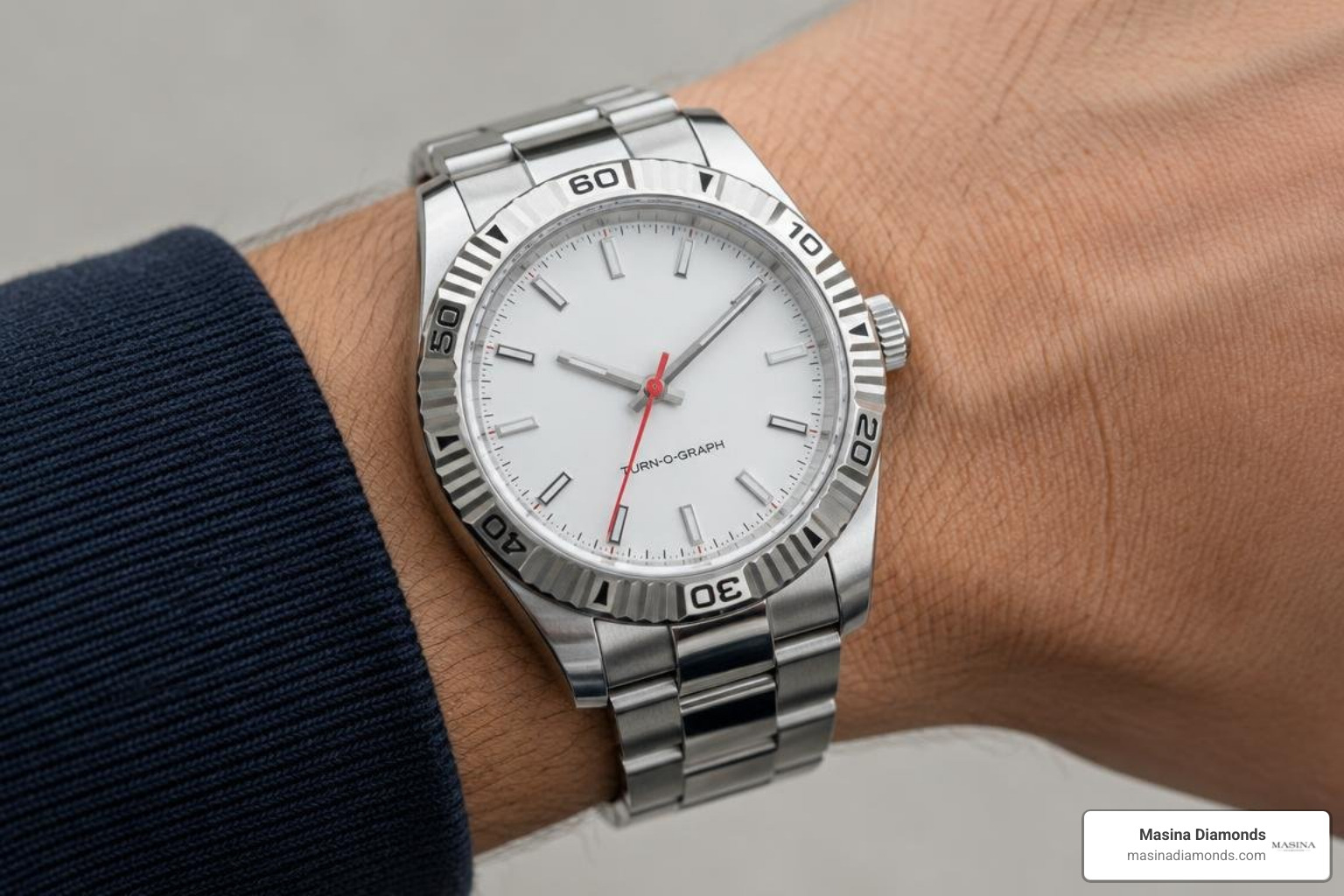
What sets the Turn-O-Graph apart is its rotating bezel. Unlike standard fluted bezels found on contemporary classics like the Datejust 36 Wimbledon, the Turn-O-Graph features a 60-minute scale engraved directly into the flutes, paired with a triangular zero indicator at 12 o'clock.
Turn-O-Graph vs. Submariner and GMT-Master
Understanding where the Turn-O-Graph sits within the Rolex sports-luxury catalog helps illustrate why it appeals to collectors:
- Bezel Mechanism & Functionality: While dive watches like the two-tone Submariner use a unidirectional 60-minute ratcheting bezel to prevent accidental underwater timing errors, the Turn-O-Graph employs a bidirectional turning bezel designed for versatile general timing.
- Dual Time Tracking: In contrast to the 24-hour dual-time bezel found on models like the GMT-Master II Coke, the Turn-O-Graph relies on a 60-minute bezel driven by standard 12-hour analog time.
- Case Profile and Depth Ratings: The Turn-O-Graph maintains a slim Datejust case profile with a 100-meter (10 bar / 328 feet) water resistance rating, offering everyday water protection without the added bulk of dedicated 300-meter dive cases.
The 36mm Proportions and Modern Unisex Appeal
The Turn-O-Graph never grew beyond its classic 36mm case diameter. While larger sports watches surged in popularity during the late 2000s, the 36mm profile has seen a strong resurgence. Its modest lug-to-lug proportions, balanced dial layout, and versatile case thickness make it an ideal unisex option for diverse wrist sizes.
Collecting Rarities, Market Valuations, and Discontinuation
When Rolex retired the Turn-O-Graph in 2011, secondary market interest began to steadily climb. Collectors looking to navigate the pre-owned space often consult our certified pre-owned Rolex buying guide to assess condition, originality, and pricing.
Secondary market valuations generally range between $7,000 and $10,000 for standard five-digit and six-digit references in sound condition. At the top of the spectrum, original vintage Reference 6202 models command upwards of $30,276 at international auctions.
Market data reveals that the popular Reference 116264 maintains an active secondary footprint, recording an annual sales volume of 672 units, a low median of 28.1 days on the market, and a stable 9.4% market volatility rate.
Rare Variants: Standard de Liège and Historic Provenance
Among six-digit variants, the 2010 Rolex Datejust Turn-O-Graph 'Standard de Liège' (Reference 116264) represents one of Rolex's rarest modern special editions. Produced in a run of only 100 individually numbered pieces to commemorate the Belgian football club's championship title, its signature red accents paid homage to the team's colors.
Other historic pieces have commanded significant international attention:
- The Todd Beamer 9/11 Watch: The Turn-O-Graph Reference 16263 worn by passenger Todd Beamer aboard United Flight 93 now rests preserved in the National September 11 Memorial & Museum.
- Celebrity Provenance: High-profile auction appearances, such as Eric Clapton's vintage Reference 6202 crossing the auction block, have further highlighted the historical importance of the reference.
How to Authenticate and Value a Pre-Owned Datejust Turn-O-Graph
When evaluating a pre-owned Datejust Turn-O-Graph, keep the following checklist in mind:
- Inspect Bezel Action and Condition: Ensure the bezel rotates smoothly in both directions with appropriate mechanical tension. Examine the fluted numerals for signs of aggressive polishing.
- Check Dial Components: On modern six-digit references (116264, 116263, 116261), confirm the presence of the original red central seconds hand and genuine red/roulette date disc.
- Review Provenance and Documentation: While unpolished watches with original box, punched warranty papers, or service cards command higher market premiums, condition remains paramount.
- Verify Gasket Seals and Pressure Resistance: Because vintage and neo-vintage timepieces require ongoing maintenance, confirm recent service records and verify that case gaskets have been pressure tested to 100 meters before wear around water.
Frequently Asked Questions
Why was the Rolex Turn-O-Graph discontinued in 2011?
Rolex discontinued the Turn-O-Graph in 2011 primarily due to shifting market trends. Mainstream buyers looking for tool watches gravitated toward dedicated sports lines like the Submariner and GMT-Master, while dress watch buyers preferred the classic smooth or fluted bezels of standard Datejust configurations.
What is the difference between a standard Datejust and a Turn-O-Graph?
While both share identical 36mm Oyster cases, water resistance ratings, and internal calibers, the Turn-O-Graph features a functional bidirectional rotating timing bezel marked with 60-minute graduations. Modern six-digit variants also incorporate distinctive red model text, a red seconds hand, and a red or roulette date display.
How much is a Rolex Datejust Turn-O-Graph worth in 2026?
In 2026, most five-digit and six-digit Turn-O-Graph models (such as References 16264 and 116264) trade between $7,000 and $10,000 depending on metal composition, dial configuration, and accompanying box and papers. Rare original 1953 Reference 6202 models frequently exceed $30,000.
Conclusion
The Rolex Datejust Turn-O-Graph remains one of the most intriguing chapters in luxury horology. As the first mass-produced wristwatch to introduce the rotating timing bezel, it bridged the gap between pure utility and refined dress aesthetics for nearly sixty years.
Whether you are exploring vintage tool watches or building an heirloom fine jewelry collection, our team at Masina Diamonds brings over four decades of Atlanta jewelry expertise to help guide your selections. Explore our comprehensive Atlanta luxury watch guide to learn more about iconic timepieces, fine jewelry design, and collector essentials.