Birthstone Names by Month at a Glance
Here are the birthstone names by month, including widely recognized alternatives:
- January: Garnet
- February: Amethyst
- March: Aquamarine, bloodstone
- April: Diamond
- May: Emerald
- June: Pearl, alexandrite, moonstone
- July: Ruby
- August: Peridot, spinel, sardonyx
- September: Sapphire
- October: Opal, tourmaline
- November: Topaz, citrine
- December: Turquoise, zircon, tanzanite
Some months have more than one stone because birthstone lists have changed over time and vary by tradition. You can choose the one whose color, meaning, and care needs fit you best.
At Masina Diamonds, we’ve spent over 40 years crafting fine jewelry and custom engagement rings in Atlanta. We’ll use that experience to help you make sense of birthstone names by month, starting with the modern and traditional lists.
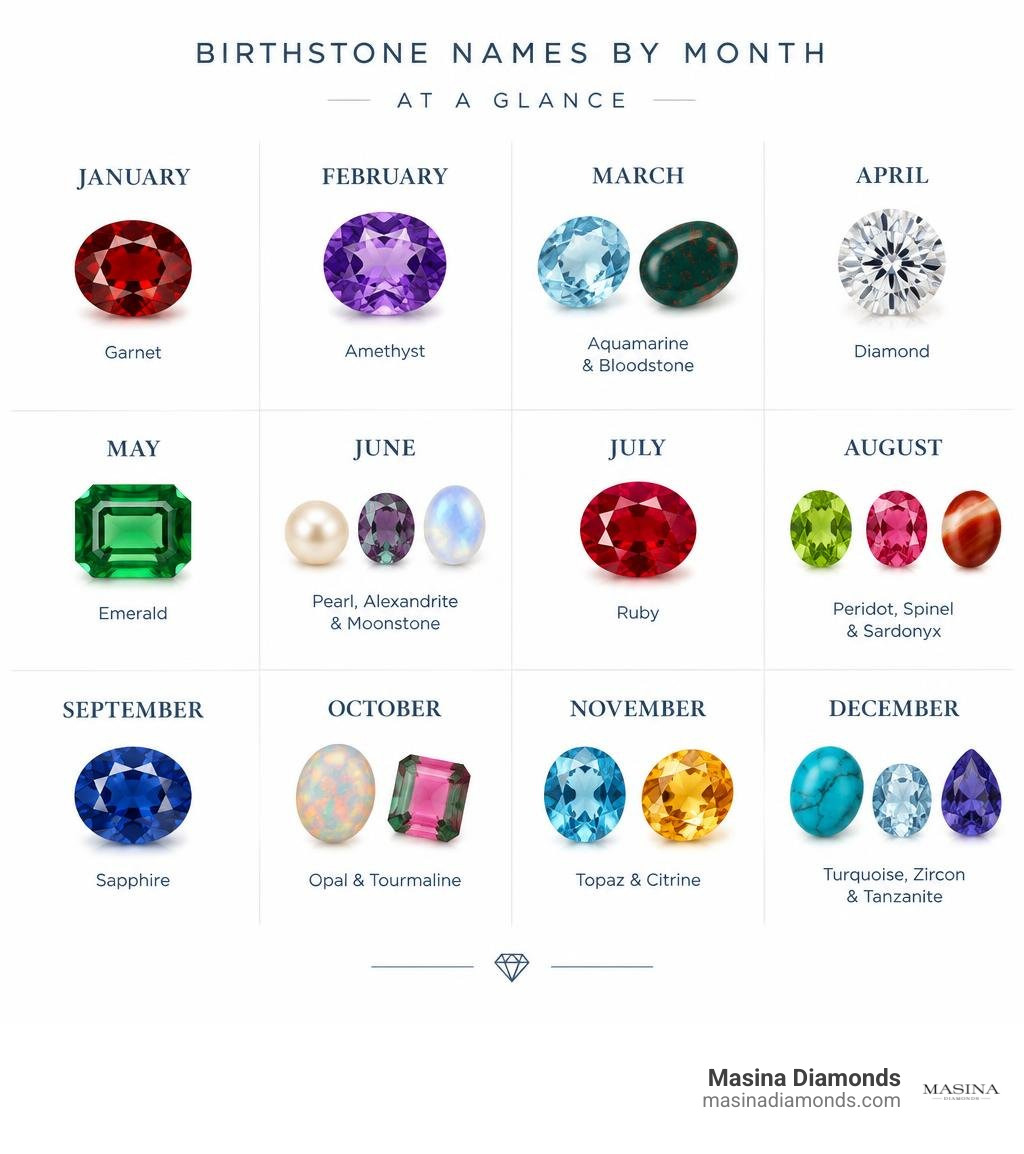
Birthstone names by month: modern and traditional charts
Birthstone customs evolved over centuries, blending historical lore with standardized jewelry lists. Educational authorities like the GIA’s birthstone guide and cultural resources such as The Old Farmer's Almanac note that many months feature primary and secondary options.
Understanding both modern and historical charts helps you pick the right gem for your style, budget, and daily wear. Consulting a comprehensive chart reveals how today's list evolved from earlier customs.
| Month | Modern Birthstone(s) | Traditional Birthstone(s) | Typical Primary Color |
|---|---|---|---|
| January | Garnet | Garnet | Deep Red |
| February | Amethyst | Amethyst | Purple |
| March | Aquamarine | Bloodstone | Pale Blue / Blue-Green |
| April | Diamond | Diamond | Colorless (White) |
| May | Emerald | Emerald | Vivid Green |
| June | Alexandrite, Cultured Pearl | Pearl, Moonstone | White / Color-Changing |
| July | Ruby | Ruby | Radiant Red |
| August | Peridot, Spinel | Sardonyx | Olive Green |
| September | Sapphire | Sapphire | Royal Blue |
| October | Tourmaline, Opal | Opal | Multicolor / Pink |
| November | Golden Topaz, Citrine | Topaz | Warm Yellow / Orange |
| December | Tanzanite, Blue Zircon, Blue Topaz | Turquoise, Lapis Lazuli | Vivid Blue |
Modern birthstone names by month
The modern birthstone system was officially established in August 1912 when the National Association of Jewelers (now Jewelers of America) met in Kansas City. Their goal was to create a commercially practical, standardized selection focusing largely on transparent, facetable gems.
Over the decades, industry associations have updated this list to introduce striking new discoveries. The American Gem Trade Association (AGTA) and Jewelers of America added tanzanite to December in 2002 and introduced spinel as an August birthstone in 2016.
Traditional birthstone names by month
The traditional list reflects customs popular in the United States and Europe between the 16th and 18th centuries, rooted deeply in Polish traditions. These historical charts often featured opaque cabochons and ornamental stones like bloodstone for March, sardonyx for August, and turquoise or lapis lazuli for December. Today, jewelry lovers freely embrace stones from both modern and traditional lineages.
Every birthstone by month: color, character, and meaning
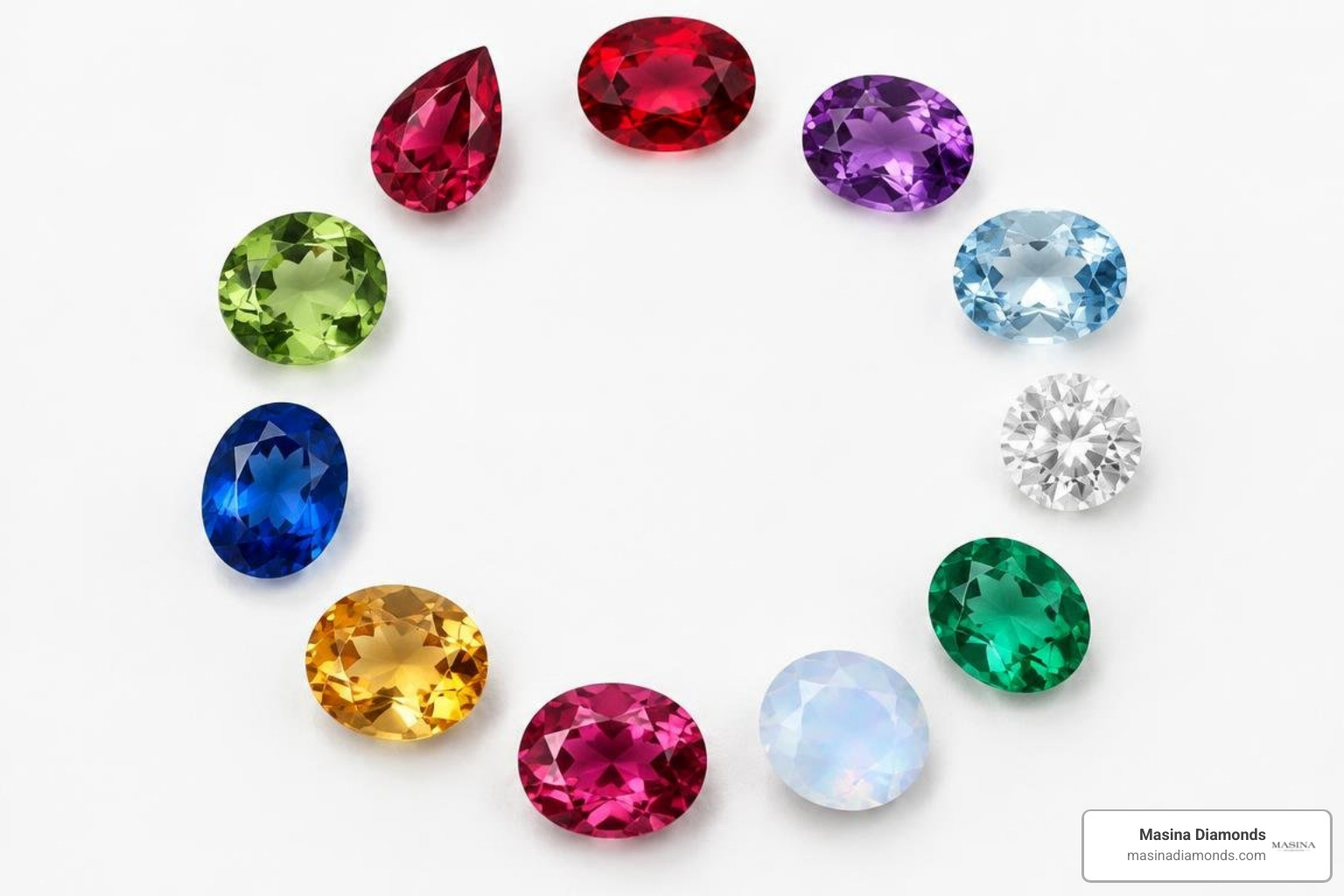
Every gem carries its own geological personality, historical legends, and durability profile. Exploring our birthstone colors guide will give you a deeper look at the spectrum of shades found across the calendar.
January — Garnet
- Color & Character: While famous for its deep pomegranate-red hue, garnet is actually a complex mineral group spanning orange spessartine, vibrant green tsavorite, and rich purples.
- Symbolism & Lore: Garnet derives its name from the early French word grenate, meaning "seedy," honoring its visual likeness to pomegranate seeds. Historically worn by travelers and warriors, it symbolizes vitality, safe journeys, light, and lasting loyalty.
- Durability: Ranking 6.5 to 7.5 on the Mohs hardness scale, garnet is durable for everyday rings and pendants when given sensible care.
February — Amethyst
- Color & Character: A celebrated crystalline quartz, amethyst ranges from delicate pale lilac to rich, royal reddish-purple.
- Symbolism & Lore: The name originates from the Greek amethystos, translating to "sober" or "not intoxicated." Ancient Greeks believed wearing it prevented drunkenness and fostered clear-headed business acumen. It remains a hallmark of peace, mental clarity, and spiritual balance.
- Durability: With a Mohs hardness of 7, amethyst is scratch-resistant and highly resilient for daily jewelry wear.
March — Aquamarine and Bloodstone
- Color & Character: Aquamarine is the tranquil blue to blue-green variety of beryl. Traditional bloodstone (heliotrope) is dark green jasper speckled with iron oxide red flecks.
- Symbolism & Lore: Ancient mariners carried aquamarine talismans etched with Neptune to protect against stormy waters. Bloodstone was long revered for strength and physical healing. Together, March gems represent courage, safety, and renewed health.
- Durability: Aquamarine scores 7.5 to 8 on the Mohs scale, while bloodstone rates 6.5 to 7.
April — Diamond
- Color & Character: Renowned for exceptional brilliance and dispersion, diamonds occur in classic colorless forms as well as fancy yellows, pinks, and blues.
- Symbolism & Lore: Derived from the Greek adamas ("invincible") and known in ancient Sanskrit as vajra ("lightning"), the diamond symbolizes unbreakable strength, purity, and eternal romance—making it the classic centerpiece for engagement rings.
- Durability: As the hardest natural mineral on Earth (Mohs 10), diamond resists scratches better than any other gem.
May — Emerald
- Color & Character: The premier green gemstone of the beryl family, emerald is celebrated for its lush hue. Most natural emeralds feature natural internal inclusions known as jardin (garden).
- Symbolism & Lore: Loved by Cleopatra and dedicated by the ancient Romans to Venus, emerald symbolizes rebirth, fertility, intellectual wisdom, and foresight.
- Durability: Rated 7.5 to 8 for scratch resistance, emeralds often require gentle cleaning and protective settings to safeguard their natural internal inclusions.
July — Ruby
- Color & Character: Ruby is the red variety of corundum, colored by trace elements of chromium. Top-tier specimens display a saturated, vibrant red with subtle fluorescent glow.
- Symbolism & Lore: Hailed as the "king of gems" in ancient Sanskrit (ratnaraj), rubies were believed to protect warriors and bestow unyielding vitality. To learn more about grading and styling, read our ruby birthstone guide. Fine rubies can command record auction prices topping $1,000,000 per carat.
- Durability: With a Mohs hardness of 9, ruby is exceptionally tough and ideal for lifetime heirloom rings.
June — Pearl, Alexandrite, and Moonstone
- Color & Character: Pearls are organic treasures formed within mollusks, alexandrite displays dramatic color change from green in daylight to ruby-red under incandescent light, and moonstone exhibits an ethereal adularescence (floating bluish sheen).
- Symbolism & Lore: Ancient lore called pearls the hardened tears of Aphrodite or celestial dew carried by dragons. Alexandrite represents luck and adaptability, while moonstone brings intuition and serenity.
- Durability: Pearls (2.5–4.5 Mohs) require delicate care, moonstone sits at 6–6.5, while alexandrite offers excellent hardness at 8.5.
August — Peridot, Spinel, and Sardonyx
- Color & Character: Peridot shines in an olive to lime yellow-green. Spinel comes in vivid reds, pinks, and cobalt blues, while traditional sardonyx features alternating reddish and white chalcedony bands.
- Symbolism & Lore: Dubbed the "evening emerald" by ancient Egyptians and revered as the tears of the volcano goddess Pele in Hawaiian lore, peridot protects against nighttime anxieties. Spinel symbolizes renewed energy, and sardonyx represents courage and communication.
- Durability: Spinel boasts an impressive 8 on the Mohs scale, peridot rates 6.5 to 7, and sardonyx rates 6.5 to 7.
September — Sapphire
- Color & Character: Sapphire includes all non-red gem-quality corundum. While royal velvety blue is most celebrated, sapphires naturally form in pink, peach, yellow, green, and rare star-asterism varieties.
- Symbolism & Lore: Prized by royalty and clergy for centuries, blue sapphires symbolize truth, heavenly favor, fidelity, and wisdom. For a deep dive into September jewelry options, explore our guide on selecting a gemstone for September birthday celebrations.
- Durability: Rated 9 on the Mohs scale, sapphire is one of the most durable choices for daily engagement jewelry.
October — Opal and Tourmaline
- Color & Character: Opal displays iridescent play-of-color flashes across a milky or dark body tone. Tourmaline offers one of the broadest color ranges in the mineral kingdom, especially bi-color watermelon and vivid pinks.
- Symbolism & Lore: Ancient legends described opals and tourmalines as gems born of rainbows. They symbolize boundless creativity, optimism, and emotional hope.
- Durability: Tourmaline provides solid durability at 7 to 7.5 Mohs. Opals (5.5–6.5) are softer and contain water, requiring protection from extreme heat and dry conditions.
November — Topaz and Citrine
- Color & Character: Precious topaz appears in golden ambers, pinks, and blues, while citrine—the warm yellow-to-orange crystalline quartz—glows with sunny brightness. (Many commercial citrines originate as gently heat-treated amethyst).
- Symbolism & Lore: Ancient cultures tied these golden stones to the warmth of the sun, believing they attracted prosperity, soothed temperaments, and nurtured friendships.
- Durability: Topaz scores an 8 on the Mohs scale, while citrine rates a resilient 7.
December — Turquoise, Zircon, and Tanzanite
- Color & Character: December delights blue lovers with turquoise's robin's-egg opaque blue, zircon's fiery optical brilliance, and tanzanite's rich velvety purplish-blue.
- Symbolism & Lore: Native American and Persian traditions celebrated turquoise as a talisman of fortune and physical protection. Tanzanite, discovered in 1967 near Mount Kilimanjaro, represents rare beauty and spiritual elevation.
- Durability: Tanzanite (6.5–7 Mohs) and turquoise (5–6) thrive best in protective bezel settings, while natural zircon (6.5–7.5) offers brilliant dispersion.
Birthstone history and how the lists changed
The journey of monthly gemstones began thousands of years ago. The earliest connection traces back to the Biblical Book of Exodus, which describes the breastplate of Aaron—a sacred ceremonial garment set with twelve distinct gemstones representing the Twelve Tribes of Israel. Flavius Josephus (1st century CE) and St. Jerome (5th century CE) linked these twelve stones to the months of the year and the signs of the zodiac.
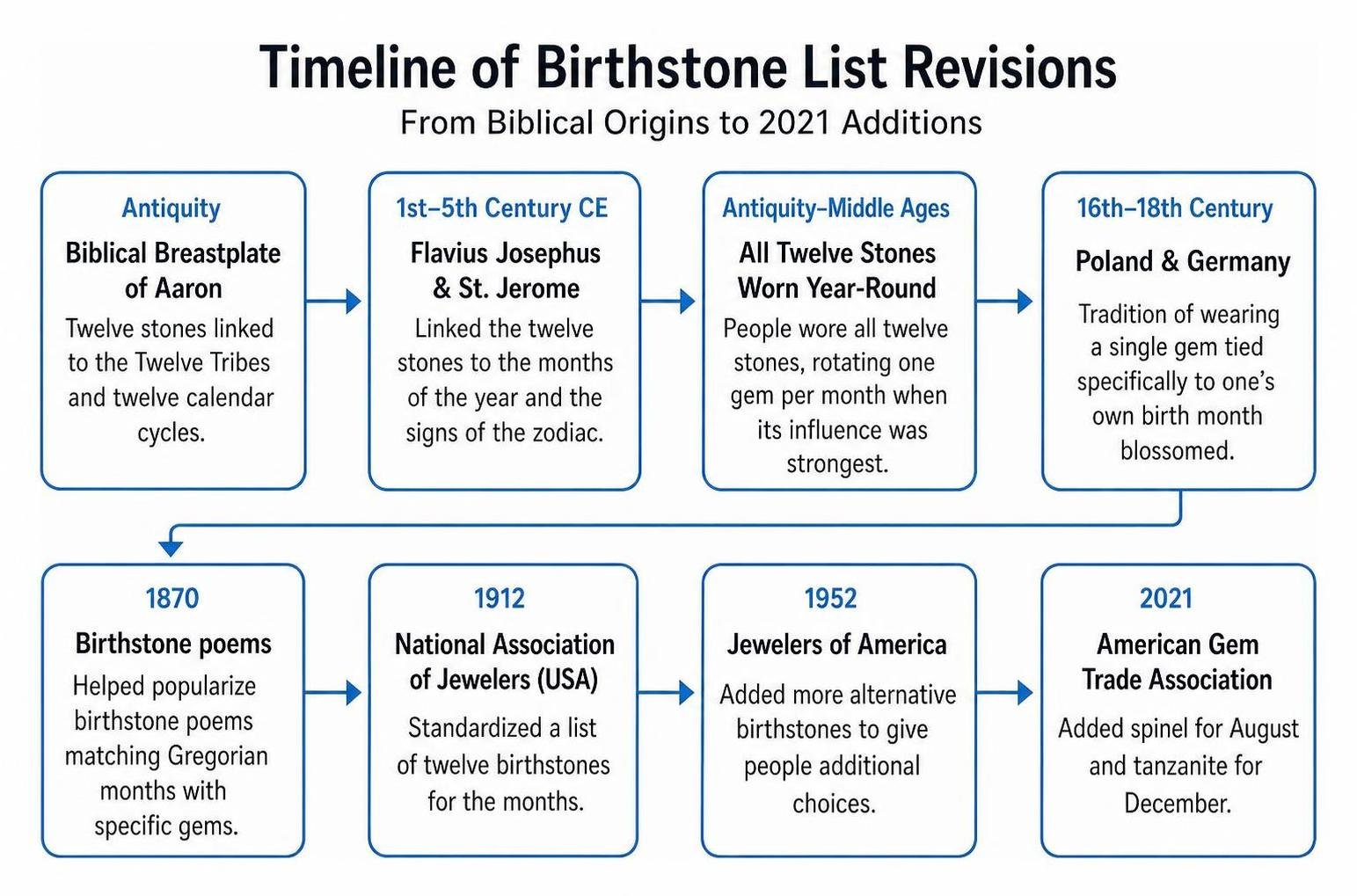
Originally, people wore all twelve stones throughout the year, rotating one gem per month when its celestial influence was believed to be strongest. The tradition of wearing a single gem tied specifically to one's own birth month blossomed in Poland and Germany between the 16th and 18th centuries. In 1870, published birthstone poems helped popularize matching Gregorian months with specific gems.
| Year / Era | Organization / Origin | Key Changes and Significance |
|---|---|---|
| Antiquity | Biblical Breastplate of Aaron | Twelve stones linked to the Twelve Tribes and twelve calendar cycles. |
| 16th–18th C. | Polish & German Traditions | Wearing a single gemstone tied directly to an individual's birth month. |
| 1870 | American Jewelers' Pamphlets | Published rhyming poems linking Gregorian calendar months with stones. |
| 1912 | National Assoc. of Jewelers (US) | First official standardization in Kansas City, focusing on transparent stones. |
| 1952 | Jewelry Industry Council | Added alexandrite (June), citrine (Nov), tourmaline (Oct), and zircon (Dec). |
| 2002 | AGTA | Officially designated Tanzanite as a modern December birthstone. |
| 2016 | AGTA & Jewelers of America | Added Spinel as an official co-birthstone for August. |
| 2021 | Japan Jewelry Association | Added 10 new birthstones to expand their cultural and regional options. |
Zodiac, weekday, and cultural birthstone traditions
Beyond the Gregorian calendar, rich astrological and global cultures associate gems with birthdays in distinct ways according to historical birthstone traditions.
How do zodiac stones differ from monthly birthstones?
Zodiac stones are aligned with the tropical astrological calendar based on sun signs rather than calendar months. Because zodiac dates overlap two calendar months, your zodiac gem depends on your exact day of birth:
- Aries (Mar 21 – Apr 19): Bloodstone, Diamond
- Taurus (Apr 20 – May 20): Sapphire, Emerald
- Gemini (May 21 – Jun 20): Agate, Pearl
- Cancer (Jun 21 – Jul 22): Emerald, Ruby
- Leo (Jul 23 – Aug 22): Onyx, Peridot
- Virgo (Aug 23 – Sep 22): Carnelian, Sapphire
- Libra (Sep 23 – Oct 22): Peridot, Opal
- Scorpio (Oct 23 – Nov 21): Beryl, Topaz
- Sagittarius (Nov 22 – Dec 21): Topaz, Turquoise
- Capricorn (Dec 22 – Jan 19): Ruby, Garnet
- Aquarius (Jan 20 – Feb 18): Garnet, Amethyst
- Pisces (Feb 19 – Mar 20): Amethyst, Aquamarine
What are birthday stones for each day of the week?
Some historical traditions assign specific gems to the day of the week you were born:
- Sunday: Sunstone, Topaz, or Diamond (Ruled by the Sun)
- Monday: Moonstone or Pearl (Ruled by the Moon)
- Tuesday: Ruby, Garnet, or Bloodstone (Ruled by Mars)
- Wednesday: Emerald or Turquoise (Ruled by Mercury)
- Thursday: Sapphire or Amethyst (Ruled by Jupiter)
- Friday: Diamond, Cat's Eye, or Emerald (Ruled by Venus)
- Saturday: Turquoise or Blue Sapphire (Ruled by Saturn)
How does the Hindu tradition assign gemstones?
In Vedic astrology and Hindu tradition, gemstones are governed by the Navagraha (nine celestial influences). Instead of assigning a gem by birth month, an astrologer charts the planetary alignments at the exact moment of birth.
The Navaratna (nine sacred gems)—ruby, pearl, red coral, emerald, yellow sapphire, diamond, blue sapphire, hessonite garnet, and cat's eye—are worn in specific configurations to balance cosmic energies and invite harmony.
Do modern and traditional lists mean different things?
Both lists celebrate the joy of personal identity. The traditional list reflects centuries of folklore, antique cuts, and opaque cabochons.
The modern list prioritizes durability, availability, and transparent brilliance in contemporary jewelry settings. Neither list is "wrong"—jewelry is personal, and you can choose the gem that resonates most with your aesthetic taste.
Can a month have more than one birthstone?
Yes! Months like June (Pearl, Alexandrite, Moonstone), August (Peridot, Spinel, Sardonyx), and December (Tanzanite, Zircon, Turquoise) feature multiple stones. This flexibility allows you to select a gem based on preferred color palette, budget, and daily wear requirements.
Conclusion
Finding the right birthstone is a timeless way to celebrate yourself, mark an anniversary, or gift a loved one a personalized heirloom. Whether you lean toward the regal fire of a July ruby, the cool elegance of a March aquamarine, or the color-shifting magic of a June alexandrite, each gem tells a personal story.
At Masina Diamonds, we combine over 40 years of jewelry craftsmanship in Atlanta with our interactive 3D Ring Builder, empowering you to design bespoke rings, custom birthstone bands, and heirloom pendants with confidence. To find the ideal setting and gemstone style for your next piece, explore the birthstone meanings and jewelry guide and let our family help you bring your vision to life.