Birthstone Colors by Month at a Glance
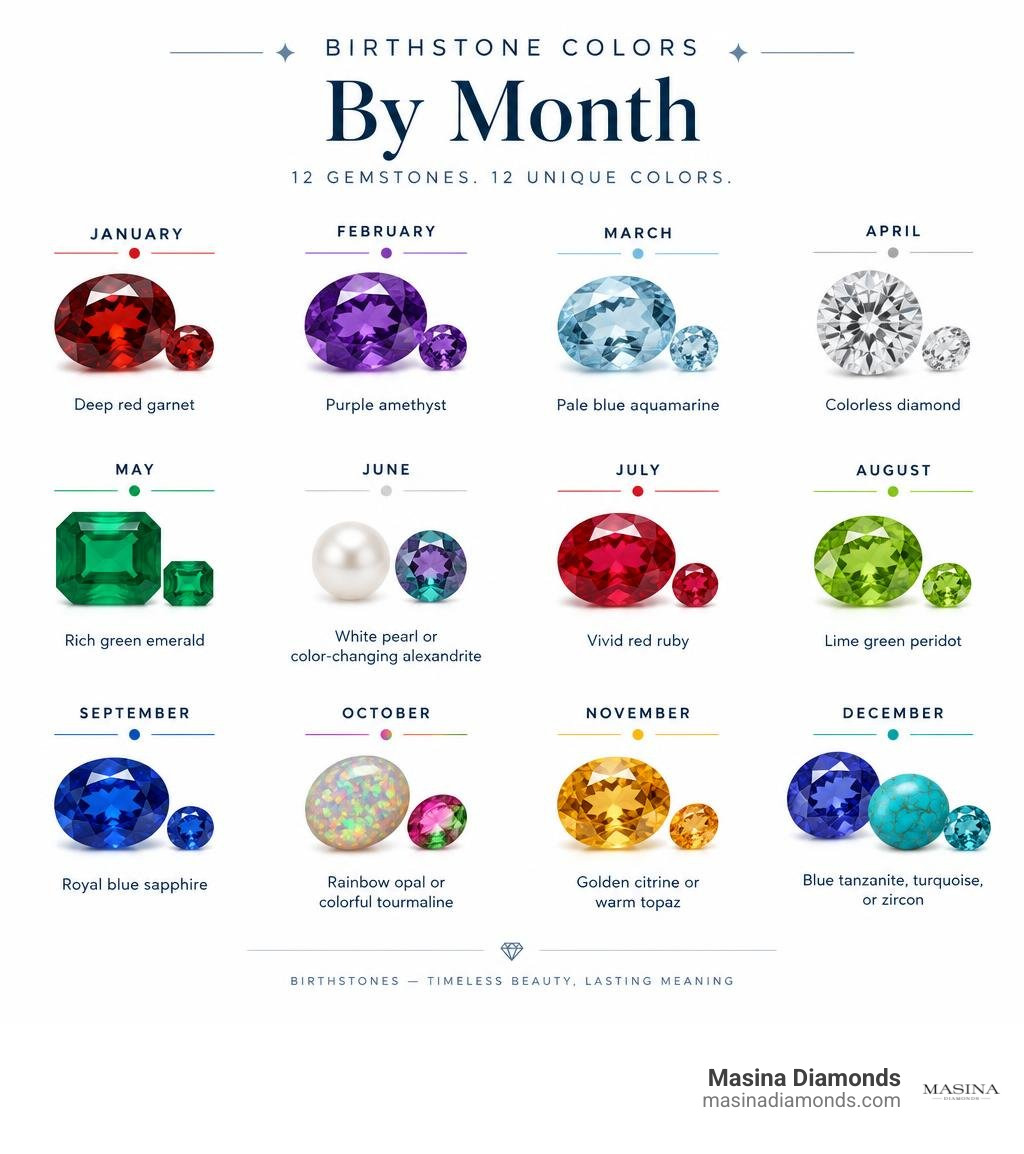
The classic birthstone colors by month are: January red, February purple, March blue, April colorless, May green, June white or color-changing, July red, August green, September blue, October multicolored, November golden yellow, and December blue to blue-green.
| Month | Signature birthstone color |
|---|---|
| January | Deep red garnet |
| February | Purple amethyst |
| March | Pale blue aquamarine |
| April | Colorless diamond |
| May | Rich green emerald |
| June | White pearl or color-changing alexandrite |
| July | Vivid red ruby |
| August | Lime green peridot |
| September | Royal blue sapphire |
| October | Rainbow opal or colorful tourmaline |
| November | Golden citrine or warm topaz |
| December | Blue tanzanite, turquoise, or zircon |
These colors are not strict rules. Many gems occur in more than one shade, and several months have modern and traditional stone choices. Birthstone traditions reach back thousands of years, often linked to the gemstones described on the Breastplate of Aaron, but today's widely used U.S. list was standardized by jewelers in 1912 and later updated.
At Masina Diamonds, we have spent more than 40 years helping Atlanta clients choose custom jewelry, engagement rings, and meaningful gemstones. This guide to birthstone colors by month will help you compare shades, symbolism, and modern options before choosing a piece that tells your story.
Complete Guide to Birthstone Colors by Month
To understand how each month's signature hue developed, it helps to examine the gems side by side. Over centuries, certain gems were prized for their rich pigmentation, spiritual symbolism, and rarity. Today, both modern and traditional lists give you a rich palette of shades to choose from.
| Month | Modern Birthstone | Traditional Birthstone | Primary Color Shades | Symbolic Meaning |
|---|---|---|---|---|
| January | Garnet | Garnet | Deep pomegranate red, orange, vibrant green | Protection, strength, endurance |
| February | Amethyst | Amethyst | Deep royal purple, lavender, violet | Clarity, peace, sobriety |
| March | Aquamarine | Bloodstone | Pastel sky blue, ocean cyan, dark green with red specks | Serenity, safe travels, courage |
| April | Diamond | Diamond | Brilliant white/colorless, yellow, pink, champagne | Eternal love, invincibility, clarity |
| May | Emerald | Emerald | Vivid forest green, deep bluish-green | Rebirth, prosperity, wisdom |
| June | Alexandrite | Pearl, Moonstone | Emerald-green to ruby-red (alexandrite), creamy white, iridescent silver-blue | Purity, transformation, intuition |
| July | Ruby | Ruby | Pigeon's blood vivid red, crimson, deep rose | Passion, vitality, nobility |
| August | Peridot, Spinel | Sardonyx | Lemony lime-green, fiery red, cobalt blue, banded reddish-brown | Radiance, renewal, harmony |
| September | Sapphire | Sapphire | Deep royal blue, velvet cornflower, fancy rainbow hues | Loyalty, truth, wisdom |
| October | Tourmaline | Opal | Bubblegum pink, forest green, fiery play-of-color rainbow | Creativity, hope, innocence |
| November | Citrine | Golden Topaz | Sunlit gold, honey orange, amber-brown | Abundance, warmth, joy |
| December | Tanzanite, Blue Zircon | Turquoise | Deep violet-blue, electric cyan, robin's-egg blue | Intuition, good fortune, peace |
January to June Birthstone Colors by Month
January: Garnet
While most people recognize garnet for its signature deep burgundy shade reminiscent of pomegranate seeds (from the Latin granatus), this gemstone family actually occurs in nearly every color imaginable. Tsavorite garnet offers an intense emerald-like green, while spessartine boasts a vibrant mandarin orange. Historically, warriors wore red garnets into battle as protective talismans. Today, garnet symbolizes enduring loyalty and grounding energy.
February: Amethyst
Amethyst is the premier purple gemstone, varying from soft pastel lilac to deep, velvety royal violet. As a variety of quartz, its rich color historically rivaled rubies and emeralds in value, making it a favorite of royalty and religious leaders. The ancient Greeks believed amethyst prevented drunkenness—its name comes from amethystos, meaning "not intoxicated"—and it remains a modern symbol of mental clarity, inner calm, and balance.
March: Aquamarine and Bloodstone
March offers a balance between modern brilliance and ancient mysticism:
- Aquamarine (Modern): Evoking crystal-clear tropical waters, aquamarine spans from pale pastel blue to rich ocean cyan. In lore, sailors carried it to ensure calm seas and safe voyages.
- Bloodstone (Traditional): A dark green jasper flecked with bright red spots of iron oxide, bloodstone represents physical healing, vitality, and courage.
If you are exploring your options for this quarter of the year, our comprehensive birthstones by month list provides a great breakdown of how these classic hues pair with modern fine jewelry settings.
April: Diamond
April's birthstone is celebrated worldwide for its unmatched fire, brilliance, and strength. Formed deep within the Earth over billions of years under intense heat and pressure, diamonds score a perfect 10 on the Mohs hardness scale. While colorless white diamonds are the classic choice, fancy-colored diamonds in yellow, pink, champagne, and blue offer striking personal alternatives. Diamonds represent eternal love, clarity, and unbreakable resilience.
May: Emerald
May is defined by the rich, soothing green of emerald, a beryl variety colored by trace amounts of chromium and vanadium. Favored by Cleopatra and European monarchs alike, emeralds have symbolized rebirth, renewal, and wisdom since antiquity. Fine emeralds often feature natural internal inclusions known as the jardin (French for "garden"), which give each natural emerald its individual personality.
June: Pearl, Alexandrite, and Moonstone
June boasts three remarkably distinct birthstones:
- Pearl (Traditional): The only gemstone created by living mollusks, pearls showcase a classic creamy white luster, though they also occur in shimmering gold, silver, and moody peacock black.
- Alexandrite (Modern): Often described as "an emerald by day, a ruby by night," fine alexandrite changes color from vivid bluish-green in daylight to raspberry red under incandescent light.
- Moonstone (Alternative): Known for its adularescence—a billowy, floating blue or white sheen across the surface of the gem—moonstone represents intuition and serenity.
Learn more about the technical gemological grading of these early-year treasures by visiting the Gemological Institute of America's guide to Birthstones for each month.
July to December Birthstone Colors by Month
July: Ruby
Ruby, the king of precious gems, represents the fiery red end of the corundum mineral family. The most coveted rubies display a vivid, pure crimson with a subtle hint of blue, traditionally known as "pigeon's blood" red. Revered for millennia in ancient Sanskrit as ratnaraj, rubies are enduring symbols of passion, good fortune, and royal courage.
August: Peridot, Spinel, and Sardonyx
August birthdays enjoy a diverse spectrum of options:
- Peridot (Modern): One of the few gemstones that occurs in only one color—an olive to lime green—peridot was called the "gem of the sun" in ancient Egypt. Some peridot crystals have even landed on Earth inside pallasite meteorites.
- Spinel (Modern Addition): Standardized on modern birthstone charts in 2016, spinel comes in vivid neon red, pink, purple, and rare cobalt blue. Historically mistaken for ruby, fine spinel is beloved for its exceptional brilliance.
- Sardonyx (Traditional): Featuring alternating bands of reddish-brown sard and white onyx, sardonyx was favored by Roman soldiers for carving protective warrior seals.
September: Sapphire
September is synonymous with the majestic royal blue of sapphire. Like ruby, sapphire is a corundum gem, scoring a durable 9 on the Mohs hardness scale. While deep cornflower and royal blues are the most famous, sapphires also occur in a complete spectrum of "fancy" colors, including sunny yellow, pastel pink, peach (padparadscha), and crisp white. Sapphire has long stood for integrity, wisdom, and steadfast loyalty.
October: Tourmaline and Opal
October celebrates kaleidoscopic color play:
- Opal (Traditional): Famous for its phenomenal "play-of-color," opal diffracts white light into dancing flashes of red, orange, green, blue, and yellow against a light or dark body tone.
- Tourmaline (Modern): Displaying one of the broadest color spectrums in the mineral kingdom, tourmaline is especially popular in bubblegum pink, deep teal indicolite, and bi-color watermelon slices.
For visual references of raw and faceted specimens, explore the photographic archives on Birthstones by Month: Chart and Photos, or browse our curated stones for birthday months to see how modern jewelers set these dynamic minerals.
November: Citrine and Topaz
November is bathed in the warm, radiant tones of autumn:
- Citrine (Modern): A golden variety of quartz ranging from bright lemon yellow to rich honey amber, citrine is celebrated as an affordable stone of joy, vitality, and prosperity.
- Topaz (Traditional): While precious Imperial topaz exhibits a rare reddish-orange hue, natural topaz also occurs in sherry yellow, pink, and clear varieties.
December: Tanzanite, Turquoise, and Blue Zircon
December showcases a cool, electric blue palette across three gems:
- Tanzanite (Modern): Discovered near Mount Kilimanjaro in Tanzania, tanzanite is famed for its rich trichroic color that shifts between velvety royal blue, rich violet, and hints of red.
- Blue Zircon (Modern): Not to be confused with synthetic cubic zirconia, natural blue zircon is an ancient natural mineral renowned for intense optical fire and brilliant electric-cyan sparkle.
- Turquoise (Traditional): An opaque, robin's-egg blue to teal gem interlaced with earthy dark matrix veins, turquoise has served as a sacred healing stone across Native American and ancient Persian cultures.

Modern vs. Traditional Birthstones: History and Key Differences
The concept of dedicating a specific gemstone to each month dates back at least 3,400 years to the Breastplate of Aaron described in Exodus 28:17–20. This ceremonial garment contained twelve distinct stones representing the twelve tribes of Israel, which were later linked to the twelve signs of the zodiac by the 1st-century historian Flavius Josephus and Saint Jerome in the 5th century.

For centuries, people commonly owned all twelve gems and rotated them monthly, wearing whichever stone corresponded to the current calendar period to harness its perceived energy. The practice of wearing a single gem dedicated specifically to one's own birth month arose in Poland during the 18th century.
The 1912 Modern Standardization
By the early 20th century, birthstone assignments differed wildly across countries and jewelers. To create a unified commercial standard, the American National Retail Jewelers Association (now Jewelers of America) met in 1912 to establish the modern birthstone list:
- Focus on Transparent, Faceted Gems: Older traditional charts relied heavily on opaque stones or cabochons like bloodstone, turquoise, and sardonyx. Modern jewelers prioritized transparent, durable gems like aquamarine, amethyst, and tourmaline that could be faceted into contemporary prong-set rings.
- Subsequent Revisions: The modern chart was updated in 1952 (adding alexandrite, citrine, and tourmaline), in 2002 (adding tanzanite to December), and in 2016 (adding spinel to August).
- Zodiac vs. Month Birthstones: While birthstones are strictly anchored to the Gregorian calendar (January through December), zodiac stones align with astrological sun signs (e.g., Aries, Scorpio) based on planetary movements and mystical traditions.
Durability, Rarity, and Care: Choosing the Right Gemstone for Daily Wear
Not all birthstones are created equal when it comes to daily wear. When designing custom rings and bracelets, gem durability is determined by its rating on the Mohs hardness scale (1 to 10), which measures resistance to scratching.
Gemstone Durability Breakdown
- Daily Ring Safe (Mohs 8–10): Diamond (10), Ruby (9), Sapphire (9), Alexandrite (8.5), and Spinel (8) easily withstand daily friction, hand washing, and accidental bumps.
- Moderate Wear (Mohs 7–7.5): Emerald, Aquamarine, Amethyst, and Citrine are great for daily wear, though emeralds frequently have natural internal fissures that should be protected from harsh blows.
- Special Care Pieces (Mohs 2.5–6.5): Tanzanite, Peridot, Opal, Turquoise, and Pearl are softer or more fragile. They excel in pendants, earrings, and brooches, but require protective bezel settings if worn in daily rings.
Water-Sensitive and Porous Gems
Never submerge pearls, opals, or turquoise in water, ultrasonic cleaners, or chemical solvents. Pearls are organic gems composed of calcium carbonate; prolonged moisture or perfumes will dissolve their outer nacre luster. Opals contain up to 20% water within their silica structure; sudden temperature shifts or immersion can cause irreversible crazing (internal micro-cracking).
Rarity and Market Price
- Rarest Birthstones: Natural color-changing alexandrite is exceptionally scarce in clean sizes above one carat, commanding thousands per carat. Tanzanite is a single-source gemstone mined exclusively within a small 4 km² strip near Arusha, Tanzania, with geologists estimating 30 to 50 years of supply remaining.
- Most Affordable Birthstones: Amethyst, citrine, garnet, and blue topaz are abundantly available worldwide, offering rich, striking color at accessible price points.
Styling and Combining Birthstones in Custom Jewelry
Birthstone jewelry has moved far beyond traditional single-gem birthstone rings. Today, custom jewelry design allows for sophisticated, sentimental compositions:
- The Modern Mother's Ring: Rather than using mismatched stones in bulky multi-prong clusters, modern mother's rings feature sleek multi-stone eternity bands, flush-set signet rings, or asymmetric bypass designs that seamlessly nestle family birthstones together.
- Stacking Bands: Pairing delicate, micro-pavé bands set with individual birthstones allows you to celebrate children, partners, or anniversaries with the flexibility to rearrange your stack.
- Metal Pairings: Warm golden gems (citrine, peridot, warm garnet) harmonize with yellow gold and rose gold settings. Cool blue gems (aquamarine, sapphire, tanzanite) and white diamonds pop against white gold or platinum.
- Wearing Non-Birth Month Stones: You are never restricted to your own birth month! Many clients choose gems purely based on personal color preferences, aesthetic combinations, or sentimental milestones.

Frequently Asked Questions About Birthstone Colors
Why do some months have more than one birthstone?
Several months feature multiple birthstones because jewelry organizations have updated the official charts over time to expand consumer choices. Revisions in 1952, 2002, and 2016 introduced stones like alexandrite, tanzanite, and spinel. These additions provide varied color options, price points, and durable alternatives alongside traditional stones.
Which birthstone is the rarest and most expensive?
Natural alexandrite (June) is widely considered the rarest modern birthstone due to its dramatic color-change optical properties and limited global deposits. Top-grade untreated rubies from Myanmar ("pigeon's blood" red) and single-source tanzanite (December) are also among the most valuable birthstones in the world per carat.
Which birthstones should not get wet or worn every day?
Pearls (June), opals (October), and turquoise (December) should never be worn while swimming, showering, or washing dishes. These porous or organic gems are sensitive to water absorption, heat, and household chemicals. For everyday rings, we recommend harder gems like diamond, sapphire, or ruby, or placing softer stones inside protective bezel mountings.
Designing Your Custom Birthstone Jewelry with Masina Diamonds
Whether you want to design a personalized mother's ring, reset a family heirloom, or craft a vibrant engagement ring, selecting the right gemstones begins with expert guidance. For over 40 years, our family-owned team in Atlanta, Georgia has specialized in precision jewelry craftsmanship and bespoke design.
With our interactive 3D Ring Builder and extensive gemological inventory, we help you source the perfect natural or lab-grown colored gemstones to match your vision and budget. Discover the full story behind every gemstone in our comprehensive custom birthstone jewelry guide, or book a one-on-one consultation with our design team today.