Your Quick Guide to Stones for Birthday Months
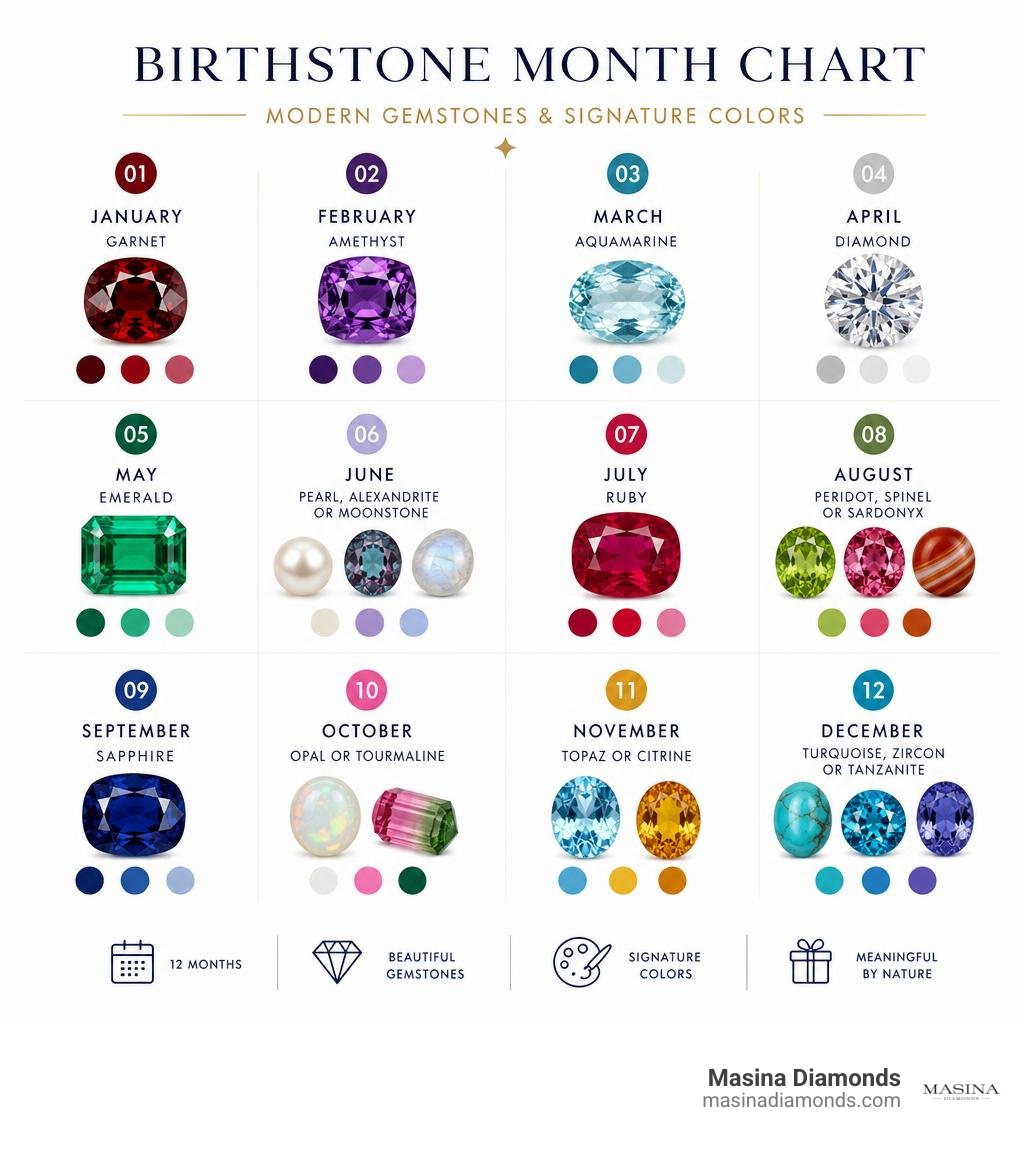
The official modern stones for birthday months are: garnet for January, amethyst for February, aquamarine for March, diamond for April, emerald for May, pearl, alexandrite, or moonstone for June, ruby for July, peridot, spinel, or sardonyx for August, sapphire for September, opal or tourmaline for October, topaz or citrine for November, and turquoise, zircon, or tanzanite for December.
These gems can make a birthday gift feel personal, but they are also useful design choices. A sapphire or ruby can suit an everyday ring, for example, while pearl and opal are often safer in pendants or earrings because they need gentler wear.
Birthstone traditions are older and less fixed than many people expect. They have roots in religious and cultural gem lore, evolved through European customs, and were organized into the modern jewelry list in 1912. That is why some months have several accepted stones, colors, and price points.
At Masina Diamonds, we have spent more than 40 years helping Atlanta clients create custom jewelry and engagement rings with meaningful gemstones, including stones for birthday months. Here are 12 lesser-known facts to help you choose a gem that fits the story, budget, and lifestyle behind your piece.
1. The Tradition Began with Ancient Ceremonial Breastplates
The concept of linking gemstones to specific timeframes traces back to antiquity. Historians and gemological scholars, including those at GIA Birthstones, connect the twelve-stone framework to the biblical Breastplate of Aaron described in the Book of Exodus (c. 1400 BC). This ceremonial garment featured twelve distinct gemstones arranged in four rows of three, each inscribed with the name of one of the twelve tribes of Israel.
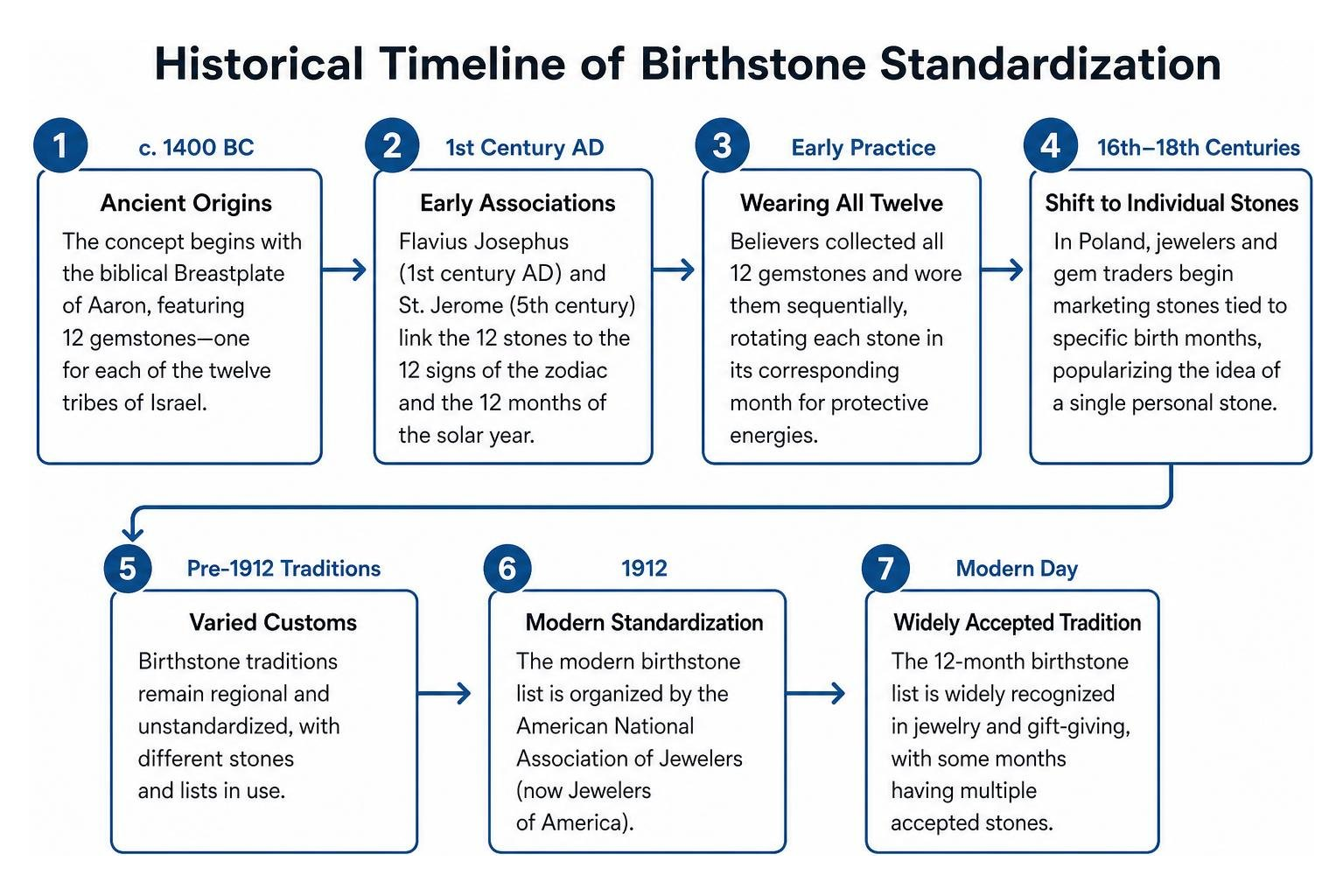
In the first century AD, the Jewish-Roman historian Flavius Josephus, followed later by St. Jerome in the fifth century, drew the direct connection between these twelve stones, the twelve signs of the zodiac, and the twelve months of the solar year. Originally, believers did not own just one stone. Instead, individuals collected all twelve gemstones and wore them sequentially, rotating each stone as its corresponding month arrived to harness its perceived protective energies.
The custom of wearing a single stone tied specifically to one's own birth month did not gain widespread popularity until the 16th to 18th centuries in Poland. Local jewelers and gem traders began marketing individualized stones, establishing the foundation for contemporary birthday jewelry traditions.
2. The Official Birthstone Chart Has Been Updated Multiple Times
Many people assume the calendar gemstone list is ancient and immutable, but the standardized roster used across North America today was established in 1912 by the National Association of Jewelers (now Jewelers of America) in Kansas City.
The 1912 meeting aimed to resolve commercial confusion caused by differing European regional customs and prioritize transparent, cuttable gemstones suited for modern metal settings. The chart has continued to evolve since then:
- 1952: The Jewelry Industry Council updated the roster by adding alexandrite to June, citrine to November, and pink tourmaline to October.
- 2002: The American Gem Trade Association (AGTA) added tanzanite as an official December birthstone, celebrating the vivid East African gem discovered in 1967.
- 2016: The AGTA and Jewelers of America officially welcomed spinel as an additional birthstone for August, offering a durable, brilliant alternative alongside peridot and sardonyx.
Modern vs. Traditional Stones for Birthday Months
When selecting a gem, you can explore both modern and traditional lineages. Traditional charts—rooted in older 15th- to 19th-century European preferences—often featured opaque or cabochon-cut minerals like bloodstone, onyx, and turquoise. Modern lists emphasize brilliant, transparent faceted gems that maximize light performance in prong and pavé settings.
| Month | Modern Birthstone | Traditional Birthstone | Primary Color Range |
|---|---|---|---|
| January | Garnet | Garnet | Deep red, green (tsavorite), orange (spessartite) |
| February | Amethyst | Amethyst, Hyacinth | Royal violet, lavender, deep purple |
| March | Aquamarine | Bloodstone, Jasper | Pastel cyan, seafoam blue, dark green with red specks |
| April | Diamond | Diamond, Clear Quartz | Colorless, fancy yellow, pink, blue, champagne |
| May | Emerald | Emerald, Chrysoprase | Vivid green, bluish-green |
| June | Alexandrite, Pearl, Moonstone | Pearl, Cat's Eye | White, iridescent cream, color-shifting teal to purple |
| July | Ruby | Ruby, Carnelian | Pigeon blood red, crimson, deep pinkish-red |
| August | Peridot, Spinel | Sardonyx, Peridot | Lime green, olive, fiery red, cobalt blue |
| September | Sapphire | Sapphire, Lapis Lazuli | Royal blue, cornflower blue, pink, yellow, teal |
| October | Pink Tourmaline, Opal | Opal, Jasper | Multi-color fire, soft pastel pink, emerald green |
| November | Citrine, Topaz | Golden Topaz, Citrine | Golden yellow, Madeira orange, imperial peach |
| December | Tanzanite, Blue Zircon, Turquoise | Turquoise, Lapis Lazuli | Violet-blue, vivid electric blue, sky blue |
Reviewing the comprehensive Birthstone Chart - Modern and Traditional provides insight into how these lists diverged and why specific mineral varieties were introduced to suit modern tastes.
3. April’s Diamond Shines Far Beyond Just Carat Weight
Diamonds are universally celebrated as April’s birthstone, admired for their unmatched brilliance and timeless symbolic ties to strength, purity, and enduring devotion. As the hardest naturally occurring mineral on Earth (scoring a perfect 10 on the Mohs hardness scale), diamond is exceptionally suited for everyday fine jewelry and heirloom engagement rings.
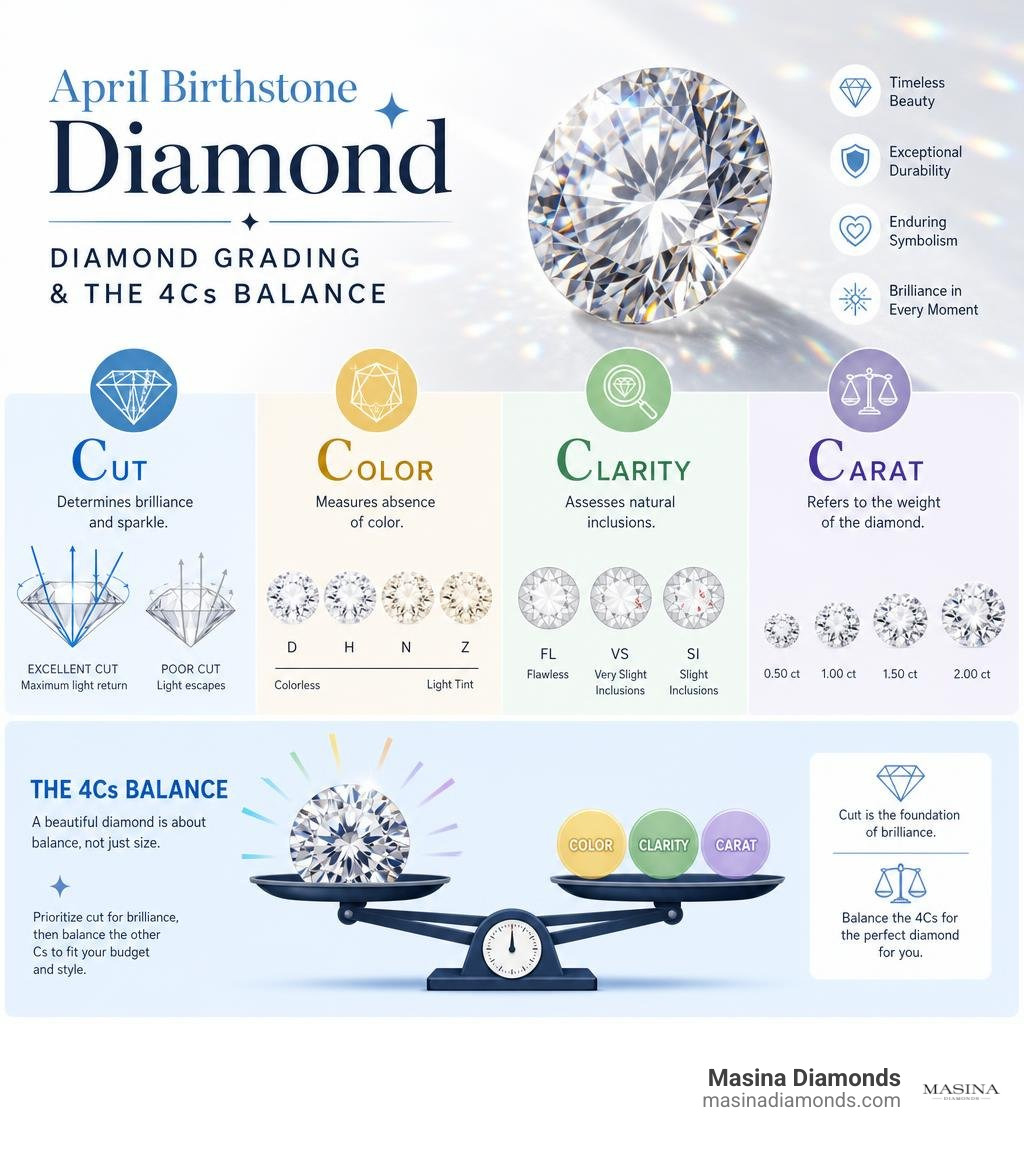
When selecting April birthstone jewelry, understanding diamond quality involves balancing the 4Cs: Cut, Color, Clarity, and Carat weight. While carat weight determines the physical scale of the gemstone, cut quality dictates how effectively light refracts through the facets to produce brilliance and fire. Reviewing our Diamond Carat Complete Guide 2026 can help you maximize your budget by balancing surface spread with superior cut proportions.
Furthermore, April celebrants today have the flexibility to choose between certified natural earth-mined diamonds and high-purity lab-grown diamonds. Lab-grown diamonds share identical optical, physical, and chemical structures with mined diamonds, allowing you to secure larger carat weights and premium clarity grades at significant savings.
4. Mineral Hardness Dictates Which Stones Belong in Daily Rings
A gemstone’s suitability for daily wear depends on its rating on the Mohs scale of mineral hardness, which measures scratch resistance from 1 (talc) to 10 (diamond). While earrings and necklaces remain relatively protected against impact, rings undergo regular friction, accidental strikes, and exposure to cleaning agents.

- Exceptional Daily Wear (Mohs 9–10): Diamond (10), Ruby (9), and Sapphire (9) represent the gold standard for daily rings. Their crystal lattice resists scratching from airborne dust particles (which consist largely of quartz, Mohs 7).
- Moderate to High Durability (Mohs 7.5–8): Spinel (8), Topaz (8), Aquamarine (7.5–8), and Emerald (7.5–8) offer solid durability. Emeralds require gentle handling due to internal natural fissures (jardin), making protective settings advisable.
- Careful Daily Wear (Mohs 6.5–7): Garnet (6.5–7.5), Amethyst (7), Citrine (7), and Peridot (6.5–7) work well in rings when mounted in secure bezel or protective halo designs.
- Delicate & Porous Gems (Mohs 2.5–6.5): Pearl (2.5–4.5), Turquoise (5–6), and Opal (5.5–6.5) are softer minerals sensitive to scratches, thermal shock, and chemical exposure. These stones perform best in pendants, brooches, drop earrings, or low-profile bezel rings reserved for special occasions.
5. You Do Not Need a High Budget for High-Impact Blue Birthday Gems
March, September, and December feature rich blue gemstones across varying price brackets. While natural unheated fine blue sapphires remain prized collector gems, there are gorgeous, durable options available at accessible prices.
If you are exploring How to Find Stunning Blue Stone Wedding Rings Without Breaking the Bank, you can consider alternative blue minerals:
- Aquamarine (March): Offers an icy blue hue with glass-like clarity and high transparency.
- Blue Topaz (November/December Alternate): Swiss Blue and London Blue topaz provide deep saturation with an 8 Mohs hardness rating at an accessible cost per carat.
- Blue Zircon (December): Boasts high refractive brilliance and fire that rivals diamond, displaying lively electric-blue sparkle.
- Tanzanite (December): Displays trichroic optical characteristics, shifting between royal blue, violet, and rich indigo under varying light conditions.
6. Many Birthstones Span Full Rainbow Color Spectrums
A common misconception is that each month corresponds to only one color. In reality, several monthly minerals span an entire palette of hues:
- Garnet (January): While pyrope and almandine garnets are known for deep burgundy, garnets occur naturally in vivid emerald green (tsavorite), bright mandarin orange (spessartite), and radiant gold (andradite).
- Sapphire (September): Beyond classic royal blue, corundum produces fancy sapphires in yellow, hot pink, vivid orange, lavender, and the rare salmon-peach padparadscha.
- Tourmaline (October): Celebrated as the "gemstone of the rainbow," tourmaline forms in bi-color watermelon slices, canary yellow, and vibrant neon blue-green Paraíba.
- Spinel (August): Naturally occurs in vivid crimson red, cobalt blue, pastel lilac, and metallic slate grey.
Discovering visual examples via resources like Birthstones by Month: Chart and Photos highlights the broad range of color choices available within a single birth month.
7. Natural Alexandrite Changes Color Based on Lighting
June’s modern birthstone, alexandrite (a rare chrysoberyl variety discovered in Russia's Ural Mountains), is famous for its optical phenomenon: "emerald by day, ruby by night."
Due to trace amounts of chromium in its crystal structure, fine alexandrite appears bluish-green in natural daylight or fluorescent lighting, then shifts to raspberry red or purplish-crimson under warm incandescent light. Because gem-quality natural alexandrite above one carat is rarer than diamond, high-clarity lab-grown alexandrites have become a popular way to enjoy this color-change effect.
8. Spinel Was the Great Impostor in Royal Crown Jewels
August's modern co-birthstone, spinel, has a rich history in royal jewelry collections. For centuries, red spinel was frequently identified as ruby because the two minerals often form in the same alluvial deposits.
The most famous example is the historic 170-carat Black Prince’s Ruby, set prominently in the Imperial State Crown of the United Kingdom. Modern gemological testing confirmed this legendary centerpiece is actually a red spinel. With an 8 Mohs hardness rating, exceptional clarity, and high brilliance, spinel serves as a durable August birthstone.
9. Citrine and Amethyst Are Geological Siblings
February’s amethyst and November’s citrine are mineralogical twins—both belong to the crystalline quartz family ($\text{SiO}_2$).
Their distinctive colors result from iron impurities in the quartz lattice subjected to varying levels of geological heat:
- Amethyst obtains its purple hue from trace iron irradiated within surrounding rock formations.
- Citrine develops its golden yellow to burnt-orange coloration when that iron is exposed to higher natural temperatures.
When both conditions occur within a single crystal, the resulting gemstone is known as ametrine, displaying a split of purple and golden-yellow in one faceted gem.
10. Zodiac Gemstones Follow an Independent Astrological System
Zodiac birthstones operate on an astrological calendar rather than the standard Gregorian calendar months. Because zodiac sun signs span from approximately the 20th–23rd of one month to the 19th–22nd of the next, your astrological gemstone may differ from your monthly birthstone.
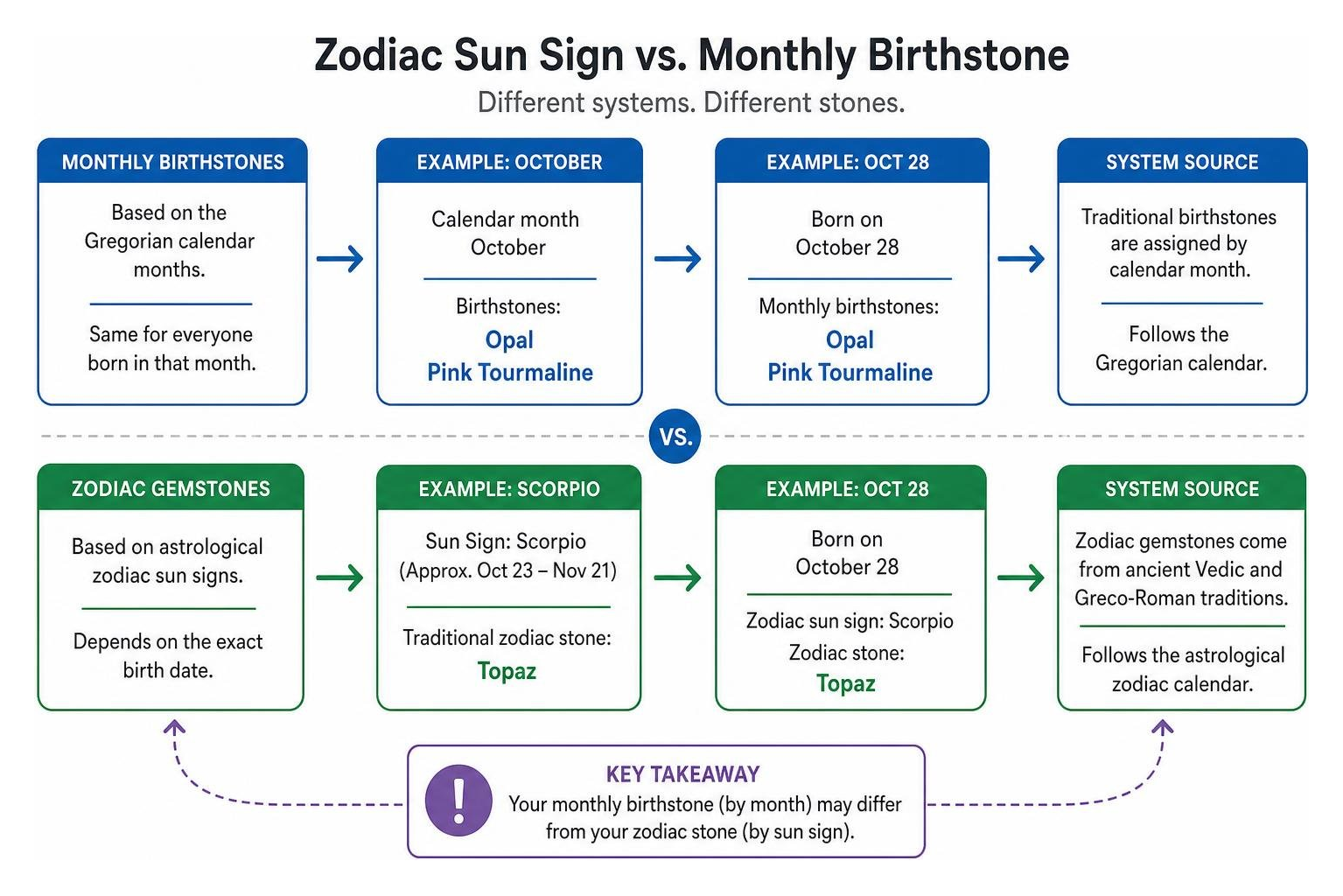
For example, a person born on October 28th is a Scorpio. While their calendar month birthstones are opal and pink tourmaline, their traditional zodiac stone is topaz. Astrological gemstones stem from ancient Vedic and Greco-Roman traditions, offering an alternative way to choose meaningful fine jewelry.
11. Custom Jewelry Lets You Combine Family Birthstones Harmoniously
Modern jewelry design frequently blends multiple birthstones into a cohesive heirloom. Whether crafting a multi-stone Mother’s ring, an asymmetrical cluster pendant, or a stack of channel-set eternity bands, combining different gems requires careful structural planning.
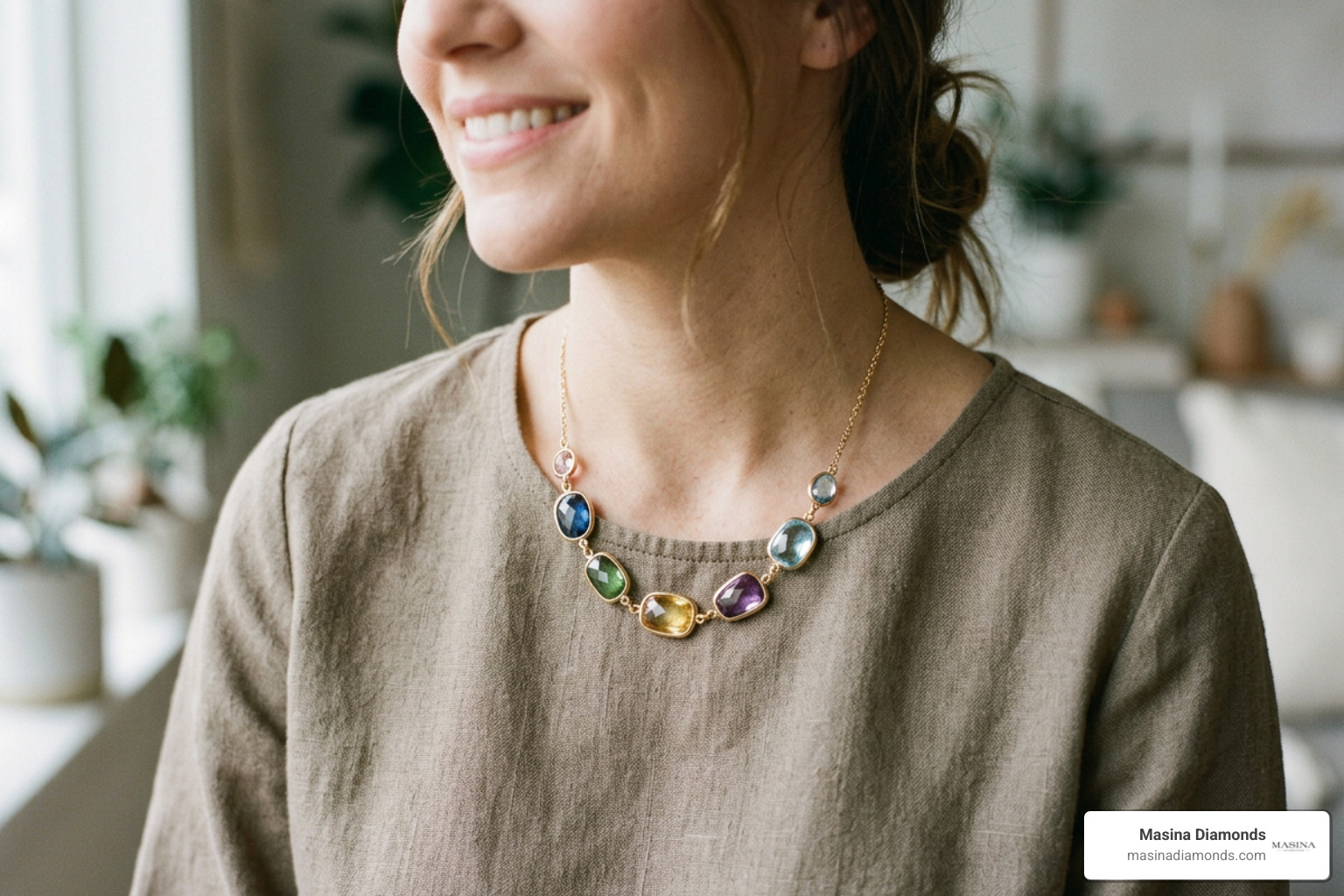
When mixing stones with different hardness levels—such as pairing an April diamond with a May emerald or a June pearl—custom settings can help protect delicate gems. Using protective bezels, recessed channels, or halo crowns allows softer gems to sit safely alongside harder stones.
To explore creative layout possibilities, review our Custom Jewelry Ultimate Guide 2026 for expert guidance on metal selection, structural balance, and setting styles.
12. You Have Complete Permission to Wear Any Birthstone You Love
A common myth is that wearing a birthstone from a month other than your own invites bad luck or breaks etiquette. In fine jewelry, there are no rigid rules restricting which gemstones you can wear.
Many clients select gemstones based on color harmony, milestone anniversaries, children's birth months, or metaphysical symbolism:
- Choosing emerald for a tranquil forest green aesthetic.
- Selecting garnet for its deep red hue and historical associations with vitality.
- Choosing sapphire for an everyday alternative to diamond engagement rings.
Your jewelry should reflect your personal aesthetic and the milestones meaningful to you.
Designing, Styling, and Gifting Birthstone Jewelry
Selecting birthstone jewelry involves pairing the stone with a setting suited to the wearer's daily routine:
- Rings: Best suited for durable gemstones rated 7.5 to 10 on the Mohs scale (diamond, sapphire, ruby, spinel, topaz, aquamarine). For softer gems like opal or emerald, choose low-profile bezel or semi-bezel mountings.
- Pendants and Necklaces: Ideal for delicate, organic, or moisture-sensitive stones like pearl, opal, and turquoise, as they sit safely against clothing without sustaining heavy impact.
- Earrings: Versatile for every gemstone variety. Studs and drop earrings protect soft minerals while keeping them secure for daily wear.
- Stackable Bands: Perfect for honoring multiple family members. Slim eternity or semi-eternity bands set with individual birthstones can be added over time to mark significant milestones.
Frequently Asked Questions About Birthday Gemstones
Can I wear a birthstone that does not belong to my birth month?
Yes. You can wear any gemstone that resonates with your personal style, wardrobe preferences, or symbolic goals. Many people wear the birthstones of their children, partners, or parents, or simply select gems based on color and durability.
Which birthstone is the rarest and most valuable?
Natural, untreated alexandrite (June) is among the rarest and most valuable birthstones in large carat weights due to its dramatic color-change phenomenon. High-grade unheated Burmese rubies, fine Colombian emeralds, and untreated Kashmir sapphires also command record prices per carat. Additionally, tanzanite (December) is geologically unique, sourced exclusively from a single 4-square-kilometer mining area near Mount Kilimanjaro in Tanzania.
How should delicate birthstones like pearl, opal, and turquoise be cleaned?
Delicate gems require gentle care:
- Mix warm water with a few drops of mild, phosphate-free dish soap.
- Dampen a clean, soft microfiber cloth with the soapy water and gently wipe the stone surface.
- Wipe clean with a damp cloth rinsed in fresh water, then pat dry immediately.
- Never place pearls, opals, emeralds, or turquoise into ultrasonic or steam cleaners, as high-frequency vibrations and heat can strip moisture, loosen mountings, or crack internal inclusions. Keep these gems away from perfumes, hairsprays, household chemicals, and chlorine.
Designing Your Heirloom Piece with Masina Diamonds
For over 40 years, our team at Masina Diamonds has designed custom fine jewelry and engagement rings in our Atlanta showroom. Whether you are building an anniversary pendant, a multi-gemstone family ring, or an everyday signature piece, our interactive 3D Ring Builder lets you visualize your custom design from every angle before casting.
To explore the symbolism, grading standards, and history of each monthly gem in deeper detail, read our comprehensive birthstones by month meanings and jewelry guide.
Visit our Atlanta showroom or consult online with our master gemologists to select your ideal birthday gemstones and bring your custom design to life.