Comparing Popular Engagement Ring Stones by Durability and Cost
Choosing the right engagement ring stones comes down to balancing durability, brilliance, and cost. Natural and lab-grown diamonds offer unmatched scratch resistance (Mohs 10) for lifetime daily wear. Moissanite provides exceptional hardness (9.25) and superior rainbow fire dispersion at an accessible price point, while sapphires and rubies (Mohs 9.0) deliver resilient, vibrant color. Softer alternatives like emeralds (7.5–8.0) bring lush beauty but require protective mountings.
When evaluating center gems, durability is scientifically measured by the Mohs Scale of Mineral Hardness. Developed in 1812, this scale ranks minerals from 1 (talc) to 10 (diamond) based on scratch resistance. Because an engagement ring encounters countertops, car doors, workout equipment, and daily friction, selecting a stone with adequate hardness ensures it retains its polish without turning cloudy or abraded.
Hardness, however, is only one piece of the puzzle. Optical performance—governed by refractive index (how much light bends upon entering the crystal) and fire dispersion (how light breaks into rainbow flashes)—determines the visual sparkle of your ring. Balancing these optical traits against your total budget allows you to maximize stone size and quality without overspending. In the United States, where the average engagement ring cost hovers around $5,500, allocating your budget strategically between the stone and the mounting makes all the difference.
| Gemstone | Mohs Hardness | Refractive Index (Sparkle) | Fire Dispersion | Average Relative Cost | Daily Wear Rating |
|---|---|---|---|---|---|
| Natural Diamond | 10 | 2.42 | 0.044 | Premium ($$$$) | Exceptional |
| Lab-Grown Diamond | 10 | 2.42 | 0.044 | Moderate ($$) | Exceptional |
| Moissanite | 9.25 | 2.65 – 2.69 | 0.104 | Budget-Friendly ($) | Exceptional |
| Sapphire (Corundum) | 9.0 | 1.76 – 1.77 | 0.018 | Moderate to High ($$ - $$$) | Excellent |
| Ruby (Corundum) | 9.0 | 1.76 – 1.77 | 0.018 | Moderate to Premium ($$ - $$$$) | Excellent |
| Emerald (Beryl) | 7.5 – 8.0 | 1.57 – 1.58 | 0.014 | High ($$$) | Moderate (Requires Care) |
| Morganite (Beryl) | 7.5 – 8.0 | 1.57 – 1.58 | 0.014 | Accessible ($) | Moderate (Frequent Cleaning) |
Diamonds and Moissanite: Brilliance and Hardness
Diamond remains the gold standard in fine jewelry, with approximately 86% of couples selecting a diamond center stone. Composed of pure carbon atoms crystallized under intense heat and pressure, a diamond sits at a perfect 10 on the Mohs scale. It can only be scratched by another diamond, making it virtually impervious to everyday abrasions. The average diamond center stone chosen by couples in the United States sits around 1.0 carat, though sizes between 0.5 and 1.5 carats remain exceptionally popular for their balance of presence and wearability. If you are comparing mid-range proportions, exploring a 0.75 Carat Diamond provides an elegant balance of finger coverage and value. To master the broader spectrum of stone measurements, our Diamond Carat Complete Guide 2026 breaks down weight versus millimeter dimensions in full detail.
Moissanite, composed of silicon carbide, represents the most capable alternative to diamond. Originally discovered in a meteor crater, all modern moissanite is created in specialized laboratories. Ranking at 9.25 on the Mohs scale, moissanite is harder than sapphires or rubies. Where it differs noticeably is its refractive index: at 2.65 to 2.69 with a dispersion of 0.104, moissanite produces more than double the rainbow fire of a traditional diamond. This creates a distinct, fiery brilliance often described as a "disco-ball" effect under bright sunlight, offering a striking, durable look at a fraction of the cost.
Modern Trends in Colored Engagement Ring Stones
Roughly 15% of couples now select alternative gemstones such as moissanite, sapphire, or emerald to infuse color, personality, and heritage into their designs. Sapphires and rubies belong to the corundum mineral family, boasting a resilient 9.0 Mohs rating. This makes them the premier colored stones for daily wear, resisting chipping and maintaining their luster with minimal effort. While royal velvety blue is the iconic sapphire shade, corundum naturally occurs in pink, yellow, peach, teal, and green. If you are captivated by deep azure tones, you can discover how to find stunning blue stone wedding rings without breaking the bank to complete a colorful bridal set.
Emeralds, part of the beryl family, rank between 7.5 and 8.0 on the Mohs scale. Renowned for their lush green hue and organic internal clarity characteristics—poetically called jardin—emeralds possess higher internal tension and are more brittle than corundum. They require thoughtful settings, such as protective bezels or low-profile halos, and should be removed before rigorous physical tasks.
Natural vs. Lab-Grown Center Stones: Price, Ethics, and Value
The fine jewelry market has evolved substantially, with lab-grown diamonds accounting for nearly 30% of all diamond engagement ring sales. Choosing between an earth-mined stone and a modern lab-created gem involves balancing personal sentiment, budget priorities, and ecological values.

From a physical, chemical, and optical standpoint, lab-grown diamonds are authentic diamonds. They are cultivated using High Pressure High Temperature (HPHT) or Chemical Vapor Deposition (CVD) processes that replicate the mantle conditions of the earth. Because laboratory production bypasses complex mining logistics, lab-grown diamonds typically cost 60% to 85% less than their mined counterparts of identical carat weight, color, and clarity. For couples seeking impressive finger coverage, our 2 Carat Lab Diamond Guide outlines how lab-grown gems allow you to prioritize premium cut and clarity grades while remaining comfortably within your target investment.
When weighing your options:
- Natural Stones carry deep geological heritage, having formed over billions of years. They hold enduring rarity, traditional appeal, and a track record of long-term market value retention.
- Lab-Grown Stones provide modern tractability, a reduced surface environmental footprint, and significant cost savings that allow you to maximize your center stone dimensions or invest more heavily into an intricate, custom-crafted mounting.
How Stone Cuts and Setting Styles Maximize Sparkle and Security
The geometric cut of your center stone dictates how effectively light enters the crown, bounces across the internal facets, and returns to your eye as brilliance. The classic round brilliant cut remains the undisputed favorite, accounting for over 50% of all engagement ring diamond sales worldwide due to its unmatched light return and symmetrical faceting.
Fancy shapes, however, provide elongated silhouettes that flatter the finger and often appear larger per carat than round stones:
- Pear Cuts: Combining the curves of a round with the tapered point of a marquise, pear-shaped gems create a slimming visual effect. Learn about pricing dynamics in our guide to the Cost of 2 Carat Pear Shaped Diamond.
- Marquise Cuts: Featuring pointed ends and an elongated body, this vintage-inspired cut maximizes surface area. To explore multi-gem arrangements, review our 3 Stone Marquise Guide 2026 for balanced layout inspiration.
- Oval and Cushion Cuts: These offer soft, rounded edges with expansive tables, combining classic sparkle with contemporary proportions.
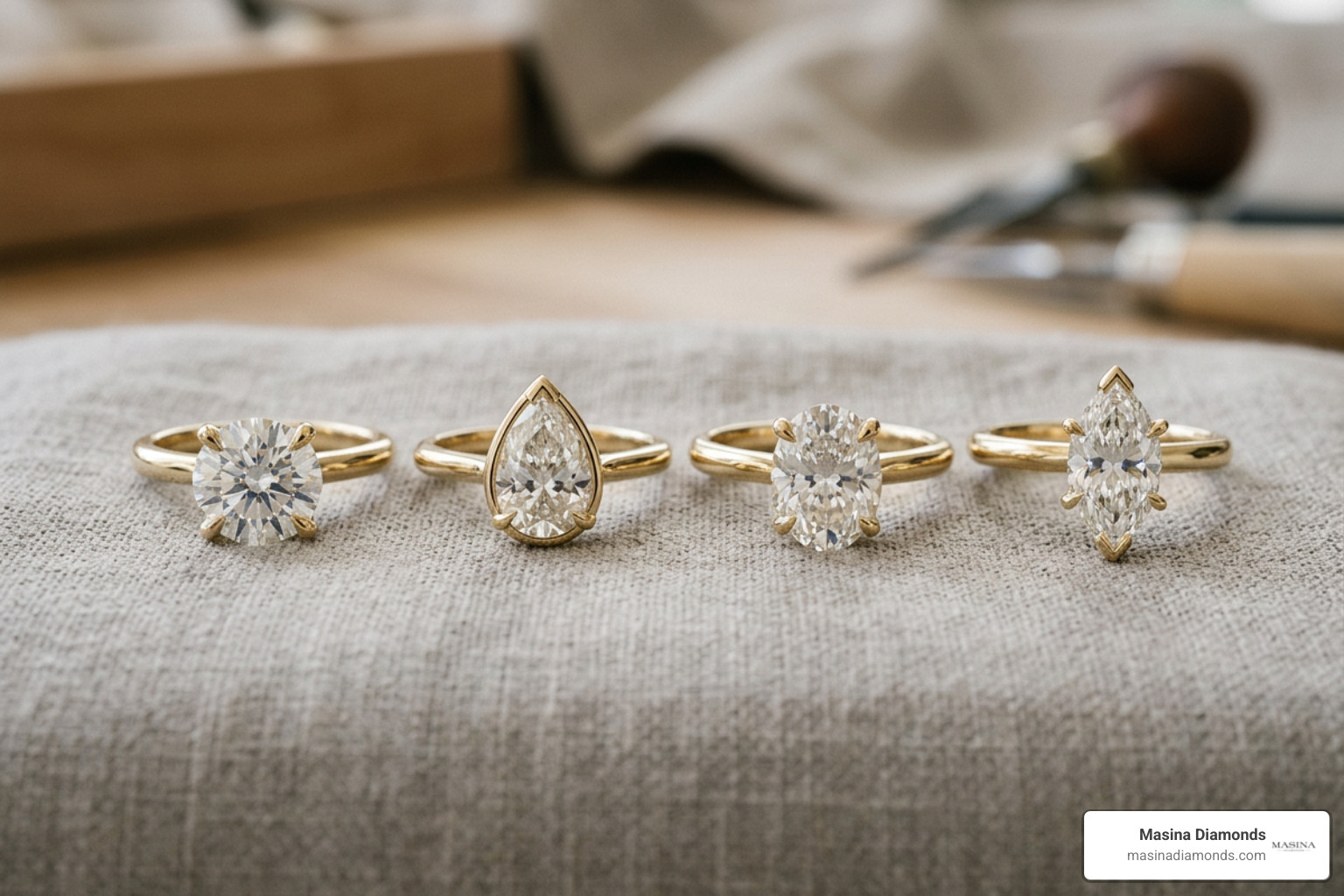
Your setting style provides both aesthetic character and vital structural defense for your center gem:
- Prong Settings (4-Prong or 6-Prong): Maximize light exposure from all angles, lifting the gem above the finger. Six prongs offer superior security for valuable or softer stones.
- Bezel Settings: Encircle the perimeter of the gemstone in a solid metal collar. This provides ultimate protection against edge chipping, making it ideal for active lifestyles, emeralds, or pear points.
- Halo Settings: Ring the center stone with miniature accent diamonds, adding visual diameter while shielding the main gem's girdle from incidental side impacts.
Quality Evaluation and Authentication for Fine Jewelry
Assessing the quality of any center stone requires evaluating the universal "Four Cs": Cut, Color, Clarity, and Carat weight. While cut geometry governs sparkle, clarity grading pinpoints natural internal inclusions or surface blemishes.
When commissioning a custom bridal design, you want your center stone proportions to align harmoniously with your wedding band. Our Custom Jewelry Ultimate Guide 2026 walks through the full bespoke design timeline. Furthermore, understanding the nuances of properly pairing an engagement ring and marriage ring ensures that both pieces sit flush against one another without rubbing or compromising delicate stone prongs over time.
How to Verify the Authenticity of Alternative Engagement Ring Stones
Verifying the identity and quality of non-diamond gemstones requires thorough gemological documentation:
- Independent Gemological Certification: Always request a grading dossier from reputable, independent laboratories such as the Gemological Institute of America (GIA) or the International Gemological Institute (IGI). These reports explicitly declare whether a stone is natural, lab-grown, or color-enhanced.
- Thermal and Electrical Conductivity Testing: Basic diamond testers measure thermal conductivity, but because moissanite conducts heat similarly to diamond, dual-probe testers measuring electrical resistance are necessary to differentiate the two accurately.
- Loupe Magnification Analysis: Under a standard 10x jeweler's loupe, master jewelers can detect telltale optical signatures, such as the double refraction (facet doubling) inherent to moissanite, or the natural multiphase inclusions typical of mined sapphires and emeralds.
Frequently Asked Questions About Engagement Ring Stones
What is the most durable alternative to a natural diamond?
The most durable alternative to a natural diamond is moissanite. Scoring a 9.25 on the Mohs scale, moissanite is harder than sapphires, rubies, and all other common gemstones. It provides exceptional scratch resistance, withstands high heat, and does not chip easily, making it the premier choice for lifetime daily wear if you prefer a non-diamond center gem. Lab-grown diamonds also share an identical Mohs hardness of 10 with natural diamonds.
How do colored gemstones hold up to everyday wear?
Corundum gemstones (sapphire and ruby) hold up exceptionally well to everyday wear thanks to their 9.0 Mohs hardness and superior structural toughness without cleavage planes. Softer stones like emeralds (7.5–8.0 Mohs) or opals (5.5–6.5 Mohs) require greater mindfulness; they should be mounted in protective bezel settings, kept away from harsh household chemicals, and cleaned gently with warm soapy water rather than ultrasonic cleaners.
Can you tell the difference between lab-grown and mined stones without tools?
No, it is impossible to distinguish a high-quality lab-grown diamond from a mined diamond with the naked eye. Both stones exhibit the exact same refractive index, chemical composition, crystal structure, and optical brilliance. Only trained gemologists using advanced laboratory spectroscopy and microscopic luminescence equipment can identify the subtle growth patterns that distinguish lab creation from geological formation.
Conclusion
Selecting the right center stone is an intimate journey that unites your aesthetic tastes, daily habits, and financial priorities. Whether you are drawn to the timeless permanence of an earth-mined diamond, the accessible scale of a lab-grown diamond, the vivid brilliance of moissanite, or the rich, royal colors of a natural sapphire, there is no single "correct" choice—only the stone that reflects your story.
At Masina Diamonds, our family has guided generations of couples through this exciting process with over 40 years of hands-on expertise in Atlanta. We invite you to explore our interactive 3D Ring Builder or schedule a personalized consultation in our showroom to compare loose gems side-by-side in natural light. To continue your journey and discover every available gemstone aesthetic, explore our comprehensive guide to exploring ring stone types and start designing your dream ring today.