Aquamarine: March's Sea-Blue Birthstone
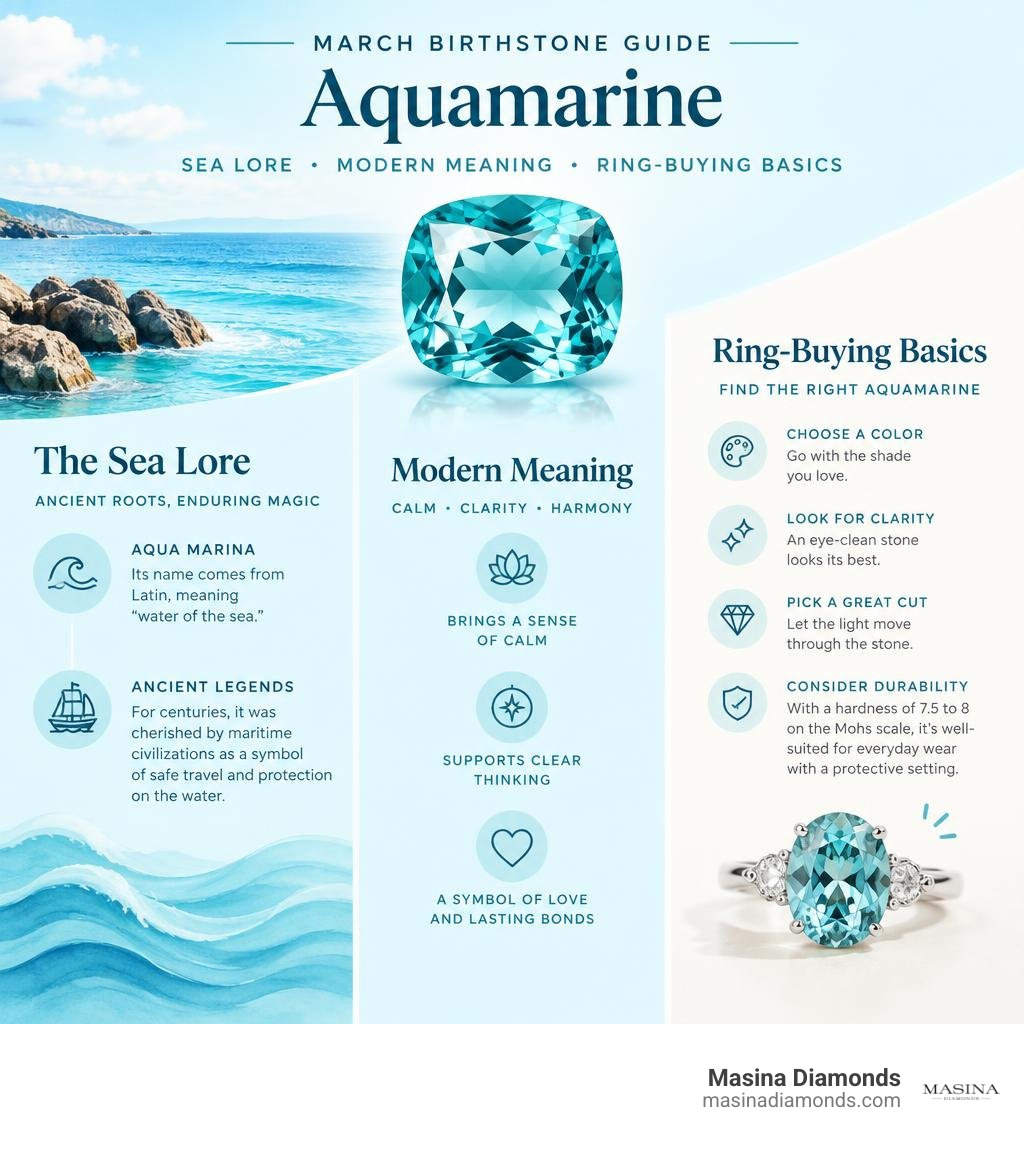
Aquamarine is a March birthstone and the blue to blue-green variety of the mineral beryl. Its name means "seawater," a nod to the color that made it a symbol of calm and safe travel. It is also a gemstone for the 19th wedding anniversary.
For a ring, look for a color you love, an eye-clean stone, and a cut that lets light move through it. Aquamarine rates 7.5 to 8 on the Mohs scale, so it can suit everyday wear with a setting that helps protect it from knocks.
We're Masina Diamonds, Atlanta jewelers with over 40 years of experience in custom jewelry and engagement rings. If you're considering an aquamarine birth stone for a personal ring, this guide will help you weigh its meaning, quality, and care.
Origins and Symbolism: The Lore of the Aquamarine Birth Stone
Etymology and Ancient Maritime Legends
The word aquamarine traces back to the Latin aqua marina, literally translating to "water of the sea." While ancient civilizations cherished the crystal for centuries, the compound term was first recorded in mineralogical texts around the year 1677.
Throughout antiquity, the gem was inextricably linked to the mysteries of the deep. In classical mythology, Roman and Greek mariners revered aquamarine as the sacred treasure of the sirens and mermaids, washed ashore from the jewel caskets of Neptune (Poseidon). Ancient sailors wore polished raw crystals as protective amulets tucked inside their tunics, firmly believing the stone held the power to calm tempestuous waves, prevent seasickness, and ensure safe passage across uncharted waters. Beyond seafaring protection, early Roman traditions held that engraving a frog onto an aquamarine could reconcile enemies and transform hostile rivals into lifelong friends. Detailed accounts of March birthstones and ocean lore highlight how this connection to water made the stone a universal symbol of hope, safety, and youth across early Mediterranean cultures.
Modern Meanings and Month Significance: The Aquamarine Birth Stone
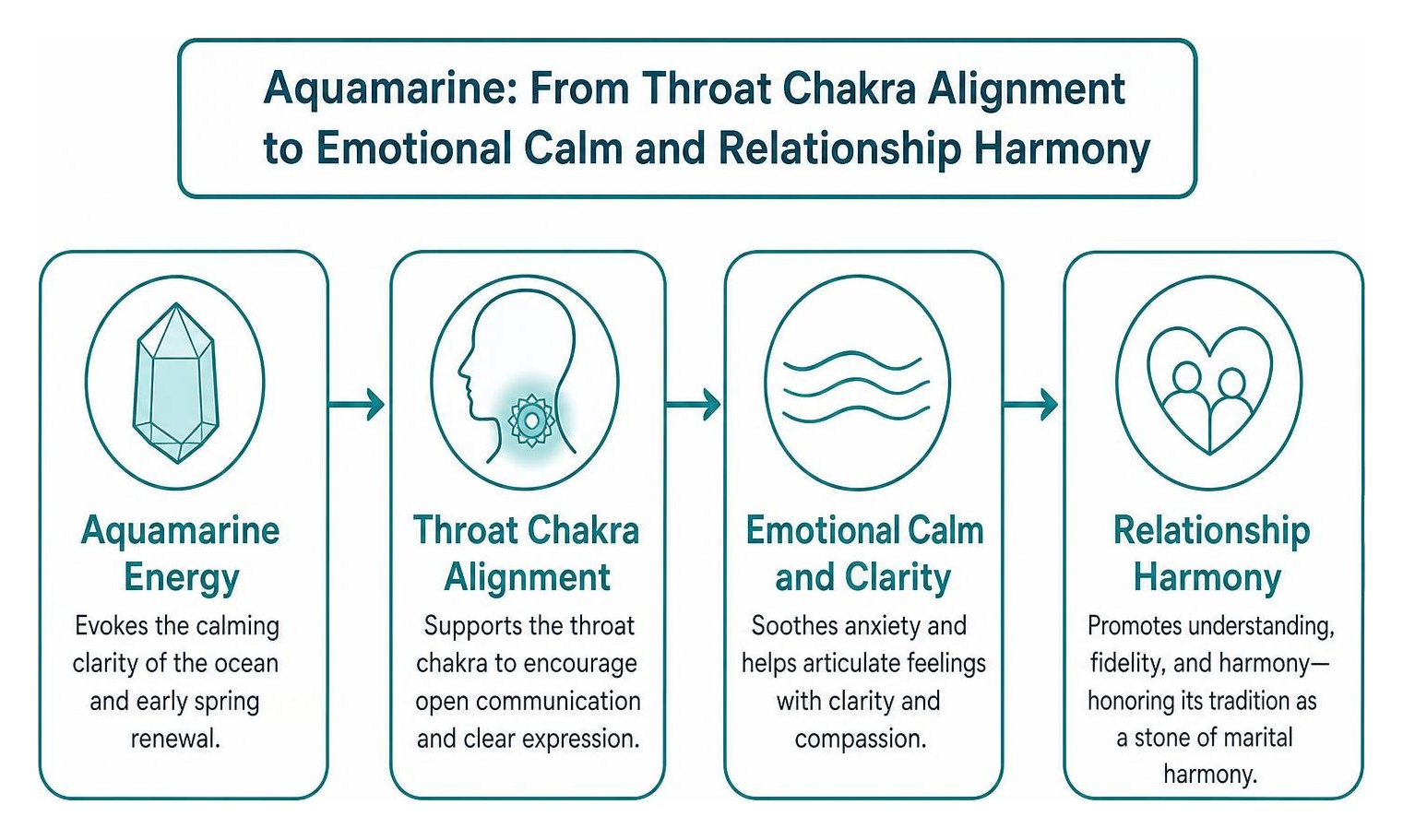
In contemporary jewelry and metaphysical traditions, aquamarine continues to evoke the rejuvenating clarity of crisp ocean waters and early spring thaws. As March marks the seasonal transition into spring, aquamarine serves as an emblem of rebirth, cleansing, and emotional renewal.
In holistic crystal philosophy, aquamarine connects deeply with the throat chakra. It is celebrated for encouraging open communication, soothing anxiety, and helping wearers articulate their feelings with clarity and compassion. Because of its serene energy, it has long been recognized as a stone of marital harmony and fidelity, making it the customary choice for the 19th wedding anniversary.
If you are exploring the symbolic connections between calendar dates and gems, exploring our comprehensive birthstones by month list and understanding vibrant birthstone colors offers a wonderful perspective on how each gemstone pairs its distinct color palette with personal heritage.
Gemological Properties and Geological Formation
Chemical Composition and Beryl Family Classification
From a gemological perspective, aquamarine is the blue-to-greenish-blue variety of the mineral beryl, sharing its chemical lineage with emerald, morganite, and heliodor. Its chemical formula is $\text{Be}_3\text{Al}_2\text{Si}6\text{O}{18}$ (beryllium aluminum silicate).
The enchanting sea-blue color is caused by trace impurities of iron within the crystal structure. Specifically, ferrous iron ($\text{Fe}^{2+}$) substitutions absorb light in the yellow and red spectrums, allowing pure blue and subtle green wavelengths to transmit through the gem.
Key gemological properties include:
- Crystal System: Hexagonal (forming elongated six-sided prismatic crystals)
- Mohs Hardness: 7.5 to 8.0
- Refractive Index: 1.577 to 1.583
- Specific Gravity: 2.65 to 2.85 (typically 2.72)
- Luster: Vitreous (glass-like)
- Optical Character: Uniaxial negative, displaying noticeable pleochroism (showing near-colorless to deep blue tones depending on the viewing angle)
Understanding the geological formation of aquamarine helps explain why it possesses such high clarity compared to its sister gemstone, emerald. For collectors and jewelry lovers exploring colorful ring stone options, aquamarine provides an exceptional balance of structural resilience and optical brilliance.
Geological Occurrence and Global Mining Sources
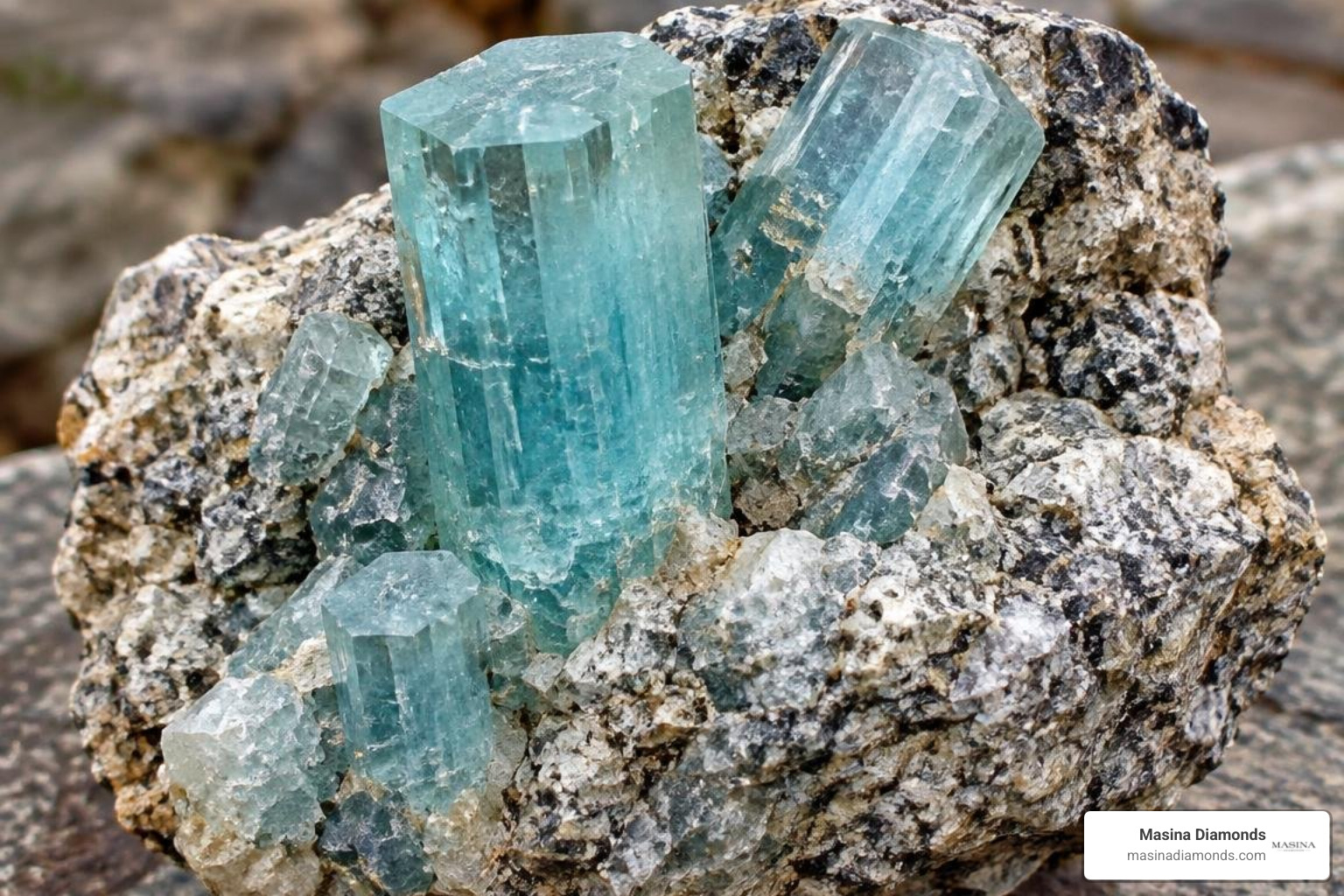
Aquamarine forms deep within the Earth's crust inside coarse-grained igneous rocks known as granite pegmatites, as well as in hydrothermal vein systems. Over millions of years, late-stage magmatic fluids rich in beryllium, aluminum, and silica cool slowly under extreme pressure, allowing expansive, well-formed hexagonal crystals to develop.
The world's most prolific and historically celebrated source of gem-quality aquamarine is Brazil, particularly the state of Minas Gerais, which has produced magnificent rough material for more than two centuries. In 1910, the legendary Marambaia mine in Minas Gerais yielded a massive green-blue crystal weighing 110 kilograms (242 pounds) and measuring 19 inches long—the largest gem-quality aquamarine ever discovered.
Other notable global mining regions include:
- Pakistan: High-altitude deposits in the Karakoram Mountains, where miners work treacherous steep slopes at elevations reaching up to 15,000 feet to extract pristine, icy-blue crystals.
- Mozambique and Nigeria: Famous for yielding saturated, naturally vivid blue gems that rival historic Brazilian finds.
- Madagascar and Zambia: Producing clean rough with delightful pastel and greenish-blue nuances.
- United States: Found across several alpine pegmatite deposits, most famously on Mount Antero in Colorado, where the gem's beauty led to its official adoption as the Colorado state gemstone in 1971.
Evaluating Quality, Color Varieties, and Treatments
Evaluating the 4Cs of the Aquamarine Birth Stone
When assessing aquamarine quality, gemologists use the standard 4Cs framework: Color, Clarity, Cut, and Carat Weight.
- Color: The most critical value factor. While all aquamarines feature a blue to greenish-blue body color, saturation dictates market value. Gems range from pale "ice water" tints to moderately strong, deep blue hues. The most prized specimens display a rich, velvety medium-dark blue with subtle teal overtones, historically known as "Santa Maria" blue.
- Clarity: Unlike emeralds, which often contain heavy visible inclusions (known as jardin), high-grade aquamarine is typically "eye-clean." Visible fractures, cloudy veiling, or mineral tubes will significantly reduce the gem's value, though parallel hollow tubes occasionally create rare "cat's eye" or asterism effects when cut as cabochons.
- Cut: Because aquamarine boasts exceptional clarity and a vitreous shine, precision cutting is essential to unlock its brilliance. Step cuts, like emerald and radiant shapes, accentuate crystalline transparency, while brilliant cuts (oval, round, cushion, and pear) maximize sparkle.
- Carat Weight: Large aquamarine crystals are far more common than large emeralds or rubies. However, because pale rough requires substantial depth to display noticeable color saturation, smaller stones (under 5 carats) with deep natural color command a premium per carat.
For those interested in discovering fine colored gemstones, the table below outlines typical market varieties and relative pricing tiers:
| Color Variety | Visual Characteristics | Primary Sources | Relative Price Range (Per Carat) |
|---|---|---|---|
| Pale Ice Blue | Very light, subtle sky-blue or watery appearance | Global (Brazil, Madagascar, USA) | $20 – $75 |
| Classic Seawater Blue | Light to medium ocean-blue with soft green undertones | Brazil, Pakistan, Nigeria | $75 – $250 |
| Medium Vivid Blue | Noticeable color depth, crisp blue with minimal green | Mozambique, Zambia, Brazil | $250 – $600 |
| Santa Maria Blue | Intense, highly saturated medium-dark blue | Brazil (Santa Maria de Itabira), Mozambique | $500 – $2,000+ |
Heat Treatment, Maxixe Variants, and Gemstone Identification
The vast majority of faceted aquamarines available on the global market undergo routine, industry-accepted heat treatment. Heating rough stones to approximately 400°C to 450°C (752°F to 842°F) alters ferric iron ($\text{Fe}^{3+}$) ions into ferrous iron ($\text{Fe}^{2+}$), permanently removing unwanted yellow and greenish secondary tones. This thermal enhancement is stable, undetectable by standard gemological instruments, and completely safe for everyday wear.
However, buyers should be aware of rare blue beryl variations and common market lookalikes:
- Maxixe Beryl: An uncommon, deeply saturated royal blue beryl discovered in northern Minas Gerais. Its color is caused by natural or lab-induced radiation affecting nitrate or carbonate impurities rather than iron. Maxixe is unstable; its rich blue hue rapidly fades to a pale brownish-yellow when exposed to sunlight or heat.
- Blue Topaz: Often mistaken for aquamarine due to similar color options. Blue topaz is denser (specific gravity ~3.53 vs. aquamarine's 2.72) and exhibits distinct refractive index values (1.61–1.62). Topaz is also generally less expensive because nearly all blue topaz starts as abundant colorless topaz that undergoes heavy laboratory irradiation.
- Glass and Synthetic Spinel: Inexpensive imitations lack aquamarine's natural pleochroism (which can be verified using a dichroscope) and often show rounded gas bubbles or mold marks under a 10x jeweler's loupe.
- Lab-Grown Synthetic Beryl: Hydrothermally grown synthetic aquamarine shares identical chemical and optical properties with natural stones. Qualified gemological laboratories identify synthetics by examining subtle chevron-like growth patterns and seed plate remnants.
Jewelry Care, Famous Gemstones, and Styling
Famous Historic Aquamarine Specimens
Aquamarine's capacity to form monumental, flawless crystals has resulted in some of the most spectacular carved and faceted treasures in history:
- The Dom Pedro Aquamarine: The world's largest cut aquamarine, weighing an astounding 10,363 carats (approximately 4.6 pounds). Mined in Pedra Azul, Brazil, and masterfully sculpted into a 14-inch-tall tapering obelisk by German lapidary artist Bernd Munsteiner in 1992, it now stands proudly on permanent display at the Smithsonian National Museum of Natural History.
- Eleanor Roosevelt's Aquamarine: In 1936, the Brazilian government presented First Lady Eleanor Roosevelt with a magnificent 1,298-carat rectangular step-cut aquamarine during President Franklin D. Roosevelt's visit to Rio de Janeiro. Today, it resides in the Franklin D. Roosevelt Presidential Library in Hyde Park, New York.
- Queen Elizabeth II's Brazilian Tiara: In 1953, the President of Brazil gifted Queen Elizabeth II an exquisite platinum necklace and earring suite set with matching oblong Brazilian aquamarines for her coronation. Captivated by their beauty, Her Majesty commissioned royal jewelers in 1957 to craft a matching tiara, which she wore to numerous state banquets.
- Princess Diana's Emerald-Cut Ring: Featuring a striking, vibrant sea-blue emerald-cut aquamarine flanked by small pavé diamonds set in 24k yellow gold, this iconic ring became one of Princess Diana's favorite personal pieces and was later worn by Meghan Markle on her wedding day.
Everyday Wear, Setting Choices, and Maintenance Guide

With a rating of 7.5 to 8 on the Mohs hardness scale, aquamarine is a durable choice for daily jewelry, including heirloom rings, statement pendants, and anniversary earrings. However, because beryl can be slightly brittle and prone to chipping along its basal cleavage planes if subjected to sharp impacts, mindful design choices are paramount.
When designing bespoke rings or exploring fine colored gemstone engagement rings, pairing aquamarine with protective bezels, robust corner prongs, or a halo of accent diamonds provides structural security against accidental bumps while magnifying the center stone's oceanic glow.
To preserve the radiant clarity of your aquamarine jewelry at home:
- Gentle Soaking: Fill a small bowl with lukewarm water and a few drops of mild, fragrance-free dish soap. Let your piece soak for 10 to 15 minutes to loosen trapped oils, lotions, and dust.
- Soft Brushing: Gently clean behind the setting and under the gemstone facets using a baby toothbrush with ultra-soft bristles.
- Rinse and Dry: Rinse thoroughly under warm running water (ensure the drain is plugged!) and pat dry with a clean, lint-free microfiber cloth.
- Professional Precautions: While ultrasonic and steam cleaners are generally safe for unincluded stones, avoid them if your aquamarine contains internal liquid inclusions or visible surface-reaching fractures, as vibrations can cause cracks to expand. Always store your aquamarine pieces in separate soft fabric pouches away from harder diamonds and sapphires to avoid surface abrasion.
Frequently Asked Questions About the March Birthstone
Is aquamarine durable enough for an everyday engagement ring?
Yes, aquamarine's Mohs hardness of 7.5 to 8 makes it resilient against surface scratching from daily airborne dust (which ranks at 7). However, because it lacks the extreme structural toughness of diamond or sapphire, we recommend selecting protective settings—such as low-profile bezel or halo mountings—and removing the ring during rigorous sports, heavy lifting, or manual yard work.
What is the rarest and most valuable aquamarine color?
The most valuable aquamarine color is a medium-dark, highly saturated pure blue with subtle, electric greenish-blue secondary tones, widely referred to in the trade as "Santa Maria" blue. Sourced historically from Brazil's Santa Maria de Itabira deposit and more recently from fine mines in Mozambique, these gems command the highest price per carat due to their vivid natural color saturation.
How can you distinguish real aquamarine from blue topaz or glass?
Natural aquamarine displays distinct pleochroism (shifting between watery blue and near-colorless when turned in light), contains faint natural mineral or two-phase liquid inclusions, and feels cool to the touch. In contrast, glass imitations often show tiny spherical air bubbles, feel warm quickly, and lack crystalline optical refraction. Blue topaz has a higher density and distinct refractive index that can be quickly identified using standard gemological testing tools.
Conclusion: Celebrating March with Timeless Blue Elegance
Whether you are commemorating a March birthday, celebrating a 19th wedding anniversary, or seeking a unique colored engagement ring, aquamarine delivers timeless sophistication. Its soothing oceanic hues and historical connection to safe journeys make it one of the most romantic and wearable gemstones in the world.
At Masina Diamonds, our family has brought custom jewelry dreams to life in Atlanta for over four decades. Through our interactive 3D Ring Builder and one-on-one design consultations, we pair old-world craftsmanship with modern design tools to create custom rings tailored to your vision. To discover how the March birthstone fits into the broader tapestry of fine calendar gems, explore our complete birthstones by month guide or visit our Atlanta showroom to view our curated collection.