Birthstone Colors and Months at a Glance
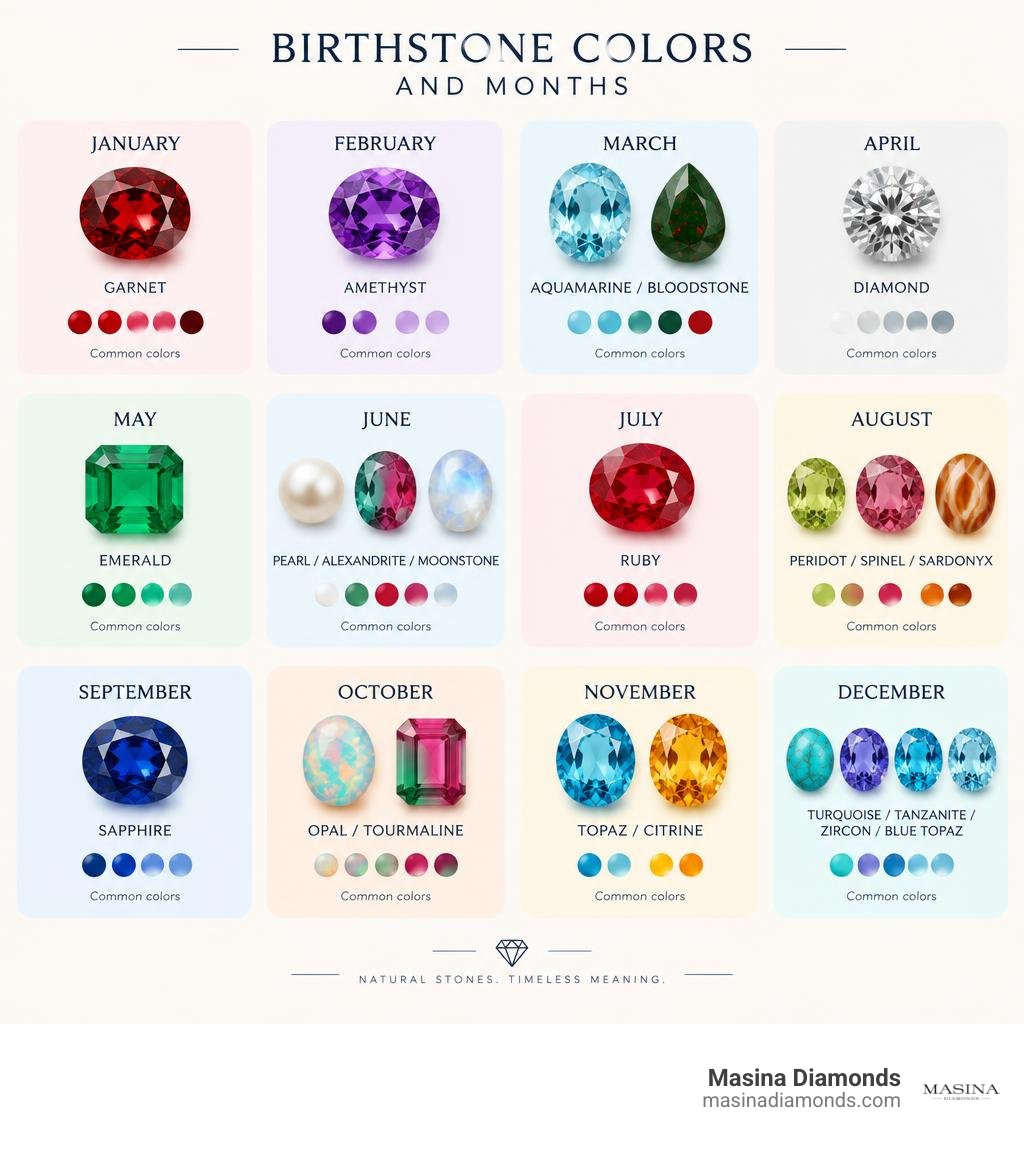
January is garnet (usually red); February, amethyst (purple); March, aquamarine (pale blue) or bloodstone (green with red flecks); April, diamond (usually colorless); May, emerald (green); June, pearl (often white), alexandrite (green to red), or moonstone (milky white); July, ruby (red); August, peridot (yellow-green), spinel (many colors), or sardonyx (brown-and-white bands); September, sapphire (usually blue); October, opal (play-of-color) or tourmaline (many colors); November, topaz or citrine (often yellow to orange); and December, turquoise (blue-green), tanzanite (blue-violet), zircon (often blue), or blue topaz.
These are the best-known colors, not strict rules. If you're choosing a ring, color is only the start: some birthstones handle daily wear better than others.
We're Masina Diamonds, Atlanta jewelers with over 40 years of experience in custom jewelry and engagement rings. We'll help you use this guide to birthstone colors and months to find a gem that fits your style and the way you'll wear it.
Complete Guide to Birthstone Colors and Months
Gemstones hold a captivating place in human history, bridging natural science, art, and personal identity. Whether you want to celebrate an anniversary, design a meaningful ring, or mark a birthday, pairing your birth month with its signature stone provides an enduring connection to history.
Below is our comprehensive reference table comparing all twelve months across modern and traditional designations, signature color spectrums, and durability ratings. For further reading, consult the educational guides from the Gemological Institute of America on Birthstones for each month as well as our Birthstones by Month Guide 2026.
| Month | Modern Birthstone | Traditional Birthstone | Primary Color | Mohs Hardness |
|---|---|---|---|---|
| January | Garnet | Garnet | Deep Burgundy / Red | 6.5 – 7.5 |
| February | Amethyst | Amethyst | Royal Purple / Violet | 7.0 |
| March | Aquamarine | Bloodstone | Sea Blue / Dark Green | 7.5 – 8.0 (Aqua) / 6.5 – 7.0 (Bloodstone) |
| April | Diamond | Diamond | Colorless / White | 10.0 |
| May | Emerald | Emerald | Lush Vivid Green | 7.5 – 8.0 |
| June | Alexandrite, Pearl | Pearl, Moonstone | White / Color-Change / Cream | 8.5 (Alex) / 2.5 – 4.5 (Pearl) / 6.0 – 6.5 (Moonstone) |
| July | Ruby | Ruby | Pigeon Blood Red | 9.0 |
| August | Peridot, Spinel | Sardonyx | Lime Green / Vibrant Red | 6.5 – 7.0 (Peridot) / 7.5 – 8.0 (Spinel) / 6.5 – 7.0 (Sardonyx) |
| September | Sapphire | Sapphire | Deep Royal Blue | 9.0 |
| October | Tourmaline, Opal | Opal | Play-of-Color / Pink | 7.0 – 7.5 (Tourmaline) / 5.5 – 6.5 (Opal) |
| November | Citrine, Topaz | Topaz | Golden Yellow / Amber | 8.0 (Topaz) / 7.0 (Citrine) |
| December | Tanzanite, Blue Topaz | Turquoise, Zircon | Sky Blue / Blue-Violet | 5.0 – 6.0 (Turquoise) / 6.0 – 7.0 (Tanzanite) / 7.5 (Zircon) / 8.0 (Topaz) |
January: Garnet
January opens the year with garnet, a gemstone family celebrated since antiquity for its rich hues. While deep, pomegranate-red pyrope and almandine garnets are the most familiar, the garnet species encompasses a broad spectrum. This includes vibrant green tsavorites, fiery mandarin spessartites, and honey-toned grossulars.
Historically revered as a protective talisman by travelers and warriors, garnet symbolizes constancy, warmth, and vitality. With a Mohs hardness of 6.5 to 7.5, it serves as an excellent option when choosing stones for birthday months in pendants, earrings, and low-impact rings.
February: Amethyst
February’s signature gem is amethyst, the regal purple variety of crystalline quartz. Found in shades ranging from delicate lilac to deep royal violet with flashes of rose, amethyst derives its color from iron traces exposed to natural irradiation within the earth.
In ancient Greece, it was believed to prevent intoxication (its name originates from the Greek amethystos, meaning "not drunken"). It has long been associated with clear-headedness, spiritual clarity, and emotional balance. Ranking at a solid 7 on the Mohs scale, amethyst offers dependable durability for jewelry celebrating February birthdays.
March: Aquamarine and Bloodstone
March offers a distinct choice between coastal pastels and earthy strength. Aquamarine, the modern March birthstone, is a variety of beryl that owes its luminous sea-blue and pastel-cyan tones to trace amounts of iron. Historically carried by sailors to ensure calm seas and safe voyages, it embodies serene courage and clear communication. Its cool blue tones also carry a romantic legacy, as explored in the Something Blue History surrounding wedding traditions.
Bloodstone, the traditional stone for March, is an opaque dark green chalcedony marked with vivid red inclusions of iron oxide. Valued for thousands of years as a stone of physical endurance and grounded strength, bloodstone offers a striking earthy alternative.
April: Diamond
April is represented by diamond, the ultimate standard of strength and brilliance. Composed of pure crystallized carbon formed under intense heat and pressure deep within the earth's mantle, diamond sits at the pinnacle of the Mohs scale at a hardness of 10.
While colorless diamonds are renowned for their fire and dispersion of light, diamonds also occur naturally in fancy hues including yellow, pink, blue, and champagne. Symbolizing invincibility, purity, and everlasting devotion, diamond remains the quintessential choice for bridal and heirloom jewelry.
May: Emerald
May is represented by the lush green hues of emerald, the prized green variety of the beryl family. Colored by chromium and vanadium, emerald echoes the vibrant return of spring, representing rebirth, wisdom, and renewal.
Top-tier specimens from Colombian and Zambian mines frequently display microscopic internal inclusions affectionately termed the jardin (French for garden). These natural features verify authenticity and provide organic character. Because emerald rates between 7.5 and 8.0 on the Mohs scale but can be prone to chipping if heavily included, our custom Emerald Engagement Rings are carefully mounted in protective settings that preserve the stone's integrity.
June: Pearl, Alexandrite, and Moonstone
June boasts three distinctive birthstones: organic pearl, optical wonder alexandrite, and ethereal moonstone.
- Pearl: Formed within mollusks, natural and cultured pearls produce soft, glowing nacre associated with elegance, sincerity, and purity.
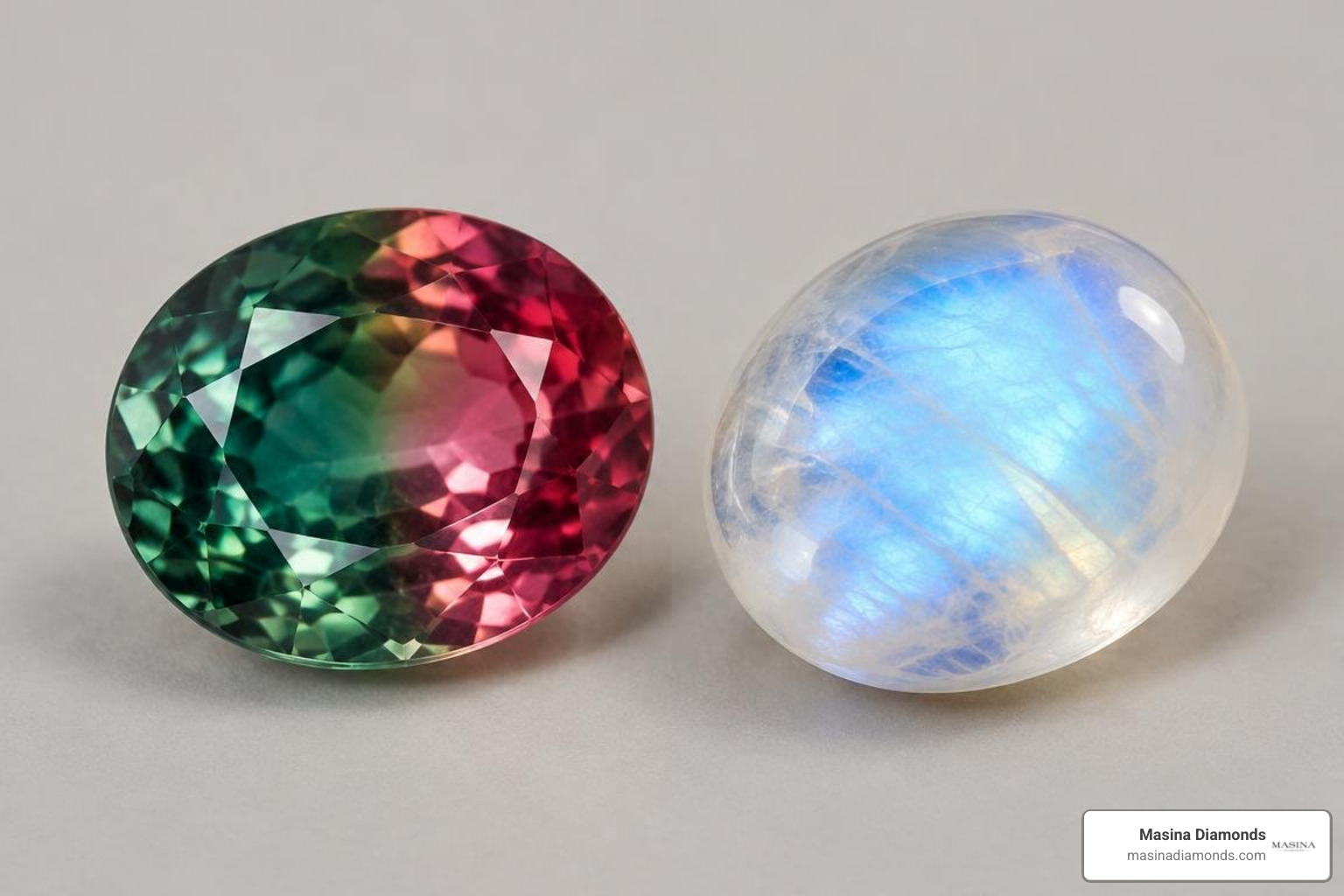
- Alexandrite: A chrysoberyl discovered in the Ural Mountains, fine natural alexandrite is exceptionally rare. It exhibits a color shift—appearing emerald-green in natural sunlight and shifting to ruby-red under incandescent evening light.
- Moonstone: Celebrated for its adularescence (a billowy, floating blue or silver sheen), moonstone reflects balanced intuition and calm grace.
July: Ruby
July’s gemstone is ruby, the fiery red variety of the mineral corundum (Mohs 9). Cherished as the "King of Gemstones," ruby achieves its crimson color from trace amounts of chromium, with the most prized shade described in the trade as vibrant "pigeon’s blood" red.
Historically associated with passion, vitality, and royal status, ruby's high durability makes it an ideal center stone for everyday jewelry, offering brilliant color that withstands daily life.
August: Peridot, Spinel, and Sardonyx
August features a colorful trio of gems:
- Peridot: An idiochromatic mineral (olivine) formed deep within the earth’s mantle—and occasionally recovered from extraterrestrial pallasite meteorites—peridot delivers a crisp, lime-green hue linked to harmony and joy.
- Spinel: Officially added to the modern list in 2016, spinel occurs in vibrant hues of cobalt blue, pastel pink, and rich crimson. Historically mistaken for ruby in European royal collections, spinel rates at 7.5 to 8.0 on the Mohs scale, offering excellent luster and wearability.
- Sardonyx: The traditional August birthstone, this banded chalcedony combines alternating layers of carnelian and onyx, historically carved into protective Roman intaglios.
September: Sapphire
September is paired with sapphire, the companion variety of corundum (Mohs 9). While iconic royal blue sapphires remain timeless, corundum naturally occurs in an array of fancy colors, including yellow, green, violet, peach, and the rare pink-orange padparadscha.
Valued for centuries as an emblem of truth, wisdom, and steadfast loyalty, sapphire's hardness ranks second only to diamond. Its structural integrity makes our Sapphire Engagement Rings a favored everyday alternative to traditional diamonds.
October: Opal and Tourmaline
October features a dynamic display of natural color:
- Opal: Composed of microscopic silica spheres arranged in a regular pattern, precious opal diffracts light into a moving "play-of-color," revealing rainbow flashes against white, black, or crystal backgrounds.
- Tourmaline: An elbaite mineral family known for its diverse colors, tourmaline ranges from vibrant pink and mint green to bicolor watermelon varieties.
Both stones inspire creativity and emotional balance. To explore more about how unique minerals create distinctive fine jewelry, see our review of Beyond Diamonds: Stunning Gemstones.
November: Topaz and Citrine
November is characterized by warm golden tones through topaz and citrine:
- Topaz: With a hardness of 8.0, precious and Imperial Topaz display shades of rich sherry orange, peach, and golden yellow. Topaz is believed to offer soothing, grounding energy.
- Citrine: The yellow-to-amber variety of quartz (Mohs 7), citrine brings bright warmth and an accessible price point, representing optimism, clarity, and abundance.
December: Tanzanite, Turquoise, Zircon, and Blue Topaz
December features an array of blue-spectrum stones:
- Tanzanite: Sourced exclusively from a small geographic area near Mount Kilimanjaro in Tanzania, tanzanite showcases blue-violet shades and pleochroism (displaying blue, purple, and burgundy depending on viewing angle). It was added to the official modern list in 2002.
- Turquoise: A robin’s-egg blue to sea-green copper phosphate mineral celebrated for millennia in Native American, Persian, and Egyptian cultures for spiritual protection.
- Zircon: A natural gemstone known for high refractive index and dispersion, producing lively blue, red, and golden brilliance.
- Blue Topaz: A bright, accessible gem offering clear sky and London blue tones.
History and Evolution: Modern vs. Traditional Birthstone Lists
The tradition of linking specific stones to calendar intervals has evolved over thousands of years, developing from protective amulets into structured commercial standards. For historical insights, refer to Birthstones - Antique Jewelry University and the Birthstone Chart - Modern and Traditional.

Breastplate of Aaron and Ancient Folklore
The origin of assigning twelve stones to twelve distinct periods traces back to the Book of Exodus (c. 1400 BC). It describes the sacred breastplate of Aaron (hoshen), inlaid with four rows of three gemstones representing the twelve tribes of Israel.
In the first century AD, the Jewish-Roman historian Flavius Josephus and Saint Jerome connected these twelve breastplate stones to the twelve signs of the zodiac and the seasons of the year. Originally, early believers carried all twelve stones, wearing a different gem each month to align with its associated qualities.
By the 16th and 18th centuries in Central Europe and Poland, cultural practices shifted toward wearing a single personal talisman corresponding to one's birth month. This practice inspired Gregorian calendar poems that paired each stone with specific virtues.
Why Birthstone Colors and Months Feature Multiple Gems
You may wonder why months like June, August, October, November, and December list two, three, or four different stones.
The modern trade list was standardized in 1912 in Kansas City by the American National Retail Jewelers Association (now Jewelers of America). Their goal was to establish a clear commercial standard while modernizing older lists that featured rare, expensive, or fragile stones.
Over time, official organizations have modified the list to improve practicality and reflect gemological discoveries:
- In 1952, the Jewelry Industry Council added alexandrite, citrine, tourmaline, and zircon to expand consumer options.
- In 2002, the American Gem Trade Association (AGTA) added tanzanite to December.
- In 2016, AGTA and Jewelers of America added spinel to August as a durable alternative to peridot.
Because traditional folk stones were never officially discarded, many months continue to feature both modern and traditional options.
Birthstones vs. Zodiac Stones
While modern birthstone assignments align strictly with the twelve Gregorian calendar months (January 1 through December 31), zodiac stones correspond directly to astrological signs (such as Aries, Taurus, and Gemini), which span parts of two consecutive months.
Zodiac and Ayurvedic (astrological) traditions focus on planetary rulers, element affiliations (Earth, Air, Fire, Water), and energetic frequencies. In contrast, modern birthstones provide an accessible, calendar-based framework centered on personal identity and aesthetic design.
Durability, Rarity, and Practical Jewelry Styling
A birthstone should match your lifestyle as well as your personal aesthetic. While all birthstones can be set into fine jewelry, their physical properties determine how they should be mounted and worn. To learn more about selecting the right center stone, read A Guide to Ring Stone Types: Exploring Your Options and our Engagement Ring Stones Guide 2026.
Mohs Hardness Scale and Everyday Wear
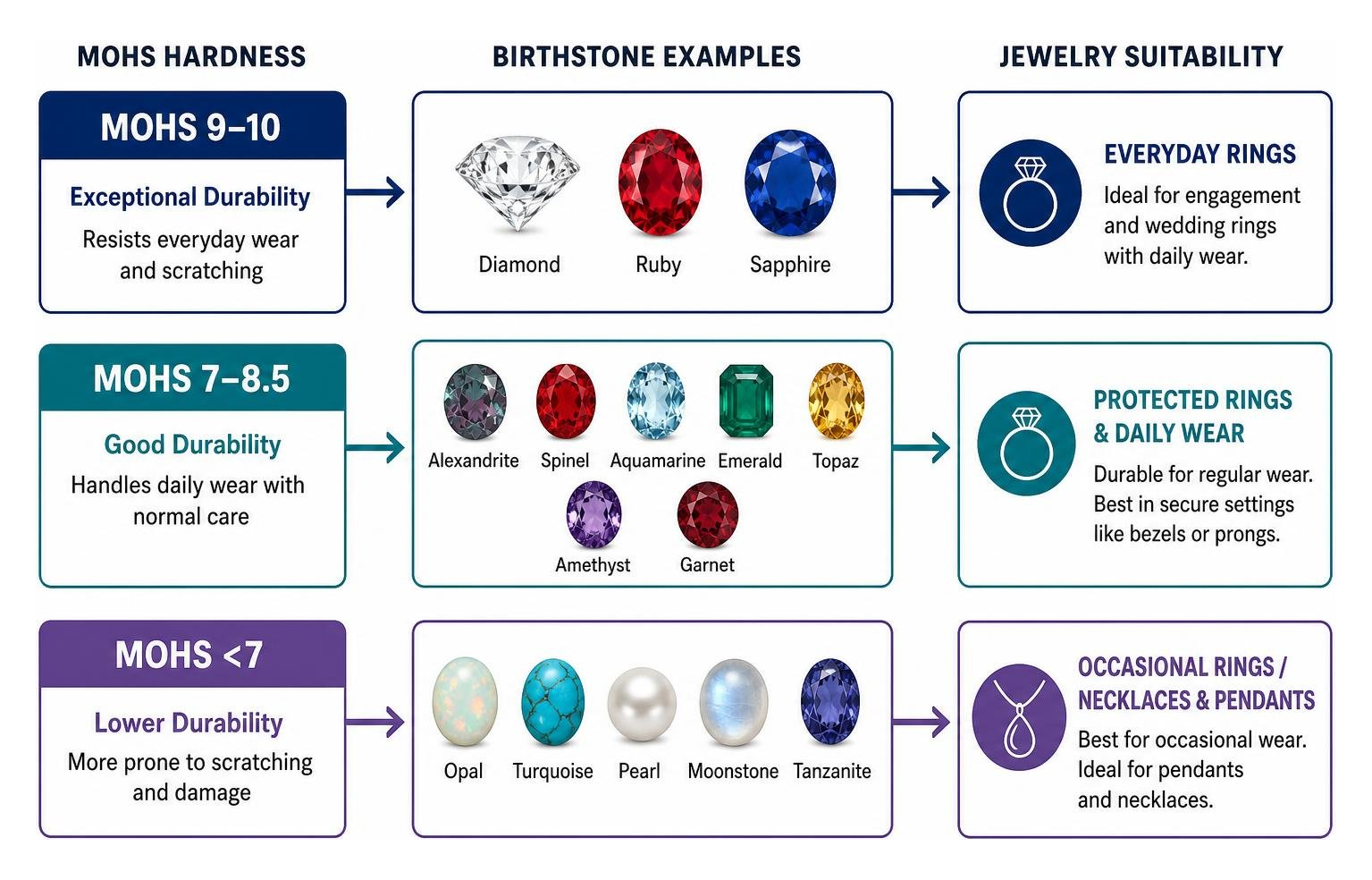
The Mohs hardness scale measures a mineral's relative resistance to surface scratching, spanning from 1 (talc) to 10 (diamond). Because ordinary atmospheric dust contains microscopic quartz particles (Mohs 7), any gemstone rated below 7 will gradually accumulate micro-abrasions if exposed to frequent friction.
- Mohs 9 to 10 (Exceptional Durability): Diamond, ruby, and sapphire handle decades of daily wear in engagement and wedding rings with minimal maintenance.
- Mohs 7.5 to 8.5 (Good to High Durability): Alexandrite, spinel, aquamarine, emerald, and topaz are suitable for daily rings, though included stones benefit from protective settings.
- Mohs 6.5 to 7.0 (Moderate Durability): Garnet, peridot, amethyst, and citrine perform reliably in rings when set in protective bezels and removed during heavy activity.
- Mohs under 6.5 (Delicate or Porous Gems): Opal, turquoise, pearl, moonstone, and tanzanite are susceptible to surface scratches, impact damage, or chemical exposure. These stones are often better suited for pendants, earrings, and special-occasion wear.
For couples exploring non-traditional ring options, understanding these mineral limits is essential. Read our analysis on Moss Agate Engagement Rings: Nature's Emerald Isle on Your Finger But Will It Last? for practical insight on balancing distinct aesthetics with daily wearability.
Matching Birthstone Colors and Months to Daily Wear Rings
Pairing your birthstone with precious metals requires balancing hue, saturation, and skin tone:
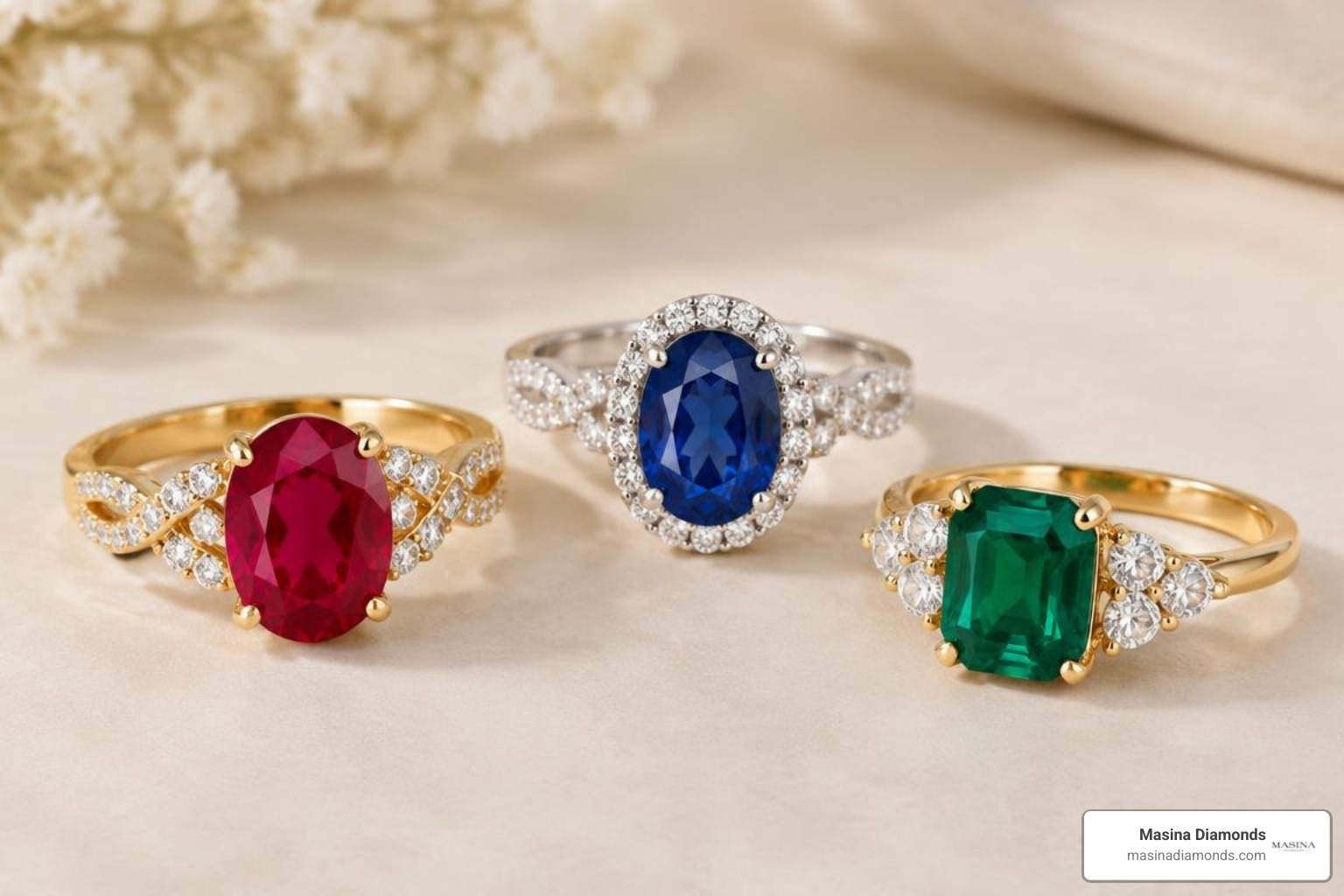
- Warm Undertones: Warm, rich gems such as ruby, garnet, citrine, and peridot pair naturally with 14k or 18k yellow gold and rose gold settings.
- Cool Undertones: Cool, crisp stones such as aquamarine, blue sapphire, emerald, and diamond stand out sharply against platinum or 14k white gold.
- Neutral or Color-Shifting Stones: Gems like alexandrite, moonstone, and opal adapt across metals, offering versatile styling options.
When setting softer birthstones into rings, consider choosing a bezel, half-bezel, or low-profile halo setting to protect the stone's edges from daily wear.
Rarity, Affordability, and Lab-Grown Alternatives
Natural gemstone values vary considerably based on geological rarity, clarity, and market demand:
- Rarest Birthstones: Natural alexandrite in larger sizes is exceptionally rare, often commanding higher per-carat prices than standard white diamonds. High-clarity untreated emeralds, fine unheated rubies, and untreated sapphires also represent rare collector-grade treasures.
- Most Affordable Birthstones: Amethyst, citrine, and blue topaz are abundant globally, allowing you to select large, clean gems at budget-friendly prices.
- Lab-Grown Alternatives: For high-value gemstones like diamond, ruby, emerald, sapphire, and alexandrite, lab-grown alternatives provide an accessible, ethical option. These stones share the identical chemical composition, crystal lattice structure, refractive index, and Mohs hardness of their mined counterparts, delivering comparable brilliance and everyday durability at an accessible price.
Frequently Asked Questions About Birthstones
What is the rarest birthstone?
Fine natural alexandrite (June) is widely considered the rarest and most valuable birthstone per carat. Discovered in Russia and mined in limited quantities in Brazil and East Africa, top-quality alexandrite that displays a sharp, dramatic color change (shifting from vivid green in daylight to rich red under incandescent lighting) in sizes above one carat is exceptionally rare. Top-grade tanzanite (December) is also geologically scarce, originating from a single deposit spanning roughly four square kilometers near Mount Kilimanjaro.
Which birthstones should not be worn in everyday rings?
Pearl (June), opal (October), and turquoise (December) are the most delicate birthstones and require extra care when mounted in rings. Pearls rate between 2.5 and 4.5 on the Mohs scale and are sensitive to acids, perfumes, and household chemicals. Opals (Mohs 5.5 to 6.5) contain up to 20% water and can craze or crack under sudden temperature shifts or physical impacts. Turquoise is porous and can absorb oils and cleaning agents, leading to discoloration. If you wear these stones in everyday jewelry, consider featuring them in pendants, earrings, or bezel settings designed for special occasions.
What are the most affordable birthstones?
Amethyst (February), citrine (November), and blue topaz (December) are the most accessible and budget-friendly birthstones. Because quartz and topaz deposits are relatively abundant worldwide, fine-quality, eye-clean gemstones with rich color saturation are readily available in substantial carat weights at accessible price points.
Conclusion
Every birthstone tells a distinctive story through its geological formation, historical meaning, and personal significance. From the deep red hues of January’s garnet to the blue-violet tones of December’s tanzanite, these twelve months provide a rich palette for celebrating milestones, honoring family, and designing bespoke heirlooms.
At Masina Diamonds, our family has spent over four decades helping clients craft timeless jewelry. Whether you want to set your birthstone in an engagement ring or build a personalized pendant, our interactive 3D Ring Builder lets you design and customize every detail with confidence.
Ready to explore your personal birthstone? Read our comprehensive birthstones by month meanings and jewelry guide, or visit our Atlanta showroom to begin designing your custom piece today.